Risk-Based Vulnerability Management: Benefits, Limits, and Reality
Prioritizing risks by context exposes hidden costs in data collection and often fails to reduce the total number of open vulnerabilities.

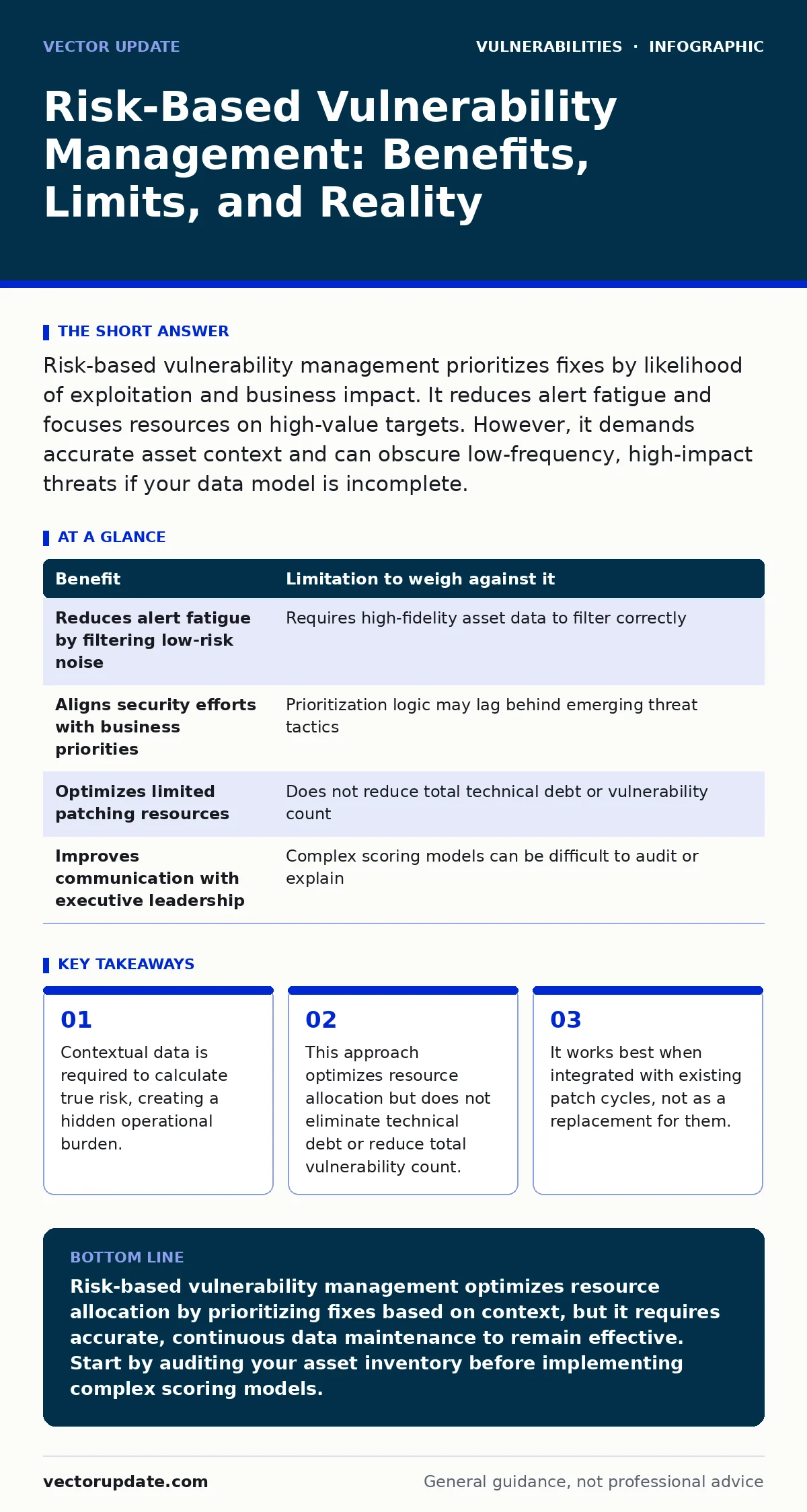
Risk-based vulnerability management prioritizes fixes by likelihood of exploitation and business impact. It reduces alert fatigue and focuses resources on high-value targets. However, it demands accurate asset context and can obscure low-frequency, high-impact threats if your data model is incomplete.
The Logic of Contextual Prioritization
Traditional vulnerability management treats every flaw as an equal threat. A missing patch on an internal printer carries the same weight as a critical flaw on a public-facing web server. Risk-based vulnerability management changes this equation. It assigns priority based on the likelihood of exploitation and the potential impact on your organization.
You must answer two questions for every finding. First, can an attacker reach this system? Second, what happens if they do? This method shifts the focus from the vulnerability itself to the asset it inhabits. It forces you to map your infrastructure against real-world attack paths rather than theoretical severity scores.
This approach aligns security work with business outcomes. You stop chasing low-impact issues that consume time without reducing risk. Instead, you address the gaps that actually expose sensitive data or critical operations. The goal is not to fix everything, but to fix what matters most first.
The Hidden Cost of Context
The primary benefit of this method is clarity. You know exactly which systems need immediate attention. The primary limitation is the data required to make that determination. You cannot assess risk without accurate context. This context includes asset criticality, exposure status, compensating controls, and threat intelligence.
Gathering this data is expensive. It requires integration between configuration management databases, network mapping tools, and security scanners. If your asset inventory is outdated, your risk calculations are wrong. A server marked as decommissioned but still running introduces false confidence. A critical database missing from the inventory introduces blind spots.
You must maintain this data continuously. Technology changes, networks shift, and permissions evolve. The effort to keep the context accurate often rivals the effort to patch the vulnerabilities. This is the hidden cost most organizations underestimate. You are trading patching time for data management time.
Benefits and Limitations in Balance
Every benefit of risk-based management has a corresponding limitation. Understanding this trade-off prevents over-reliance on the model. The table below outlines the primary advantages and the constraints you must manage to realize them.
| Benefit | Limitation to weigh against it |
|---|---|
| Reduces alert fatigue by filtering low-risk noise | Requires high-fidelity asset data to filter correctly |
| Aligns security efforts with business priorities | Prioritization logic may lag behind emerging threat tactics |
| Optimizes limited patching resources | Does not reduce total technical debt or vulnerability count |
| Improves communication with executive leadership | Complex scoring models can be difficult to audit or explain |
You gain efficiency, but you lose simplicity. A simple "patch everything" rule is easy to understand and execute. A risk-based model requires constant tuning. You must validate that the scoring logic still reflects the current threat environment. If the model favors known exploits, it may ignore novel attacks that lack historical data.
When Context Fails
Imagine a zero-day vulnerability emerges in a widely used library. Your risk model has no historical data for this specific flaw. It defaults to a generic severity score. If the asset hosting this library is not flagged as critical, the fix may be delayed. This delay creates a window of opportunity for attackers.
This scenario highlights a failure mode. Risk models rely on knowns. They struggle with unknowns. A novel attack vector may bypass your assumptions about exposure. An internal tool deemed low-risk may become a pivot point if an attacker breaches the perimeter elsewhere.
You must supplement automated scoring with manual review for high-severity findings. Automated systems cannot account for every nuance of your environment. Human judgment is required to override the model when the context suggests a higher threat. This adds labor but prevents catastrophic oversights.
Integrating with Patch Cycles
Risk-based management does not replace patching. It informs it. You should not wait for a risk score to determine if a patch is available. You should use the score to determine when to apply it. This distinction is subtle but vital.
If you decouple discovery from remediation, you create bottlenecks. Scanners find issues, but the risk engine delays action. By then, the window of exposure widens. Instead, integrate risk scoring into your existing change management processes. Use the score to justify emergency patches for critical systems. Use standard cycles for lower-risk items.
This integration reduces friction. Teams do not need a separate workflow for risk assessment. They apply patches based on a schedule that already accounts for priority. The risk model acts as a filter, not a gatekeeper. This ensures that low-risk items are still addressed, just later in the queue.
The Role of Compensating Controls
A vulnerability is not always a breach waiting to happen. Sometimes, other security measures mitigate the risk. An air-gapped system cannot be exploited remotely, even if it runs unpatched software. A web application with a strict web application firewall may block exploit attempts before they reach the vulnerable code.
Risk-based management must account for these controls. If your scanner reports a critical flaw but your firewall blocks the relevant traffic, the risk is lower. Your model should reflect this reduction. However, verifying these controls is difficult. You must trust that the firewall rules are correct and enforced.
This assessment prevents unnecessary panic and resource expenditure. You can defer patching while you plan a proper fix. But you must document the compensating control. If the firewall rule is removed or changed, the risk returns. Your model must update in real-time to reflect these changes.
When It Is Worth It
This approach is worth the investment when you have a large, diverse environment. If you manage thousands of assets, you cannot patch them all immediately. You must choose. Risk-based management provides a rational framework for those choices. It prevents you from wasting time on trivial issues.
It is also worth it when you face resource constraints. If your team is small, you need every hour to count. Focusing on high-impact vulnerabilities ensures that your limited efforts yield the greatest reduction in risk. You protect the crown jewels first.
This method shines when you need to justify security spending to leadership. Business leaders understand risk, not CVEs. Showing that you are prioritizing threats based on business impact builds trust. It demonstrates that security is aligned with organizational goals.
When It Is Not
Risk-based management is not worth the effort if your environment is small and simple. If you have a handful of servers, you can patch them all. The overhead of building and maintaining a risk model exceeds the benefit. Simplicity is superior in small environments.
It is also not worth it if your data quality is poor. If you do not know what you have, you cannot risk-assess it. Trying to layer a sophisticated model on top of broken data creates more confusion than clarity. Fix your asset inventory first. Then consider risk-based prioritization.
Finally, it is not a substitute for basic hygiene. You still need to update firmware, manage third-party libraries, and secure configurations. Risk management tells you the order of operations. It does not replace the operations themselves. See our guide on firmware updates for details on maintaining hardware security.
Key takeaways
- Contextual data is required to calculate true risk, creating a hidden operational burden.
- This approach optimizes resource allocation but does not eliminate technical debt or reduce total vulnerability count.
- It works best when integrated with existing patch cycles, not as a replacement for them.
Risk-based vulnerability management optimizes resource allocation by prioritizing fixes based on context, but it requires accurate, continuous data maintenance to remain effective. Start by auditing your asset inventory before implementing complex scoring models.
Frequently asked questions
Does risk-based management reduce the total number of vulnerabilities?
No, it only changes the order in which you fix them. The total count remains the same until patches are applied.
How often should I update the risk context for my assets?
Context should be updated whenever an asset changes role, moves network zones, or has its access permissions modified.
Can automated tools handle risk-based prioritization alone?
Automated tools can calculate scores, but they cannot validate the underlying assumptions about business criticality or compensating controls without human input.
Is this approach suitable for cloud environments?
Yes, but it requires integration with cloud configuration APIs to accurately assess exposure and identity-based access controls.
How this guide was produced: written by the Vector Update editorial team with AI assistance, checked against the public references listed below, and reviewed when the facts change. See our editorial policy or report an error.