How Zero-Knowledge Encryption Works: Secrets the Provider Cannot See
Zero-knowledge encryption ensures that service providers never hold the keys to your data, making recovery impossible if you lose access.
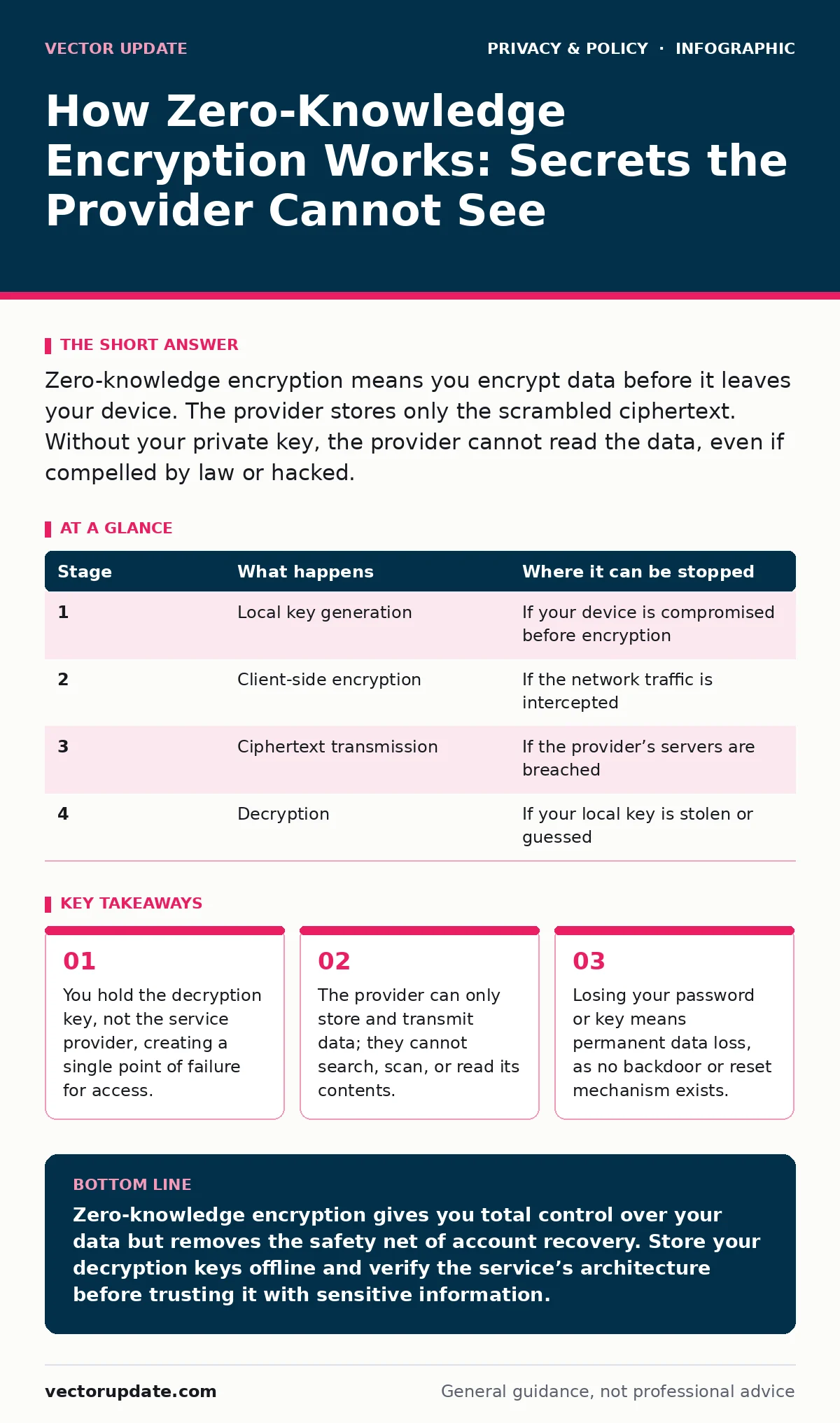
Zero-knowledge encryption means you encrypt data before it leaves your device. The provider stores only the scrambled ciphertext. Without your private key, the provider cannot read the data, even if compelled by law or hacked.
The Core Principle of Blind Storage
Zero-knowledge encryption shifts the burden of security from the service provider to the user. In traditional systems, you send data to a server, and the server encrypts it using keys it controls. The provider can decrypt the data to scan for spam, malware, or compliance violations. With zero-knowledge, you encrypt the data on your local device before it ever reaches the network. The provider receives only ciphertext, which is data that has been transformed into an unreadable format. They store this ciphertext but never possess the key to reverse the transformation.
This architecture changes the threat model entirely. The provider is no longer a trusted party for your data confidentiality. Instead, they are merely a storage facility. If an attacker breaches the provider’s servers, they steal encrypted blobs that are useless without your specific decryption key. This separation of storage and access is the foundation of privacy in cloud services.
Stage 1: Local Key Generation
The process begins on your device, not on the server. When you create an account, your software generates a cryptographic key pair or derives an encryption key from your password. This happens locally using your device’s processor and memory. The key never leaves your device in a readable form. If the software uses a password, it applies a key derivation function to stretch the password into a strong cryptographic key. This step is critical because the strength of your entire setup depends on the entropy, or randomness, of your password.
| Stage | What happens | Where it can be stopped |
|---|---|---|
| 1 | Local key generation | If your device is compromised before encryption |
| 2 | Client-side encryption | If the network traffic is intercepted |
| 3 | Ciphertext transmission | If the provider’s servers are breached |
| 4 | Decryption | If your local key is stolen or guessed |
Stage 2: Client-Side Encryption
Once the key is ready, the application encrypts your files or messages. This uses standard algorithms like AES, a widely accepted symmetric encryption standard. The data is transformed into ciphertext on your hard drive or in your device’s RAM. The provider’s software does not see the plaintext, which is the original, readable data. This stage ensures that even if the provider’s logging systems capture the request, they only record metadata about the file size and timestamp, not the content.
Imagine you are sending a letter. In a traditional system, you hand the letter to the post office, and they lock it in a box they also have the key to. In zero-knowledge, you lock the letter in a box yourself, keep the key, and hand the locked box to the post office. They can move the box, but they cannot open it.
Stage 3: Ciphertext Transmission
The encrypted data travels over the network to the provider’s servers. This transmission is usually protected by transport layer security, which encrypts the connection between your device and the server. However, the zero-knowledge property relies on the fact that the data itself is already encrypted. Even if an attacker performs a man-in-the-middle attack and intercepts the traffic, they only see the ciphertext. They cannot modify the data in a way that makes sense when you decrypt it later, because any tampering will result in decryption errors.
Stage 4: Blind Storage and Retrieval
The provider stores the ciphertext on their disks. They may replicate it for redundancy or move it between data centers. They cannot index the content for search because they cannot read it. When you request a file, they send the ciphertext back to you. Your device decrypts it using the local key. The provider has no way to verify if you are the rightful owner of the data, other than checking if you can decrypt it successfully. This is why password recovery is impossible. The provider cannot reset your password because they do not know what it is.
See also: Tor Browser: Real Privacy Gains and Hidden Performance Costs
The Trade-Off: Convenience vs. Control
The primary cost of zero-knowledge is the loss of convenience features. Because the provider cannot read your data, they cannot offer server-side search, automatic tagging, or cloud-based backups that sync across devices seamlessly. You must manage your own backups. If you lose your device and your password, your data is gone forever. There is no "forgot password" button that works by sending a reset link. The system has no way to prove you are who you say you are without the key.
This trade-off is significant for users who rely on cloud synchronization. You must implement your own redundancy strategy. Consider how this affects your approach to reducing your digital footprint, as losing access to encrypted archives can erase parts of your history permanently.
Applying Zero-Knowledge Correctly
To apply this effectively, you must treat your password as a physical key. Write it down and store it in a safe, offline location. Do not rely on memory alone. Use a password manager that supports zero-knowledge architecture, ensuring the manager itself does not hold your master key. Verify that the service you use publishes its source code or undergoes independent audits to prove they do not hold backdoor keys.
Limitations and Metadata Leakage
Zero-knowledge does not hide everything. The provider still knows who you are, when you logged in, and how much data you store. They can analyze traffic patterns. If you always upload large files on Fridays, the provider knows that pattern. This metadata can be valuable to adversaries or law enforcement. Combining zero-knowledge with tools like Tor Browser can help obscure your location and traffic patterns, adding another layer of privacy.
Be aware that some services claim zero-knowledge but still perform server-side scanning for illegal content. If they can scan it, they can read it. True zero-knowledge means the provider is technically incapable of reading your data, not just legally prohibited from doing so.
Key takeaways
- You hold the decryption key, not the service provider, creating a single point of failure for access.
- The provider can only store and transmit data; they cannot search, scan, or read its contents.
- Losing your password or key means permanent data loss, as no backdoor or reset mechanism exists.
Zero-knowledge encryption gives you total control over your data but removes the safety net of account recovery. Store your decryption keys offline and verify the service’s architecture before trusting it with sensitive information.
Frequently asked questions
Can the service provider read my data if they want to?
No, if the implementation is true zero-knowledge, the provider only holds encrypted data and lacks the keys to decrypt it, making reading impossible.
What happens if I forget my password?
Your data is permanently lost because the provider cannot reset your password or recover the encryption key for you.
Does zero-knowledge hide my IP address?
No, zero-knowledge only protects the content of your data. Your IP address and connection metadata are still visible to the provider.
Is zero-knowledge encryption slower than standard encryption?
It can be slightly slower for large files because encryption and decryption happen on your device, using your local processing power instead of the server’s.
How this guide was produced: written by the Vector Update editorial team with AI assistance, checked against the public references listed below, and reviewed when the facts change. See our editorial policy or report an error.