How the TLS Handshake Determines Your Network Security Posture
The TLS handshake negotiates the cryptographic rules before a single byte of data crosses the wire, making it the primary control point for preventing downgrade attacks and ensuring server identity.
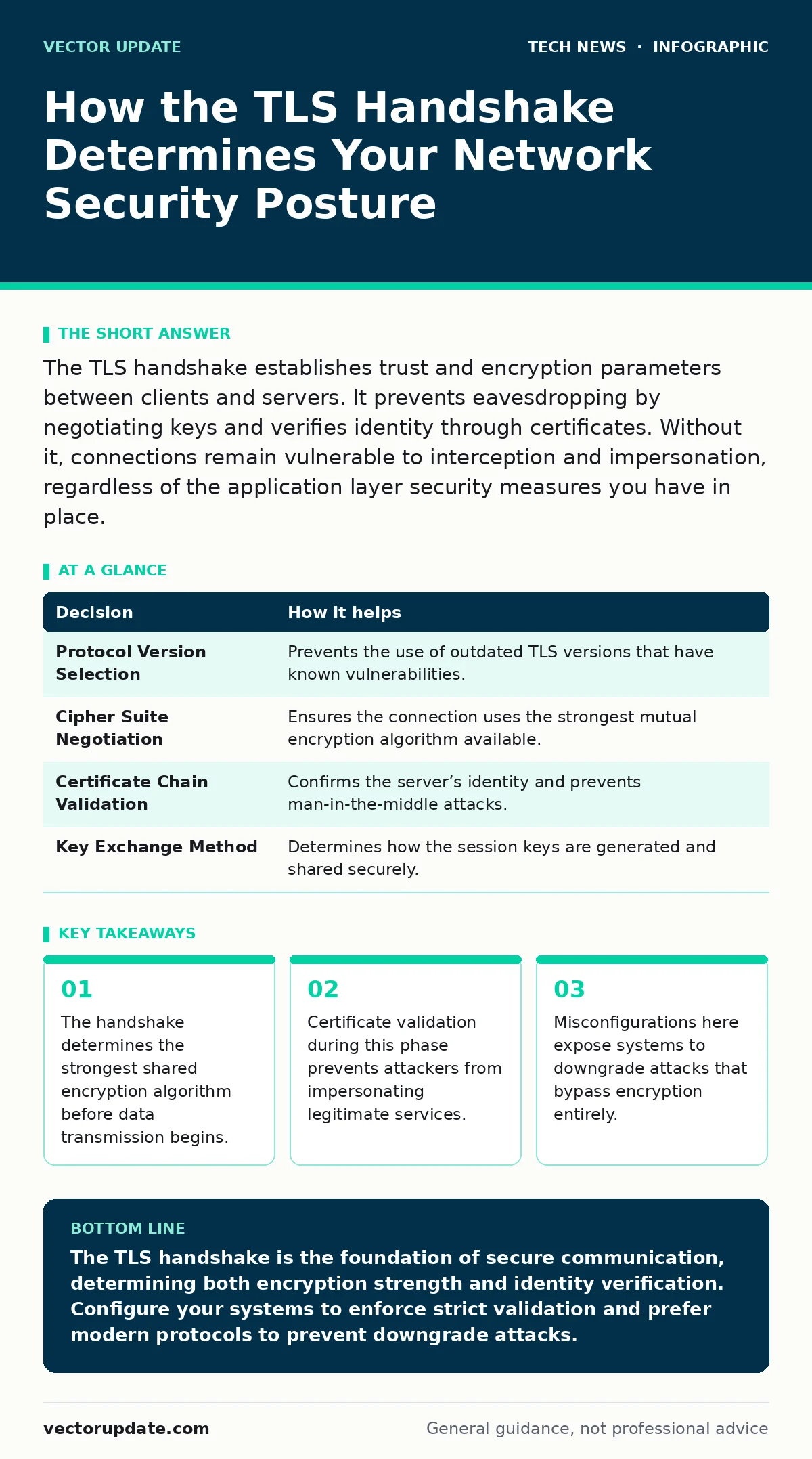
The TLS handshake establishes trust and encryption parameters between clients and servers. It prevents eavesdropping by negotiating keys and verifies identity through certificates. Without it, connections remain vulnerable to interception and impersonation, regardless of the application layer security measures you have in place.
The Negotiation Phase
The TLS handshake is not merely a greeting between two computers. It is a structured negotiation where the client and server agree on the security rules for their conversation. This process happens before any application data is sent. If this phase fails or is bypassed, the entire security model collapses.
During this exchange, the two parties determine which cryptographic algorithms they both support. They select the strongest common option to ensure that weak methods are not used. This prevents an attacker from forcing the connection to use outdated, broken encryption. The handshake also generates unique session keys that will encrypt the actual data. These keys are temporary and exist only for that specific connection.
Identity Verification Mechanisms
Encryption alone does not prove who you are talking to. You could be sending encrypted data to an attacker who is pretending to be your bank. The handshake solves this by verifying the server’s identity. The server presents a digital certificate during the exchange. This certificate contains the server’s public key and is signed by a trusted authority.
Your system checks this signature against its list of trusted certificate authorities. If the signature matches, you know the server is who it claims to be. This relies on the public key infrastructure, which manages the creation and validation of these digital identities. Without this verification step, encryption provides confidentiality but no authenticity. An attacker could intercept your traffic, decrypt it, read it, and re-encrypt it before sending it to the real server. You would never know the difference.
The Cost of Skipping Validation
Imagine a team that disables certificate verification in their application code to speed up development. They assume their network is private and secure. This assumption is dangerous. Internal networks are often compromised by malware or insider threats. When verification is skipped, any device on the network can impersonate the server.
This scenario highlights a hidden cost of convenience. The time saved by disabling checks is lost many times over during incident response. The handshake is the gatekeeper. If you leave the gate open, the strength of your locks on the data itself becomes irrelevant. You must trust the identity of the endpoint before you trust the encryption.
Decision Framework
The handshake informs several critical security decisions. Each decision has a trade-off between security and performance. Understanding these trade-offs helps you configure your systems correctly.
| Decision | How it helps |
|---|---|
| Protocol Version Selection | Prevents the use of outdated TLS versions that have known vulnerabilities. |
| Cipher Suite Negotiation | Ensures the connection uses the strongest mutual encryption algorithm available. |
| Certificate Chain Validation | Confirms the server’s identity and prevents man-in-the-middle attacks. |
| Key Exchange Method | Determines how the session keys are generated and shared securely. |
Resilience Against Downgrade Attacks
Attackers often try to force a connection to use weaker security settings. This is known as a downgrade attack. They might block support for newer TLS versions, forcing the client to fall back to an older, vulnerable version. The handshake includes mechanisms to detect this.
Modern implementations use TLS 1.3, which removes support for many weak algorithms and simplifies the handshake. This makes downgrade attacks much harder. The protocol ensures that if a client and server support strong security, they will use it. They do not negotiate down to a weaker common denominator unless absolutely necessary. This reduces the attack surface significantly.
You must ensure your systems are configured to prefer the latest protocol versions. Legacy systems may not support these newer standards. This creates a management burden. You must balance supporting old clients with maintaining high security standards. Disabling old versions entirely is the safest approach, but it may break compatibility with older devices.
See also: Intrusion Prevention Systems: How IPS Blocks Threats in Real Time · Network Address Translation: How NAT Works and Its Hidden Risks
Integration with Development Practices
Security is not just a network concern. It is a development concern. The way your application handles the TLS handshake determines its security posture. Developers must ensure that their libraries are up to date. They must also configure the handshake parameters correctly.
This aligns with secure software development practices. Security must be built into the code, not added later. Developers should test their applications against various server configurations. They should verify that their applications reject invalid certificates. They should also ensure that they do not accept self-signed certificates in production environments. This requires careful configuration and testing.
Monitoring and Detection
The handshake provides valuable data for security monitoring. Each handshake attempt generates logs. These logs show which clients are connecting, which protocols they are using, and whether the connection was successful. By analyzing these logs, you can detect anomalies.
Sudden spikes in failed handshakes might indicate a brute-force attack or a misconfigured client. Connections using outdated protocols might indicate compromised devices or legacy systems that need updating. This ties into network monitoring strategies. You can use handshake data to identify devices that do not meet your security standards. This allows you to take proactive measures before a breach occurs.
The Role of Key Management
The security of the handshake depends on the strength of the keys used. These keys are generated during the exchange and are ephemeral. This means they are used only once and then discarded. This provides forward secrecy. If an attacker records the traffic and later steals the server’s private key, they cannot decrypt the past sessions.
This is a critical feature for long-term security. It ensures that the compromise of a long-term key does not expose historical data. You must ensure that your systems support ephemeral key exchange methods. This requires proper configuration of the cipher suites. It also requires that your hardware or software can generate keys quickly and securely.
Balancing Performance and Security
The handshake adds latency to the connection. Each round of negotiation takes time. This can impact performance, especially for applications that make many short-lived connections. However, the security benefits outweigh the performance costs. You can optimize the handshake by using session resumption. This allows clients to reuse previous handshake parameters, reducing the time required to establish a new connection.
This optimization does not compromise security. It simply reuses previously established trust. You must ensure that session tickets are protected properly. If an attacker steals a session ticket, they can impersonate a client. This requires careful key management and rotation. You must balance the convenience of session resumption with the risk of ticket theft.
Key takeaways
- The handshake determines the strongest shared encryption algorithm before data transmission begins.
- Certificate validation during this phase prevents attackers from impersonating legitimate services.
- Misconfigurations here expose systems to downgrade attacks that bypass encryption entirely.
The TLS handshake is the foundation of secure communication, determining both encryption strength and identity verification. Configure your systems to enforce strict validation and prefer modern protocols to prevent downgrade attacks.
Frequently asked questions
What happens if the TLS handshake fails?
The connection is terminated immediately. No data is transmitted, ensuring that no unencrypted information is exposed.
Can the TLS handshake be bypassed?
It can be bypassed by misconfiguration, such as disabling certificate verification or using insecure protocols like HTTP.
How does TLS 1.3 improve the handshake?
TLS 1.3 reduces the number of round trips required, removes weak algorithms, and enforces forward secrecy by default.
Is the TLS handshake enough to secure an application?
No. The handshake secures the transport layer. You must also secure the application layer, including input validation and authentication.
How this guide was produced: written by the Vector Update editorial team with AI assistance, checked against the public references listed below, and reviewed when the facts change. See our editorial policy or report an error.