How AI Security Operations Work: Mechanisms, Limits, and Blind Spots
AI security tools do not understand intent; they predict patterns, creating a hidden cost of false positives that requires human review to prevent operational paralysis.

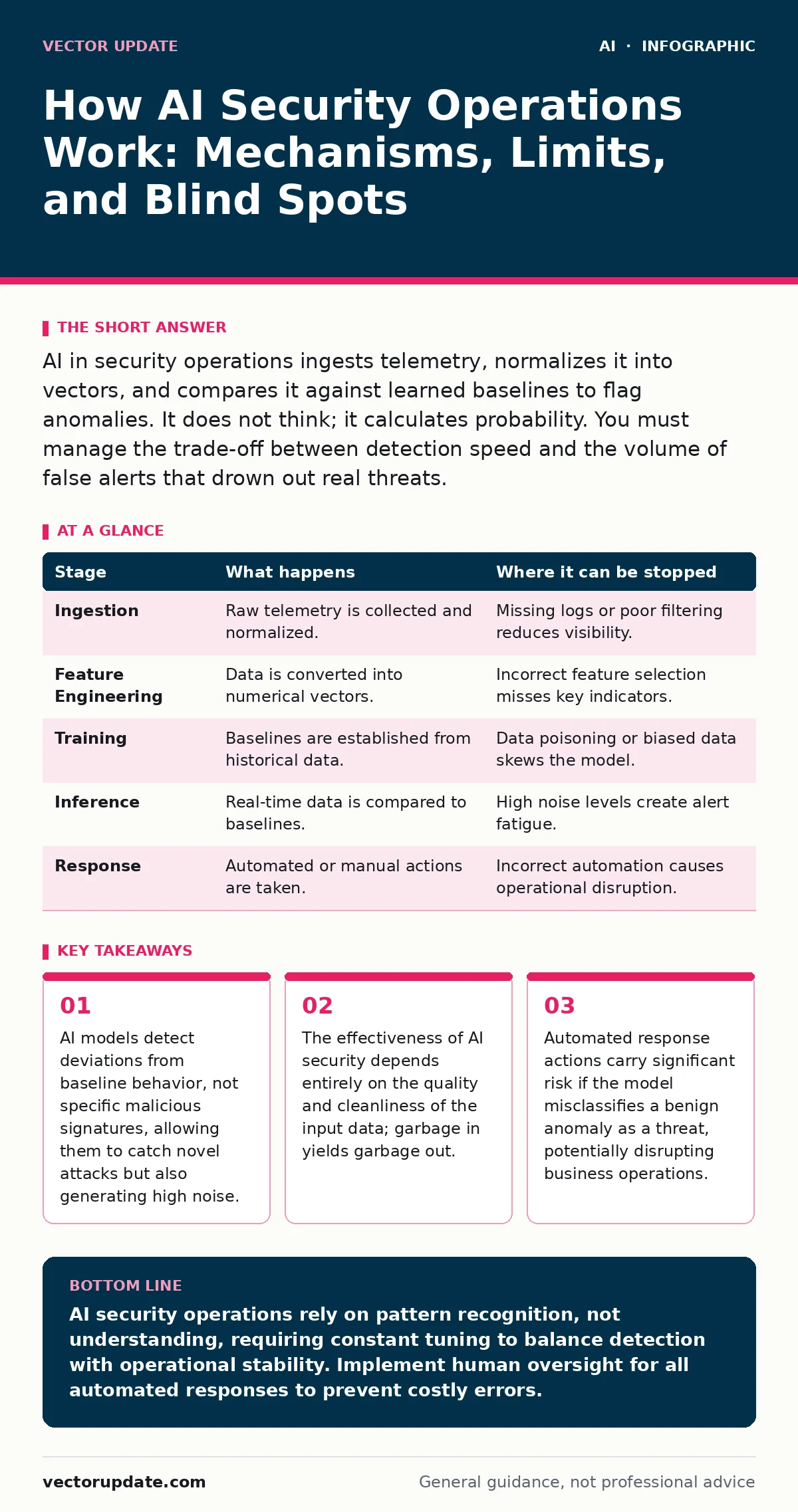
AI in security operations ingests telemetry, normalizes it into vectors, and compares it against learned baselines to flag anomalies. It does not think; it calculates probability. You must manage the trade-off between detection speed and the volume of false alerts that drown out real threats.
The Data Ingestion Pipeline
Security operations begin with data collection. Your environment generates massive volumes of telemetry from endpoints, network devices, and cloud services. This data is raw, unstructured, and often noisy. The first step in AI-driven security is ingesting this stream. The system does not store every packet forever. Instead, it streams data into a processing engine that filters for relevance.
This stage is critical because the AI model can only analyze what it receives. If your logging configuration is incomplete, the model has blind spots. You must ensure that critical events, such as login attempts and file access, are captured. The ingestion layer normalizes these disparate data sources into a common format. This allows the AI to compare a Windows event log entry with a Linux syslog entry. Without this normalization, the model cannot find correlations across different systems.
Feature Engineering and Vectorization
Raw data is useless to a machine learning model. It must be transformed into numerical representations. This process is called feature engineering. The system extracts specific attributes from the logs, such as the time of day, the source IP address, and the size of the data transfer. These attributes become "features."
Next, the system performs vectorization. It converts these features into vectors, which are mathematical objects that represent data points in a multi-dimensional space. Imagine a user’s behavior as a point in a 3D graph. Their typical login time, usual location, and standard data usage define their coordinates. When the user behaves normally, their vector stays in a specific cluster. When they deviate, their vector moves away from the cluster. This mathematical distance is what the AI measures to detect anomalies.
Model Training and Baseline Establishment
The AI model must learn what "normal" looks like before it can spot "abnormal." This happens during the training phase. The model analyzes historical data to establish a baseline for each user, device, and network segment. It does not look for known malware signatures. Instead, it learns the statistical distribution of behavior.
This baseline is dynamic. It updates continuously as new data arrives. This allows the model to adapt to changes in user behavior, such as a new project that requires late-night work. However, this adaptability is a double-edged sword. A slow-moving attacker can gradually shift the baseline, a technique known as data poisoning. The model learns the attacker’s behavior as normal, effectively blinding itself to the intrusion. You must monitor the baseline drift to ensure it reflects legitimate changes, not malicious adaptation.
| Stage | What happens | Where it can be stopped |
|---|---|---|
| Ingestion | Raw telemetry is collected and normalized. | Missing logs or poor filtering reduces visibility. |
| Feature Engineering | Data is converted into numerical vectors. | Incorrect feature selection misses key indicators. |
| Training | Baselines are established from historical data. | Data poisoning or biased data skews the model. |
| Inference | Real-time data is compared to baselines. | High noise levels create alert fatigue. |
| Response | Automated or manual actions are taken. | Incorrect automation causes operational disruption. |
Real-Time Inference and Scoring
Once the model is trained, it moves to inference. This is the real-time analysis of incoming data. As new events occur, the system calculates their vectors and compares them to the established baselines. It assigns a risk score to each event. A low score indicates normal behavior. A high score indicates a significant deviation.
This scoring is probabilistic. It tells you how likely an event is to be malicious, not whether it definitely is. The model considers multiple factors simultaneously. A single unusual login might score low. But an unusual login combined with a large data transfer and access to a sensitive directory will score high. This contextual analysis is where AI adds value over traditional rule-based systems. It detects complex, multi-stage attacks that no single rule could catch.
Alert Triage and Noise Reduction
The output of the inference stage is a stream of alerts. Without filtering, this stream is overwhelming. Security teams cannot investigate every high-score event. The AI system uses additional layers to reduce noise. It correlates alerts across different sources. If multiple users in the same department show similar anomalies, the system might flag it as a systemic issue rather than individual incidents.
This triage stage is where many implementations fail. If the threshold for alerting is too low, you drown in false positives. If it is too high, you miss real threats. You must tune these thresholds carefully. This tuning is not a one-time task. It requires continuous adjustment based on feedback from your security team. The goal is to surface only the alerts that require human attention. This reduces alert fatigue and allows analysts to focus on genuine threats.
See also: Synthetic Media Defined: What It Is and How It Works · Responsible AI Practices Checklist for Production Systems
Automated Response and Human Oversight
When an alert passes the triage stage, the system may take action. This is often called SOAR, or Security Orchestration, Automation, and Response. The system can isolate a device, disable a user account, or block an IP address. These actions are fast and consistent. They can contain a threat before it spreads.
However, automation carries risk. If the model makes a mistake, the response can be harmful. Disabling a critical server or locking out a key executive causes operational disruption. You must implement guardrails. Critical actions should require human approval. The AI should suggest actions, not execute them blindly. This human-in-the-loop approach ensures that decisions are made with context and judgment. See our guide on securing AI agents for more on managing autonomous systems.
The Limits of AI in Security
AI is not a silver bullet. It has inherent limitations. It cannot understand intent. It sees patterns, not motives. This means it can be fooled by sophisticated attacks that mimic normal behavior. It also struggles with zero-day exploits that have no historical data. The model has never seen this attack before, so it has no baseline to compare against.
Furthermore, AI models are only as good as their data. If your data is biased or incomplete, the model will be biased and incomplete. You must regularly audit your data sources and model performance. This includes checking for drift, where the model’s accuracy degrades over time. Regular retraining with fresh data helps maintain accuracy. For more on ethical considerations, see our guide on responsible AI practices.
Key takeaways
- AI models detect deviations from baseline behavior, not specific malicious signatures, allowing them to catch novel attacks but also generating high noise.
- The effectiveness of AI security depends entirely on the quality and cleanliness of the input data; garbage in yields garbage out.
- Automated response actions carry significant risk if the model misclassifies a benign anomaly as a threat, potentially disrupting business operations.
AI security operations rely on pattern recognition, not understanding, requiring constant tuning to balance detection with operational stability. Implement human oversight for all automated responses to prevent costly errors.
Frequently asked questions
Does AI replace security analysts?
No. AI handles data processing and initial triage, but human analysts are needed for complex decision-making, context interpretation, and overseeing automated actions.
How long does it take to train an AI security model?
Training is continuous. Initial baselines take time to establish, but the model updates in real-time as new data arrives, adapting to changing environments.
Can AI detect insider threats?
Yes. AI is particularly effective at detecting insider threats by identifying deviations from individual user baselines, such as unusual data access or login patterns.
Is AI security expensive to implement?
Implementation costs vary. While the software has a cost, the hidden costs of tuning, maintenance, and human oversight are significant. Poorly tuned AI can cost more than it saves.
How this guide was produced: written by the Vector Update editorial team with AI assistance, checked against the public references listed below, and reviewed when the facts change. See our editorial policy or report an error.