Synthetic Media Defined: What It Is and How It Works
Synthetic media is not just fake video; it is any content generated by algorithms that mimics real-world signals, creating a new layer of verification complexity.

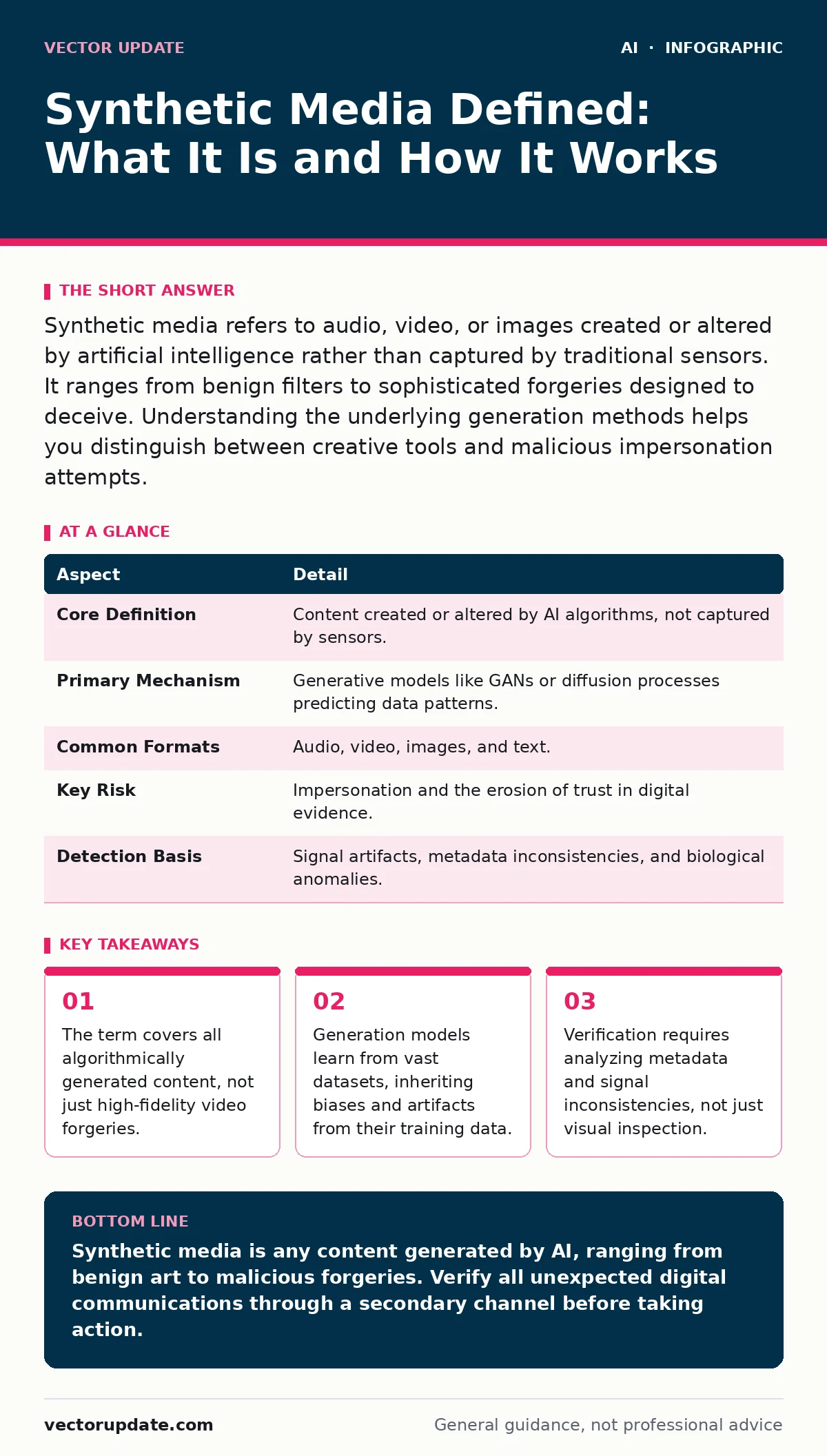
Synthetic media refers to audio, video, or images created or altered by artificial intelligence rather than captured by traditional sensors. It ranges from benign filters to sophisticated forgeries designed to deceive. Understanding the underlying generation methods helps you distinguish between creative tools and malicious impersonation attempts.
Beyond the Visual Trick
Imagine you are editing a photograph. You adjust the lighting, crop the edges, and remove a distracting object. This is traditional media manipulation. Now imagine you ask a computer to paint a landscape from scratch, describing it in text. The computer does not copy a photo. It predicts which pixels should appear next based on millions of images it has seen before. This is synthetic media.
The term often conjures images of politicians saying things they never said. While that is a part of it, the definition is much broader. Synthetic media includes any audio, visual, or textual content generated by machine learning models. It exists on a spectrum. At one end are simple filters that smooth skin. At the other end are deepfakes that clone a person’s voice and face with high fidelity.
The distinction matters because the technology behind them is the same. Both use generative adversarial networks or diffusion models. These systems create content by learning patterns in data. They do not understand truth. They understand probability. When you generate a synthetic image, the model is guessing what a realistic image looks like, pixel by pixel.
| Aspect | Detail |
|---|---|
| Core Definition | Content created or altered by AI algorithms, not captured by sensors. |
| Primary Mechanism | Generative models like GANs or diffusion processes predicting data patterns. |
| Common Formats | Audio, video, images, and text. |
| Key Risk | Impersonation and the erosion of trust in digital evidence. |
| Detection Basis | Signal artifacts, metadata inconsistencies, and biological anomalies. |
The Mechanics of Generation
To understand synthetic media, you must understand how it is built. Most modern synthetic media uses diffusion models. These models start with random noise, like static on a TV screen. They then gradually remove the noise, guided by a text prompt or a reference image. With each step, the image becomes more coherent.
This process is computationally expensive. It requires significant processing power to reverse-engineer an image from noise. However, the result is highly detailed. The model does not copy existing images. It constructs new ones. This makes it difficult to trace the source of the content.
Audio generation works differently. It often uses vocoders, which convert linguistic features into sound waves. The system learns the timbre and rhythm of a speaker from a short sample. It can then synthesize new speech in that voice. The quality depends on the length and clarity of the training sample. A few seconds of clear audio can be enough to clone a voice for short phrases.
Video generation combines these techniques. It generates frames individually or in short clips, then stitches them together. Maintaining consistency across frames is the hardest part. Faces may morph, or hands may have too many fingers. These artifacts are clues, but they are becoming harder to spot as models improve.
Where the Term Comes From
The phrase "synthetic media" gained traction as the technology moved from research labs to consumer apps. Initially, the industry used terms like "deepfake" or "face swap." These terms were too narrow. They only described video forgeries.
As audio and text generation improved, a broader term was needed. "Synthetic media" captures the essence of the technology. It emphasizes that the content is synthesized, or created, rather than captured. It applies to a cartoon character talking in a human voice. It applies to a generated image of a building that does not exist.
The shift in terminology reflects a shift in risk. It is no longer just about identity theft. It is about the pollution of the information ecosystem. When any media can be synthetic, the default assumption shifts. You cannot trust what you see or hear without verification. This changes how organizations handle evidence and communication.
Daily Use and Practical Application
Synthetic media is not only used for deception. It is used for creation and efficiency. Companies use it to generate training data for other AI systems. They create synthetic faces to test privacy-preserving technologies. They use synthetic voices to dub movies into different languages.
In marketing, synthetic media allows for rapid content creation. A brand can generate hundreds of product images with different backgrounds. It can create personalized video messages for customers. These uses are benign, but they blur the line between real and fake.
For system administrators, the daily use case is often integration. You may deploy AI tools that generate reports or summarize meetings. These tools produce synthetic text. You need to know that the output is generated, not retrieved. This affects how you audit the information. You cannot assume the source is a human analyst.
What People Usually Get Wrong
A common misconception is that synthetic media is indistinguishable from reality. This is false. Even high-quality forgeries contain artifacts. These are subtle errors in the signal. They may appear as inconsistent lighting, unnatural eye movements, or audio glitches.
Another mistake is relying on visual inspection alone. Humans are poor at detecting deepfakes. We are biased to believe what we see. Automated detection tools are better, but they are not perfect. They can be fooled by new generation techniques. This is an arms race. As generators improve, detectors must improve.
People also assume that metadata will always tell the truth. Metadata can be stripped or forged. Digital signatures and provenance standards are emerging to help. They allow you to verify the origin of a file. However, these standards are not yet universally adopted. You cannot rely on them exclusively.
See also: AI in Security Operations: 8 Best Practices for Real-World Defense · How AI Security Operations Work: Mechanisms, Limits, and Blind Spots
The Hidden Costs of Verification
Verifying synthetic media has a hidden cost: time and trust. When you question the authenticity of a video, you slow down decision-making. In a crisis, this delay can be dangerous. You may hesitate to act because you are unsure if the threat is real.
There is also a cost to privacy. Detection tools often require analyzing biometric data. This raises ethical questions. Who owns the data used to train these detectors? How is it stored? These issues are central to responsible AI practices.
For organizations, the cost is operational. You need new workflows to handle synthetic content. You need to train staff to recognize signs of manipulation. You need to update your security policies to address AI-generated threats. This is not a one-time fix. It is an ongoing process.
Navigating the Regulatory Landscape
Regulators are catching up. The EU AI Act classifies certain synthetic media as high-risk. It requires transparency and risk assessments. This affects how you deploy these tools. You must document your use cases and mitigate risks.
Other regions are developing similar frameworks. The goal is to ensure that synthetic media is used responsibly. This includes labeling generated content and preventing malicious use. You need to stay informed about these regulations. They will impact your compliance obligations.
For a deeper look at specific compliance requirements, see our guide on the EU AI Act. It details the obligations for providers and deployers of AI systems. Understanding these rules helps you avoid legal pitfalls.
The Future of Trust
The future of synthetic media is not just about better generation. It is about better verification. New standards are emerging to embed provenance information in media files. This allows you to trace the history of a file. You can see who created it, what tools were used, and when it was modified.
This technology is still developing. It is not foolproof. Bad actors can bypass it. But it provides a layer of defense. It shifts the burden from detection to verification. You do not need to prove a file is fake. You need to prove it is real.
As these standards become widespread, the role of system administrators will change. You will need to manage these provenance systems. You will need to ensure that your tools support these standards. This is a critical part of future security architectures.
For strategies on handling malicious uses, refer to our guide on deepfake fraud. It covers the tactics used by attackers and how to defend against them.
Key takeaways
- The term covers all algorithmically generated content, not just high-fidelity video forgeries.
- Generation models learn from vast datasets, inheriting biases and artifacts from their training data.
- Verification requires analyzing metadata and signal inconsistencies, not just visual inspection.
Synthetic media is any content generated by AI, ranging from benign art to malicious forgeries. Verify all unexpected digital communications through a secondary channel before taking action.
Frequently asked questions
Is synthetic media the same as a deepfake?
No. Deepfakes are a specific type of synthetic media that replaces one person's face with another. Synthetic media includes all AI-generated audio, video, and images, including those that do not involve impersonation.
Can I trust AI-generated content for official records?
Not without verification. AI models can hallucinate facts or create plausible but false information. Always verify critical information against authoritative sources before using it in official records.
How do I detect a synthetic audio message?
Look for unnatural pauses, inconsistent background noise, or slight distortions in pitch. However, detection is difficult. The best defense is to verify the request through a separate communication channel.
Does synthetic media violate copyright?
It depends on the jurisdiction and the specific use case. If the model was trained on copyrighted data without permission, legal issues may arise. Consult legal counsel for specific guidance on your use case.
How this guide was produced: written by the Vector Update editorial team with AI assistance, checked against the public references listed below, and reviewed when the facts change. See our editorial policy or report an error.