Responsible AI Practices Checklist for Production Systems
Most AI failures stem from data lineage gaps and silent model drift, not malicious code or obvious algorithmic bias in training sets.
Use this checklist to verify data provenance, enforce output boundaries, and monitor model behavior over time. It covers the technical controls needed to prevent hallucination, data leakage, and unauthorized action execution in production environments.
Scope and Application
This checklist applies to any system that uses large language models or machine learning classifiers in a production environment. It is not a theoretical framework but a set of engineering controls. You use it to verify that your AI components behave predictably under load and adversarial conditions.
The items are grouped by lifecycle phase: data preparation, model deployment, and operational monitoring. Treat each item as a binary check. If you cannot verify it with a test or a configuration audit, mark it as incomplete.
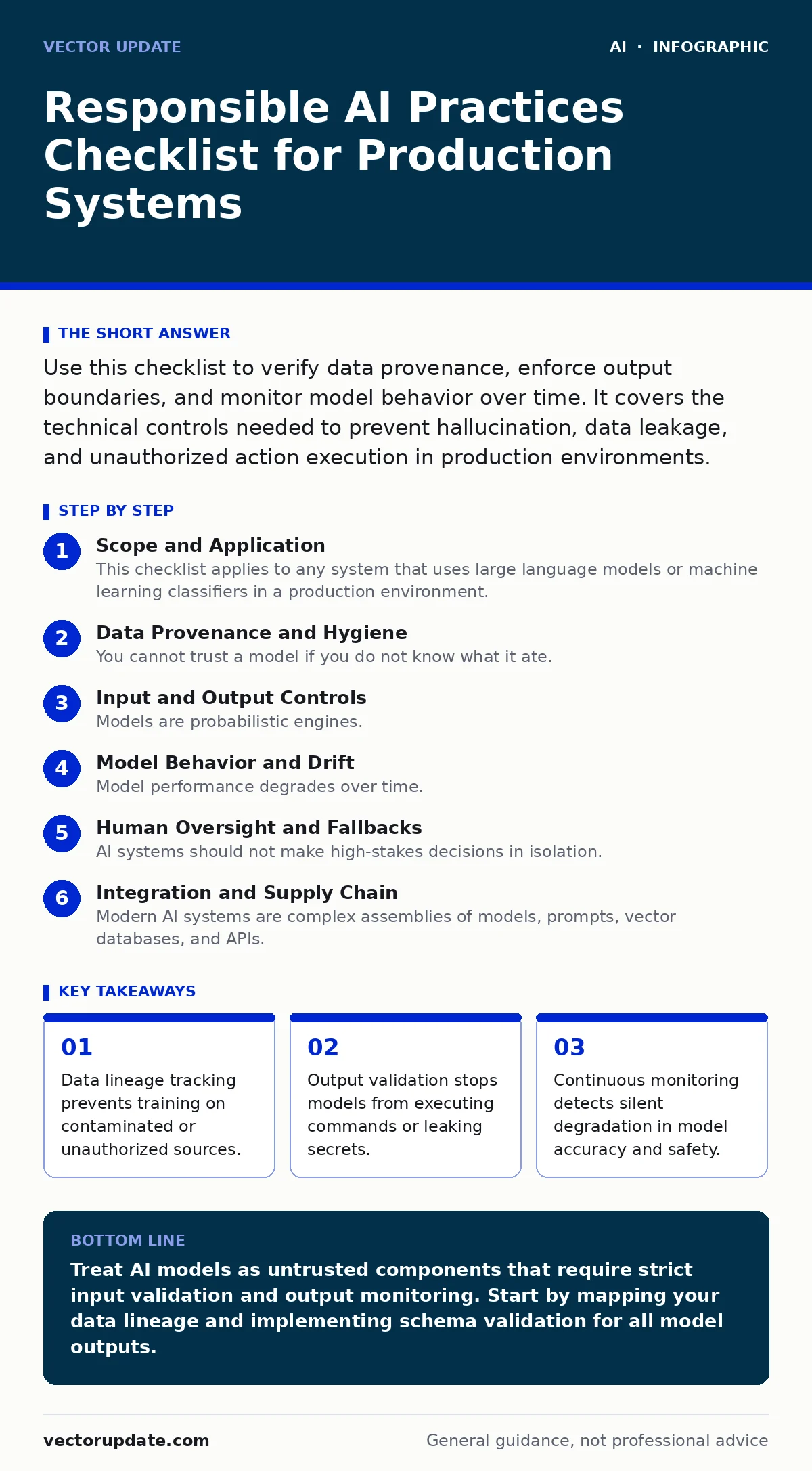
Data Provenance and Hygiene
You cannot trust a model if you do not know what it ate. Data poisoning is a low-effort attack where bad actors inject malicious patterns into training sets. These patterns can cause the model to fail specific queries or leak sensitive information.
- Map every data source to its origin and licensing status: Unknown sources introduce legal risk and potential contamination that is nearly impossible to remove later.
- Sanitize personally identifiable information from training sets: PII in training data can be extracted by attackers using membership inference attacks.
- Verify data integrity with checksums at ingestion time: Corrupted data files can cause silent training failures that degrade model performance without error logs.
- Separate training, validation, and test datasets strictly: Data leakage between sets creates false confidence in model accuracy that vanishes in production.
See the guide on sensitive data leaks through AI chatbots for details on how unscrubbed logs become training data.
Input and Output Controls
Models are probabilistic engines. They do not "know" truth; they predict the next likely token. This means they can hallucinate facts, refuse valid requests, or generate harmful content if not constrained. You must treat model output as untrusted user input.
- Implement schema validation for all structured outputs: Unstructured text responses can break downstream applications that expect specific JSON or XML formats.
- Set strict temperature and top-p parameters: High randomness increases creativity but also increases the likelihood of hallucination and inconsistency.
- Use allowlists for tool calls and function execution: Models should only be permitted to call specific, vetted functions, preventing arbitrary code execution.
- Log all inputs and outputs with PII redaction: You need an audit trail for incident response, but storing raw data creates a new security liability.
Refer to the guide on insecure AI plugins and agents to understand how excessive permissions amplify these risks.
Model Behavior and Drift
Model performance degrades over time. This is known as model drift. It happens when the real-world data distribution changes, or when attackers adapt their prompts to bypass your filters. A model that was safe at launch may become unsafe six months later.
- Monitor for distribution shifts in input data: Sudden changes in query patterns can indicate adversarial testing or a change in user behavior that the model cannot handle.
- Set thresholds for output confidence scores: Low confidence scores indicate the model is guessing, which is a signal to route the query to a human or a fallback system.
- Test against known prompt injection patterns regularly: New injection techniques emerge frequently, and static filters become obsolete quickly.
- Validate model responses against ground truth data: Automated checks can detect when a model starts asserting false facts as truth in critical domains.
See the guide on machine learning for fraud detection for examples of how drift affects classification accuracy.
Human Oversight and Fallbacks
AI systems should not make high-stakes decisions in isolation. Human-in-the-loop architectures add latency but provide a critical safety net. You must design your system to fail safely when the model is uncertain or the human is unavailable.
- Define clear escalation paths for low-confidence predictions: Users need to know when they are interacting with an AI and when a human has taken over.
- Implement circuit breakers for rapid error rates: If the model starts failing repeatedly, the system should stop sending queries to it to prevent cascading failures.
- Provide users with a way to report bad outputs: User feedback is the most reliable signal for identifying edge cases that automated tests miss.
- Ensure audit trails survive system restarts: Logs must be stored in a tamper-evident manner to support forensic analysis after an incident.
Consult the guide on EU AI Act for regulatory requirements on human oversight in high-risk applications.
See also: AI in Security Operations: 8 Best Practices for Real-World Defense · How AI Security Operations Work: Mechanisms, Limits, and Blind Spots
Integration and Supply Chain
Modern AI systems are complex assemblies of models, prompts, vector databases, and APIs. Each component is a potential failure point. You must verify the security of the entire stack, not just the model weights.
- Verify the integrity of model weights and checkpoints: Downloaded models can be tampered with during transfer, introducing backdoors or performance killers.
- Secure the vector database access controls: Vector stores often contain embeddings of sensitive data; unauthorized access can reveal semantic similarities in proprietary information.
- Pin dependencies to specific versions: Unpinned dependencies can introduce vulnerable libraries or breaking changes that alter model behavior unexpectedly.
- Test the full pipeline under load: Performance bottlenecks often reveal race conditions or data corruption issues that unit tests do not catch.
See the guide on securing AI agents for details on protecting the execution environment.
Verification and Maintenance
Responsibility is not a one-time setup. It is a continuous process of verification. You must have a process to decommission models that no longer meet safety or performance standards.
- Schedule regular red teaming exercises: External testers can find logical flaws and injection vectors that internal teams overlook due to familiarity bias.
- Document the model's limitations explicitly: Users and developers need to know what the model cannot do to prevent misuse and incorrect expectations.
- Plan for model decommissioning: You need a strategy for securely deleting data and models when they are no longer supported or needed.
- Review access controls quarterly: Permissions often expand over time; regular reviews ensure that only necessary services can interact with the AI components.
Refer to the guide on AI in security operations for how to integrate these checks into your SOC workflow.
Key takeaways
- Data lineage tracking prevents training on contaminated or unauthorized sources.
- Output validation stops models from executing commands or leaking secrets.
- Continuous monitoring detects silent degradation in model accuracy and safety.
Treat AI models as untrusted components that require strict input validation and output monitoring. Start by mapping your data lineage and implementing schema validation for all model outputs.
Frequently asked questions
How often should I retrain my AI model?
Retrain when you detect significant model drift or when new data sources become available. Continuous retraining can introduce instability, so batch updates are often safer.
Can I use open-source models for sensitive data?
Yes, if you host them privately and ensure no telemetry or data exfiltration occurs. Verify the license and audit the code for backdoors before deployment.
What is the best way to prevent prompt injection?
There is no single fix. Use layered defenses: input sanitization, output validation, and separation of user data from system instructions.
Do I need to comply with the EU AI Act if I am not in Europe?
If you serve users in the EU, you likely do. The regulation applies to providers and deployers regardless of location.
How this guide was produced: written by the Vector Update editorial team with AI assistance, checked against the public references listed below, and reviewed when the facts change. See our editorial policy or report an error.