Deepfake Fraud: How Attackers Bypass Verification and How to Stop Them
Voice and video forgeries now mimic biometric traits so closely that standard liveness checks fail, forcing organizations to verify identity through out-of-band channels rather than trusting the media itself.
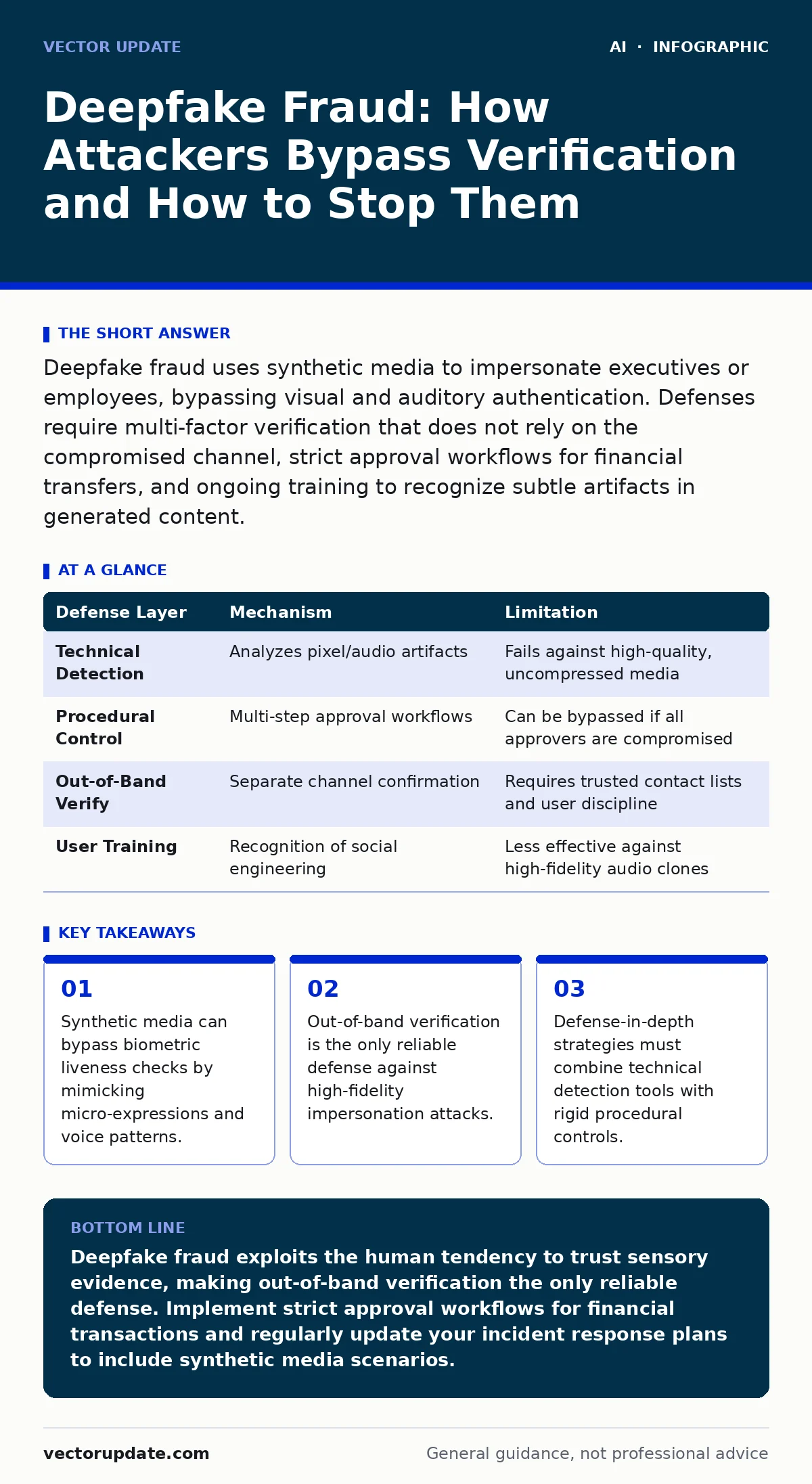
Deepfake fraud uses synthetic media to impersonate executives or employees, bypassing visual and auditory authentication. Defenses require multi-factor verification that does not rely on the compromised channel, strict approval workflows for financial transfers, and ongoing training to recognize subtle artifacts in generated content.
What makes deepfake fraud different from traditional impersonation?
Traditional impersonation relies on social engineering where the attacker mimics a persona through text or standard voice calls. Deepfake fraud uses generative artificial intelligence to create synthetic media that visually and audibly replicates a specific individual with high fidelity. This shifts the attack from exploiting human trust in a name to exploiting human trust in sensory evidence. You can no longer assume that seeing a face or hearing a voice confirms identity.
Can deepfakes bypass standard biometric authentication?
Yes, advanced generative models can create video and audio that pass many liveness detection systems. Liveness detection is a security measure designed to ensure the subject presenting biometric data is a live human present at the time of capture, rather than a photo or recording. Attackers use deepfakes to simulate blinking, head movements, and lip synchronization, which tricks these sensors into accepting the spoof as genuine. This creates a hidden cost for organizations relying solely on facial recognition or voice prints for high-security access.
How do attackers use deepfakes in business email compromise?
Attackers use deepfakes to escalate the urgency and credibility of business email compromise schemes. Imagine a scenario where an attacker sends an email from a spoofed executive address and follows up with a realistic voice call generated by AI. The voice clone matches the executive’s tone, cadence, and speech patterns, pressuring the recipient to wire funds immediately. This combination of visual, auditory, and textual evidence overwhelms the recipient’s ability to verify the request through normal channels. For more on protecting data in these interactions, see our guide on sensitive data leaks through AI chatbots.
Why do automated deepfake detection tools sometimes fail?
Automated detection tools often fail because they rely on identifying artifacts that newer models no longer produce. These tools look for inconsistencies in pixel patterns, eye reflections, or audio frequency anomalies. As generative models improve, they eliminate these telltale signs, causing detection algorithms to report false negatives. Furthermore, re-encoding media through video conferencing platforms or social networks compresses the data, destroying the very artifacts the detectors rely on. This cat-and-mouse dynamic means detection accuracy decays rapidly as generation techniques advance.
What is the most reliable way to verify identity during a crisis?
The most reliable method is out-of-band verification, which involves confirming the identity through a completely separate communication channel. If you receive an urgent request via video call, you must verify it by calling the person on a known, trusted phone number that you have not received from the requester. This breaks the attack chain because the attacker likely does not have access to your trusted contact list or the ability to intercept that secondary channel. This principle is central to responsible AI practices when integrating synthetic media into workflows.
See also: AI in Security Operations: 8 Best Practices for Real-World Defense · How AI Security Operations Work: Mechanisms, Limits, and Blind Spots
How do deepfakes impact insider threat detection systems?
Deepfakes can mask insider threats by allowing malicious actors to appear compliant with monitoring systems. Suppose an employee uses a deepfake overlay on their webcam to appear focused on work while their actual screen shows data exfiltration. The visual feed sent to security monitoring systems shows a compliant worker, while the network traffic reveals the theft. This creates a blind spot where behavioral analytics and video surveillance contradict each other, complicating the incident response process.
What role do approval workflows play in preventing financial fraud?
Strict approval workflows act as a procedural firewall against deepfake-driven financial fraud. Even if an attacker perfectly mimics an executive’s voice, they cannot replicate the multi-person approval chain required for large transactions. By requiring at least two independent verifiers to approve significant payments, you introduce a delay that allows for sanity checks and out-of-band verification. This redundancy ensures that a single compromised identity cannot authorize unauthorized transfers.
How does the regulatory environment affect deepfake liability?
Regulatory frameworks like the EU AI Act impose strict obligations on developers and deployers of high-risk AI systems. These regulations require transparency about the use of synthetic media and mandate robust risk management measures. Organizations that use AI for identity verification must now document their accuracy rates and failure modes. This legal pressure forces companies to move beyond marketing claims and implement verifiable security controls. Understanding these requirements is critical for compliance in global operations.
| Defense Layer | Mechanism | Limitation |
|---|---|---|
| Technical Detection | Analyzes pixel/audio artifacts | Fails against high-quality, uncompressed media |
| Procedural Control | Multi-step approval workflows | Can be bypassed if all approvers are compromised |
| Out-of-Band Verify | Separate channel confirmation | Requires trusted contact lists and user discipline |
| User Training | Recognition of social engineering | Less effective against high-fidelity audio clones |
Can machine learning help detect synthetic media at scale?
Machine learning models can analyze large volumes of media to flag potential forgeries, but they are not a silver bullet. These systems use machine learning for fraud detection by comparing incoming media against known patterns of synthetic generation. However, they generate a high volume of false positives, flagging legitimate low-quality video as suspicious. This forces security teams to manually review flagged items, creating a bottleneck that attackers can exploit by flooding systems with benign but suspicious-looking content. For deeper technical insights, review our guide on AI in security operations.
What are the long-term risks of synthetic media in security?
The long-term risk is the erosion of trust in digital evidence and remote authentication. As synthetic media becomes indistinguishable from reality, organizations must fundamentally rethink how they verify identity. This shift requires a move away from "seeing is believing" toward cryptographic proof and zero-trust architectures. The cost of this transition is high, requiring new infrastructure and cultural changes in how employees handle sensitive information. To prepare for this shift, explore best practices in securing AI agents.
Key takeaways
- Synthetic media can bypass biometric liveness checks by mimicking micro-expressions and voice patterns.
- Out-of-band verification is the only reliable defense against high-fidelity impersonation attacks.
- Defense-in-depth strategies must combine technical detection tools with rigid procedural controls.
Deepfake fraud exploits the human tendency to trust sensory evidence, making out-of-band verification the only reliable defense. Implement strict approval workflows for financial transactions and regularly update your incident response plans to include synthetic media scenarios.
Frequently asked questions
Can I detect a deepfake by looking for blinking errors?
No, modern generative models accurately simulate blinking and other micro-expressions. Relying on visual artifacts is ineffective because compression and re-encoding often remove these clues anyway.
Should I disable video calls to prevent deepfake attacks?
Disabling video calls is not practical for most organizations. Instead, assume video can be spoofed and require secondary verification for any sensitive or financial discussions conducted over video.
How often should I update my deepfake detection software?
Update detection software regularly, but do not rely on it exclusively. The gap between new generation techniques and detection capabilities widens quickly, so procedural controls are more stable.
Is voice cloning a bigger threat than video deepfakes?
Voice cloning is often a higher immediate threat because high-fidelity audio requires less bandwidth and processing power than video. It is easier to execute a voice-only social engineering attack than a full video impersonation.
How this guide was produced: written by the Vector Update editorial team with AI assistance, checked against the public references listed below, and reviewed when the facts change. See our editorial policy or report an error.