Stop AI Chatbots Leaking Sensitive Business Data
Block accidental data exposure by understanding how AI models ingest text and applying strict network controls.

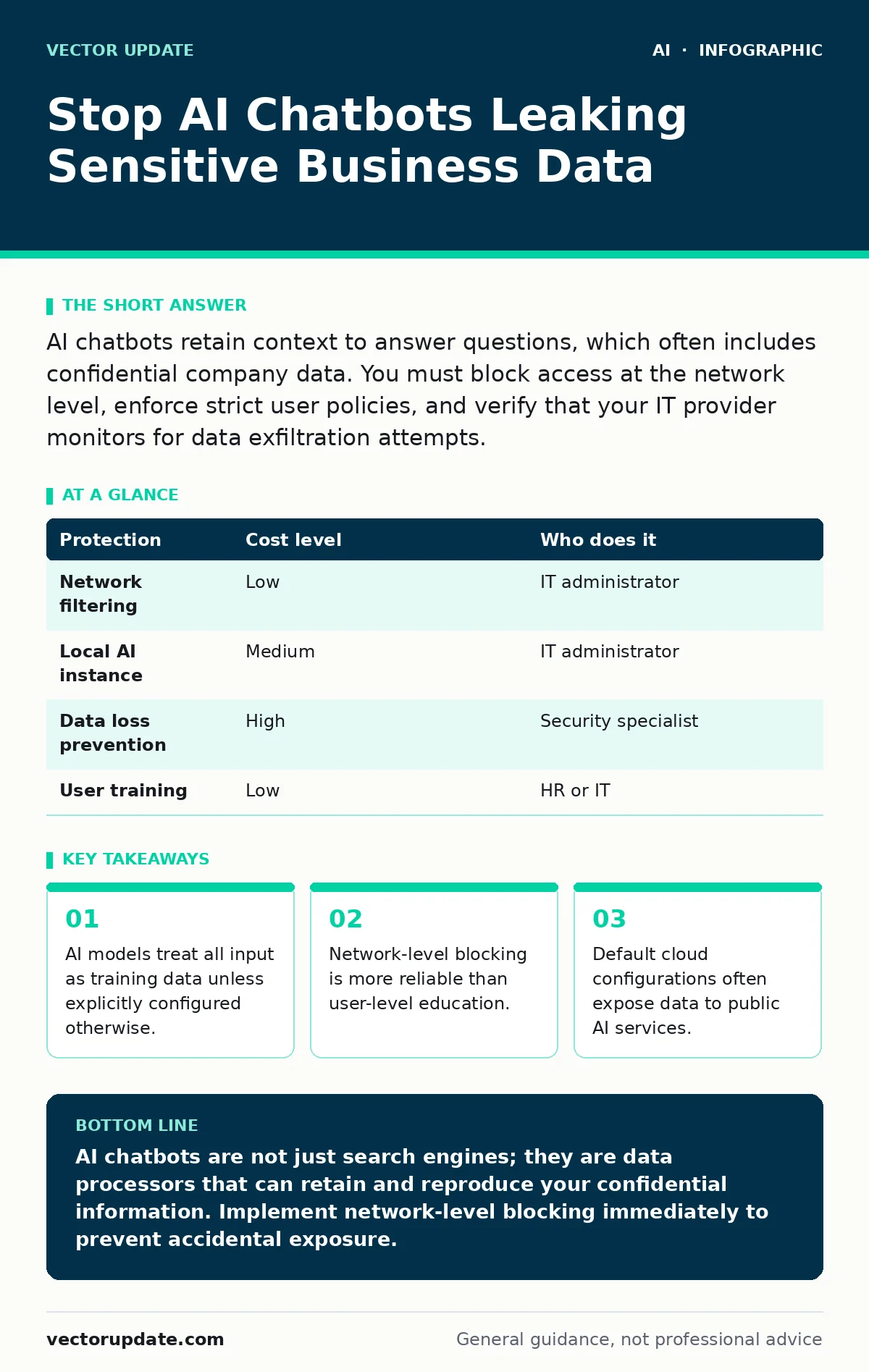
AI chatbots retain context to answer questions, which often includes confidential company data. You must block access at the network level, enforce strict user policies, and verify that your IT provider monitors for data exfiltration attempts.
The Quiet Data Drain
This scenario illustrates how sensitive information leaves your control. You do not need a sophisticated hacker to steal your data. You only need an employee who trusts the tool too much. AI chatbots function by analyzing patterns in text. To provide accurate answers, they retain context from previous interactions. This context window is where your private data lives.
Small organizations are particularly vulnerable because they lack dedicated security teams. You likely rely on general IT support or a managed service provider. These providers often prioritize uptime and cost over data governance. The assumption that "the cloud is secure" is dangerous. The cloud provider secures the infrastructure, but you secure the data you put into it.
How Context Becomes Risk
AI models do not understand confidentiality. They understand probability. When you paste a document into a chat interface, the model breaks it into tokens. Tokens are small units of text, usually parts of words or characters. The model analyzes these tokens to predict the next likely sequence.
If the model is configured to use public data for training, your tokens may become part of that dataset. Even if the provider claims not to train on user data, the immediate context window is visible to their systems. This means your data exists in memory on their servers. If those servers are compromised, your data is exposed.
The risk extends beyond direct theft. Adversaries can use prompt injection techniques. These are crafted inputs designed to trick the model into revealing system instructions or previous data. If your internal tools connect to AI models, an attacker can inject malicious prompts through user inputs. This can cause the AI to bypass safety filters and export sensitive information.
Network Controls Over Policies
You cannot rely on employees to remember what not to paste. Human error is inevitable. The most effective protection is technical, not educational. You must control where the AI traffic goes. This is done at the network level.
Use a web proxy or a firewall that can inspect outbound traffic. These tools can block requests to known AI service domains. If you need AI capabilities, you must whitelist specific, approved instances. Do not allow direct access to public chat interfaces from company devices.
This approach has a trade-off. It reduces convenience. Employees will complain if they cannot access their preferred tools. However, convenience is not worth the risk of data loss. You can offer a sanctioned, local AI instance for general queries. This instance does not send data to external servers. It processes requests locally, keeping your data within your control.
| Protection | Cost level | Who does it |
|---|---|---|
| Network filtering | Low | IT administrator |
| Local AI instance | Medium | IT administrator |
| Data loss prevention | High | Security specialist |
| User training | Low | HR or IT |
The Hidden Cost of Convenience
Many small businesses adopt AI tools because they are free or cheap. This is a false economy. The cost of a data breach far exceeds the subscription fee of a secure tool. You must consider the total cost of ownership.
Free tools often monetize your data. They may use your inputs to improve their models or sell insights to third parties. Paid tools offer better privacy guarantees, but you must read the terms of service. Look for clauses that explicitly state your data is not used for training.
You must also consider the risk of insider threats. An disgruntled employee can copy-paste large amounts of data into an AI tool. Network controls help, but they are not foolproof. You need monitoring. This means logging access to sensitive documents and detecting unusual outbound traffic.
Verifying Your IT Provider
If you outsource your IT, you must verify that they understand AI risks. Many providers are still catching up. They may not have policies in place for AI usage. You need to ask specific questions.
- Does your security policy explicitly address AI chatbot usage?
- How do you monitor outbound traffic to AI service providers?
- Do you offer a local AI solution for general queries?
- How do you handle data classification and labeling?
- What is your incident response plan for AI-related data leaks?
These questions reveal whether your provider is proactive or reactive. A proactive provider will have clear policies and technical controls. A reactive provider will rely on user education and hope for the best. You want the former.
See also: EU AI Act FAQ: What It Means for Your Systems and Data · AI in Security Operations: 8 Best Practices for Real-World Defense
Building a Defense in Depth
No single control stops all leaks. You need layers of defense. This is called defense in depth. Each layer adds a barrier that an attacker or an error must overcome.
The first layer is prevention. Block access to unauthorized AI tools at the network level. The second layer is detection. Monitor for unusual data transfers. The third layer is response. Have a plan for when data leaks occur.
This plan should include notifying affected parties and assessing the damage. You must also review your controls. Did the leak happen because of a configuration error? Did an employee bypass controls? Use the incident to improve your defenses.
The Reality of Protection
You cannot stop all data leaks. Determined attackers or negligent insiders will find ways. Your goal is to make it difficult and risky for them. By implementing network controls, you reduce the attack surface. By educating users, you reduce the likelihood of accidental leaks.
Remember that AI is a tool, not a magic solution. It amplifies your capabilities, but it also amplifies your risks. Treat it with the same caution you treat any other technology. Verify its security, control its access, and monitor its usage.
Next Steps for Your Organization
Start by auditing your current AI usage. Find out which tools your employees are using. Check if these tools are approved and secured. If not, block them and provide alternatives.
Review your IT provider's policies. Ask the questions listed above. If they cannot answer them, find a new provider. Security is not a commodity. It is a critical function that requires expertise and attention to detail.
Implement network filtering immediately. This is the lowest hanging fruit. It stops the majority of accidental leaks. Then, plan for longer-term solutions like local AI instances or dedicated security tools.
Key takeaways
- AI models treat all input as training data unless explicitly configured otherwise.
- Network-level blocking is more reliable than user-level education.
- Default cloud configurations often expose data to public AI services.
AI chatbots are not just search engines; they are data processors that can retain and reproduce your confidential information. Implement network-level blocking immediately to prevent accidental exposure.
Frequently asked questions
Can I use AI chatbots for general research?
Yes, but only on personal devices and with personal accounts. Never use company devices or networks for unvetted AI tools.
Does encrypting data stop AI leaks?
Encryption protects data at rest and in transit, but not when it is pasted into a chat interface. The AI sees the plaintext.
What is prompt injection?
It is a technique where an attacker inputs text designed to trick the AI into ignoring its safety rules or revealing hidden data.
How do I know if my data was leaked?
You often do not. Regular monitoring and logging are necessary to detect unauthorized data transfers to AI
How this guide was produced: written by the Vector Update editorial team with AI assistance, checked against the public references listed below, and reviewed when the facts change. See our editorial policy or report an error.