EU AI Act FAQ: What It Means for Your Systems and Data
The EU AI Act ties legal liability to technical design, forcing you to engineer risk controls into your models before they ever touch production traffic.

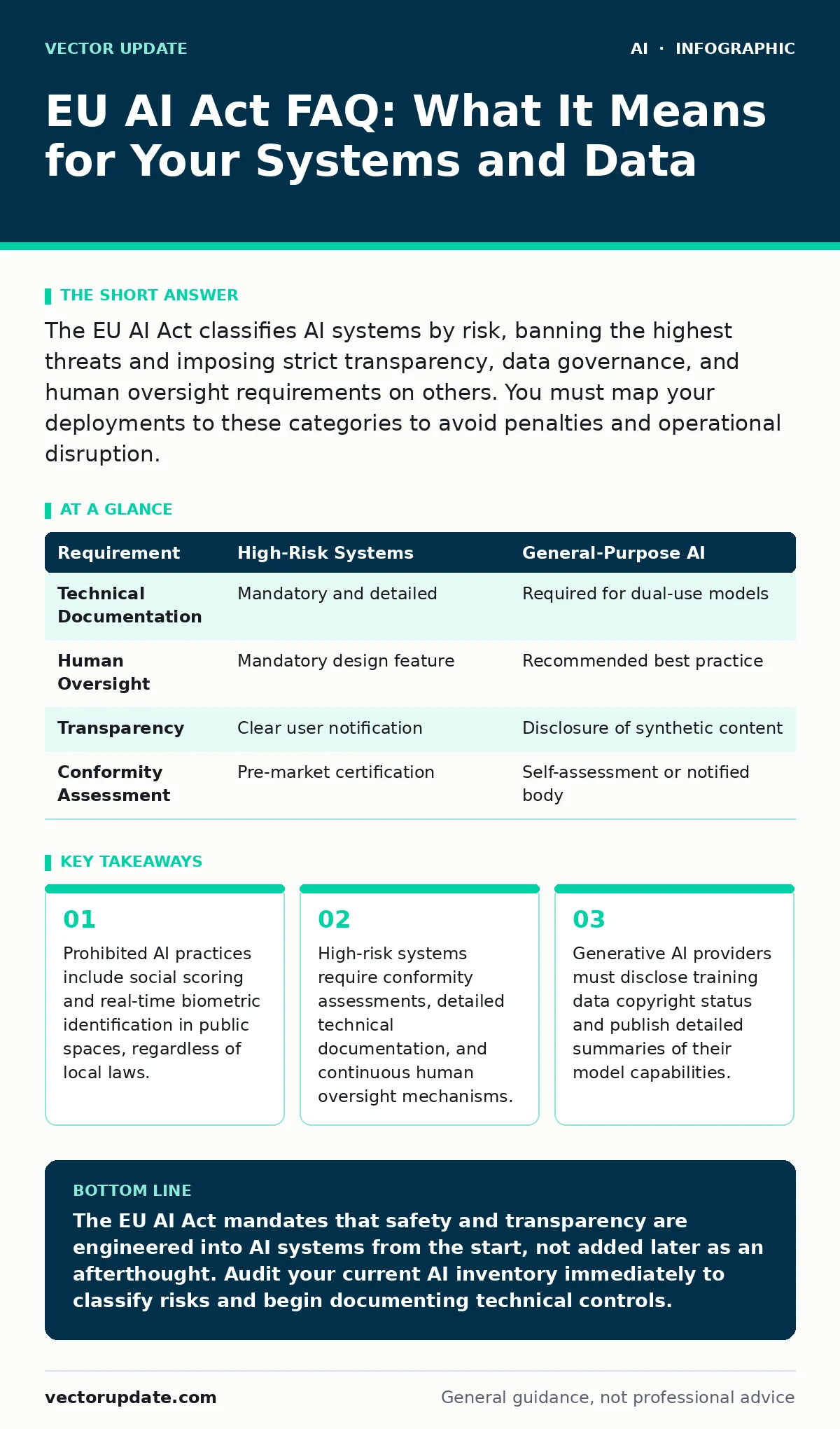
The EU AI Act classifies AI systems by risk, banning the highest threats and imposing strict transparency, data governance, and human oversight requirements on others. You must map your deployments to these categories to avoid penalties and operational disruption.
What systems fall under the EU AI Act’s scope?
The regulation applies to any provider placing an AI system on the market or putting it into service within the EU, as well as any user located in the EU. This jurisdictional reach extends to organizations outside the EU if their output is consumed by EU residents or businesses. You do not need to have a physical office in Europe for the law to bind your engineering teams. The definition of "AI system" is broad, covering any machine-based system designed to operate with a degree of autonomy.
Which AI applications are completely banned?
The Act prohibits specific practices deemed to pose an unacceptable risk to safety, livelihoods, or fundamental rights. These include subliminal techniques that bypass conscious awareness to manipulate behavior and social scoring by public authorities. Real-time remote biometric identification in publicly accessible spaces is also banned, with narrow exceptions for targeted law enforcement searches. These bans are absolute; no technical mitigation or user consent can render them legal. If your system relies on these mechanisms, you must redesign it or restrict its deployment entirely outside the EU.
How does the Act define high-risk AI systems?
High-risk classification applies to AI used in critical infrastructure, education, employment, or law enforcement that could harm health, safety, or fundamental rights. The regulation uses a risk-based approach, focusing on the context of use rather than the algorithm itself. A simple statistical model used for hiring decisions falls into this category, while the same model used for internal inventory tracking does not. You must evaluate the intended purpose and the potential severity of harm to determine this status. Misclassifying a high-risk system as low-risk exposes your organization to significant fines and mandatory product recalls.
What technical obligations do high-risk providers face?
Providers must establish a quality management system and maintain comprehensive technical documentation throughout the system's lifecycle. This includes detailed information on data governance, algorithmic logic, and performance metrics. You must implement human oversight measures that allow operators to intervene and override automated decisions. The system must be robust against errors and resilient to adversarial attacks. These requirements force you to shift from agile, opaque development cycles to rigorous, documented engineering processes similar to those in aerospace or medical devices.
| Requirement | High-Risk Systems | General-Purpose AI |
|---|---|---|
| Technical Documentation | Mandatory and detailed | Required for dual-use models |
| Human Oversight | Mandatory design feature | Recommended best practice |
| Transparency | Clear user notification | Disclosure of synthetic content |
| Conformity Assessment | Pre-market certification | Self-assessment or notified body |
How does the Act handle generative AI models?
Providers of general-purpose AI models, including those with foundation model capabilities, must comply with transparency obligations. You must provide detailed technical documentation to downstream providers who use your model to build high-risk applications. This includes information on training data composition, copyright compliance, and model performance characteristics. Generative AI systems must also generate output that is clearly identifiable as machine-generated. This prevents downstream users from unknowingly deploying unvetted models in critical contexts. The burden of safety shifts to both the model creator and the application developer.
See also: Deepfake Fraud: How Attackers Bypass Verification and How to Stop Them · Synthetic Media Defined: What It Is and How It Works
Who bears responsibility for compliance?
Providers are primarily responsible for meeting technical and documentation requirements before placing a system on the market. Importers and distributors must verify that the provider has complied with labeling and documentation rules. Users of high-risk systems, particularly public authorities, must conduct fundamental rights impact assessments. This shared responsibility model means you cannot outsource compliance to a vendor without verifying their adherence to the Act. If you integrate a third-party AI component, you remain liable for its performance in your specific context. Review your vendor contracts to ensure they include compliance warranties and audit rights.
What penalties apply for non-compliance?
Enforcement begins gradually, with bans on prohibited systems taking effect first, followed by transparency rules and high-risk requirements. The financial risk is substantial, but the operational risk of forced discontinuation is often more disruptive. You should treat compliance as a core engineering constraint, not a legal checkbox.
How do I start the compliance process?
Begin by inventorying all AI systems currently in use or in development within your organization. Map each system to its intended purpose and potential harm profile to classify its risk level. For high-risk systems, initiate the documentation and testing processes immediately. For general-purpose models, prepare technical documentation for downstream partners. Engage legal and engineering teams early to align on definitions of "human oversight" and "data quality." Compliance is an iterative process that requires continuous monitoring as models and use cases evolve.
Where can I find more technical guidance?
For detailed implementation strategies, refer to our guides on responsible AI practices and securing AI agents. These resources provide concrete steps for engineering transparency and safety into your development pipeline. You should also review insecure AI plugins and agents to understand common vulnerability patterns in integrated systems. Understanding the technical debt of AI helps you prioritize compliance efforts where they matter most.
Key takeaways
- Prohibited AI practices include social scoring and real-time biometric identification in public spaces, regardless of local laws.
- High-risk systems require conformity assessments, detailed technical documentation, and continuous human oversight mechanisms.
- Generative AI providers must disclose training data copyright status and publish detailed summaries of their model capabilities.
The EU AI Act mandates that safety and transparency are engineered into AI systems from the start, not added later as an afterthought. Audit your current AI inventory immediately to classify risks and begin documenting technical controls.
Frequently asked questions
Does the EU AI Act apply to internal tools not sold to customers?
Yes, if the internal tool is used for high-risk purposes like hiring or critical infrastructure management, it falls under the regulation. Internal use does not exempt you from compliance if the activity impacts fundamental rights.
Can I use open-source models without worrying about the Act?
No, if you deploy an open-source model in a high-risk context, you become the provider and must ensure compliance. You are responsible for documenting the model’s behavior and ensuring human oversight.
How long do I have to comply with the high-risk rules?
The timeline is phased, with high-risk requirements typically taking effect two years after the Act enters into force. However, you should start mapping your systems now to avoid last-minute engineering scrambles.
What if my AI system was developed outside the EU?
If the output is used in the EU, the regulation applies to you. You must appoint an authorized representative in the EU if you are not established there. Jurisdiction follows the user and the impact, not the developer's location.
How this guide was produced: written by the Vector Update editorial team with AI assistance, checked against the public references listed below, and reviewed when the facts change. See our editorial policy or report an error.