Open Security Groups: 6 Myths Blocking Your Cloud Defense
Open security groups do not automatically mean open ports; they often hide complex misconfigurations that standard scanners miss entirely.

Open security groups are not always dangerous. Some are designed for public services, while others are silent risks. You must distinguish between intentional public access and negligent exposure by analyzing traffic patterns, not just rule syntax.
Myth: Any Security Group Allowing Inbound Traffic Is Vulnerable
Reality: This belief assumes all inbound traffic is hostile or unnecessary. In cloud environments, certain services must be publicly accessible to function. A web server hosting a public website requires inbound traffic on standard HTTP and HTTPS ports. Blocking this traffic would render the service unusable, not more secure.
The risk lies in the destination, not the direction. You must evaluate whether the service receiving the traffic is hardened. If the application is patched and the port is restricted to the minimum required protocols, the rule is functional, not vulnerable.
Imagine a database server that accepts connections from anywhere. This is a high-risk configuration because databases rarely need public internet access. Contrast this with a load balancer that accepts public traffic to distribute it to internal servers. The load balancer’s open rules are part of the architecture, not a mistake.
Myth: Internal Security Groups Do Not Need Strict Controls
Reality: Internal network traffic is often trusted by default, creating a false sense of safety. Attackers who breach the perimeter often move laterally through internal networks. If internal security groups allow unrestricted communication between tiers, a compromised web server can easily pivot to a database server.
This is known as lateral movement. The attacker uses the trusted internal channel to reach higher-value targets. You cannot assume that traffic originating from within your cloud account is safe. The principle of least access must apply to internal communication paths just as strictly as external ones.
Suppose an application server needs to talk to a cache server. The security group should allow traffic only from the application server’s specific group, not from all internal resources. This containment limits the blast radius of a breach.
Myth: Outbound Rules Are Irrelevant to Security
Reality: Many administrators focus exclusively on inbound rules, ignoring outbound traffic controls. Outbound rules determine what a resource can contact. Without restrictions, a compromised instance can exfiltrate data to external command-and-control servers or download additional malware.
This is data exfiltration. The attacker does not need to open an inbound port to steal information. They can use the existing outbound connection to send data to an external server. Restricting outbound traffic to only necessary destinations reduces this risk significantly.
Consider a server that only needs to reach an update repository. It should not be allowed to initiate connections to random IP addresses on the internet. By defaulting outbound traffic to deny, you force the system to explicitly request permission for each external connection.
Myth: Security Groups Are Stateful, So Return Traffic Is Always Safe
Reality: Security groups are indeed stateful, meaning they automatically allow return traffic for established connections. This convenience often leads to the assumption that you do not need to worry about outbound rules for inbound-initiated traffic. However, this statefulness applies only to the specific connection that triggered the rule.
It does not protect against outbound connections initiated by the instance itself. If malware on the server initiates a new connection to an external server, the stateful rule for the inbound web traffic does not apply. The outbound rule must explicitly permit this new connection if it is legitimate, or block it if it is not.
Imagine a server that receives web traffic. An attacker exploits a vulnerability and launches a script that sends data to an external IP. The stateful rule allows the web response but does not authorize the new outbound data transfer. Without a restrictive outbound rule, the data leaves the network unchecked.
Myth: A Single "Open" Group Is Easy to Identify and Fix
Reality: Complex configurations often hide open access behind layers of abstraction. Administrators may use security group references instead of IP addresses, creating dependencies that are hard to trace. A rule might appear restricted because it references another security group, but that referenced group might be overly permissive.
This is transitive trust. The security posture of a group depends on the posture of the groups it references. If Group A allows traffic from Group B, and Group B allows traffic from the entire internet, then Group A is effectively open to the internet. Simple scanners that only look at direct IP ranges will miss this risk.
You must map the entire dependency chain. A rule that looks safe in isolation may be dangerous in context. Regularly reviewing the effective permissions, rather than just the configuration syntax, reveals these hidden exposures.
See also: Secure Cloud APIs: Block Exploits, Limit Scope, and Verify Identity · Cloud Landing Zones: Definition, Purpose, and Core Architecture
Myth: Closing All Open Ports Is the Best Security Strategy
Reality: Overly restrictive rules can break application functionality, leading to shadow IT or workarounds. If legitimate services are blocked, users may create unauthorized resources to bypass the restrictions. This creates unmanaged assets that lack proper security controls.
Security must balance protection with usability. Instead of closing everything, you should define explicit allow lists for required traffic. This approach, known as zero trust, assumes no traffic is trusted until verified. It requires more initial configuration but provides clearer visibility and control.
Suppose a developer needs access to a testing environment. Rather than opening the port to the world, you create a temporary, scoped rule that expires after the task is complete. This minimizes exposure without hindering productivity.
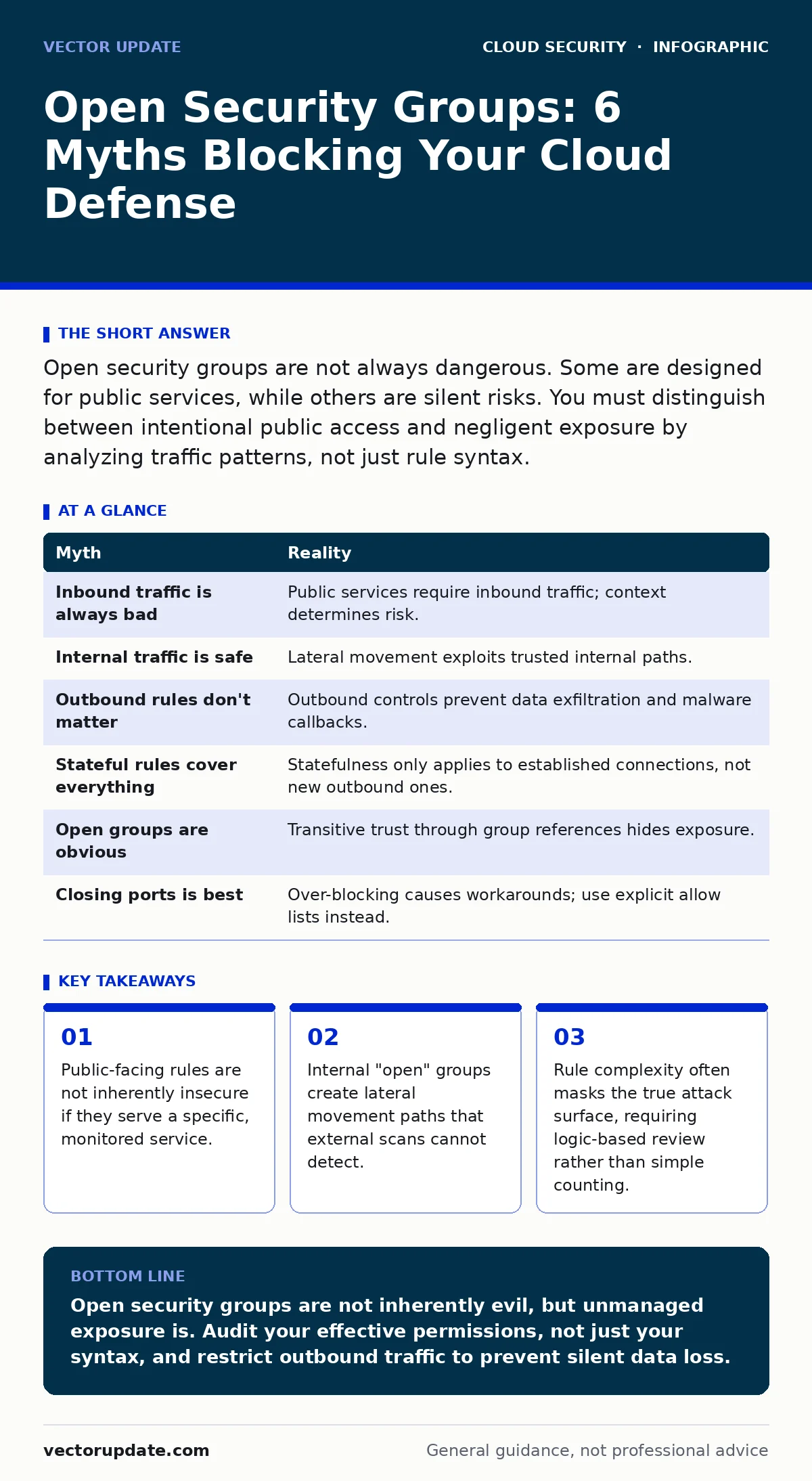
| Myth | Reality |
|---|---|
| Inbound traffic is always bad | Public services require inbound traffic; context determines risk. |
| Internal traffic is safe | Lateral movement exploits trusted internal paths. |
| Outbound rules don't matter | Outbound controls prevent data exfiltration and malware callbacks. |
| Stateful rules cover everything | Statefulness only applies to established connections, not new outbound ones. |
| Open groups are obvious | Transitive trust through group references hides exposure. |
| Closing ports is best | Over-blocking causes workarounds; use explicit allow lists instead. |
Key takeaways
- Public-facing rules are not inherently insecure if they serve a specific, monitored service.
- Internal "open" groups create lateral movement paths that external scans cannot detect.
- Rule complexity often masks the true attack surface, requiring logic-based review rather than simple counting.
- Zero-trust principles apply to internal traffic, not just perimeter defenses.
Open security groups are not inherently evil, but unmanaged exposure is. Audit your effective permissions, not just your syntax, and restrict outbound traffic to prevent silent data loss.
Frequently asked questions
How do I find transitive security group dependencies?
Use cloud-native tools or third-party scanners that map security group references. Look for tools that calculate effective permissions rather than just listing rules.
Should I block all outbound traffic by default?
Yes, for most workloads. Start with a default-deny outbound policy and add explicit allow rules for required services like updates or API calls.
What is the difference between a security group and a network ACL?
Security groups are stateful and instance-level, while network ACLs are stateless and subnet-level. Use security groups for fine-grained control and ACLs for broad subnet policies.
Can I use security groups for encryption?
No, security groups control traffic flow, not data encryption. Refer to the guide on cloud encryption for data protection strategies.
How this guide was produced: written by the Vector Update editorial team with AI assistance, checked against the public references listed below, and reviewed when the facts change. See our editorial policy or report an error.