Secure Cloud APIs: Block Exploits, Limit Scope, and Verify Identity
Insecure cloud APIs fail because they trust default access patterns, not because of missing firewalls, so you must enforce strict identity checks at the application layer.
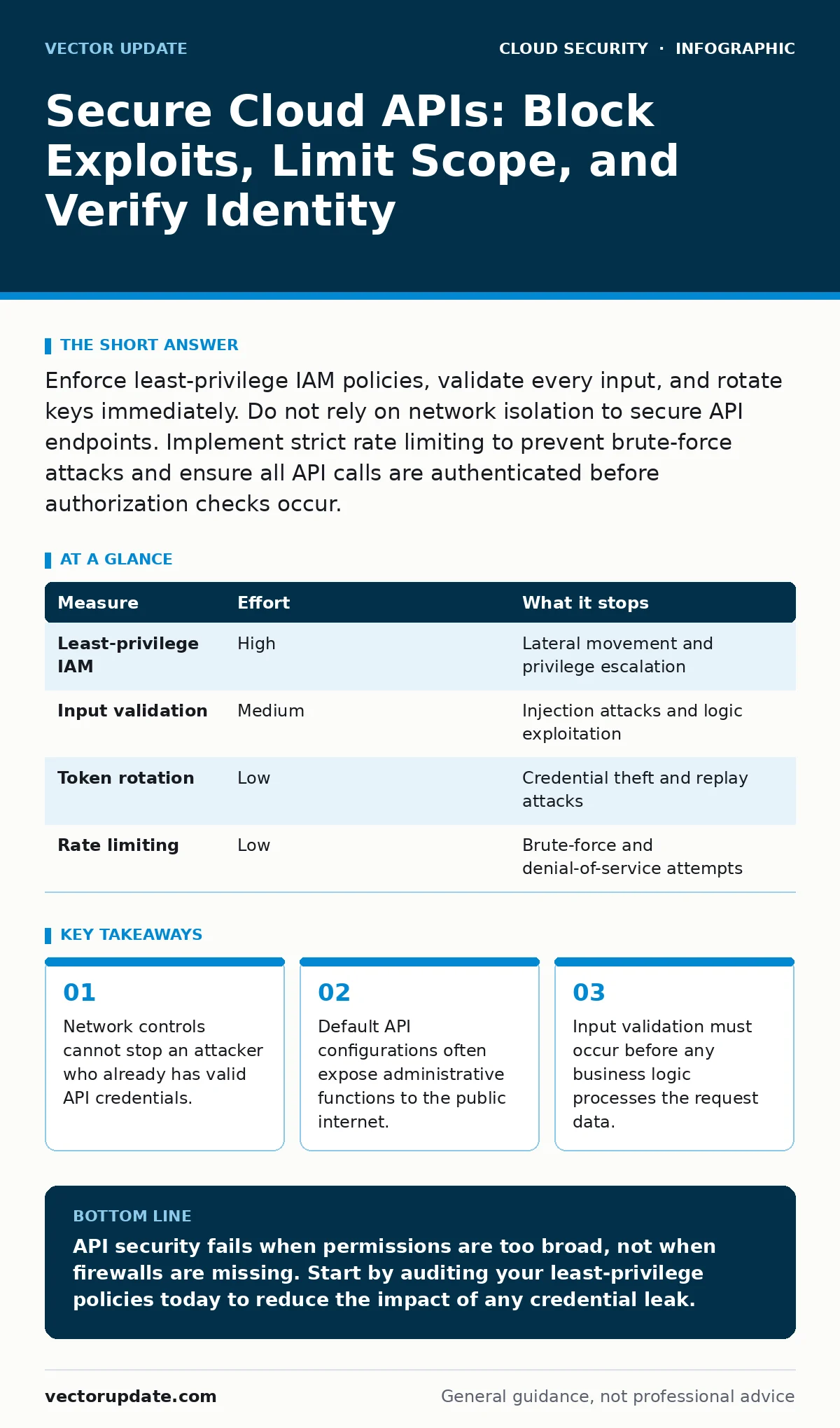
Enforce least-privilege IAM policies, validate every input, and rotate keys immediately. Do not rely on network isolation to secure API endpoints. Implement strict rate limiting to prevent brute-force attacks and ensure all API calls are authenticated before authorization checks occur.
The Identity Gap in Cloud Security
Cloud infrastructure relies on application programming interfaces to manage resources. These APIs allow scripts and applications to configure servers, databases, and storage without human intervention. When these interfaces are misconfigured, they become the primary entry point for attackers. You might secure your perimeter, but if the API accepts a request from a stolen credential, your network defenses are bypassed entirely. The problem is rarely the code itself, but the permissions granted to the identity making the call.
Imagine a developer creates an application that needs to read data from a storage bucket. Instead of granting only read access to that specific bucket, they assign an administrative role to the application for convenience. This single decision exposes the entire account to exfiltration if the application’s credentials are leaked. This is the core of insecure API risk: excessive privilege.
Enforce Least Privilege at the Identity Level
The most effective control is restricting what each identity can do. You must audit every service account and application role. Remove administrative privileges from any identity that does not need to perform administrative tasks. This requires mapping every API call your applications make and granting only those specific permissions.
This process is tedious. It forces you to understand your application’s behavior deeply. However, it limits the blast radius of a compromised credential. If a hacker steals the keys for a logging service, they cannot delete production databases because the logging role lacks those permissions. This approach aligns with the principles found in guides on cloud encryption, where access controls complement data protection.
Validate Input and Enforce Schema Strictness
APIs accept data from clients. If you do not validate that data, you risk injection attacks and logic errors. You must define a strict schema for every API endpoint. The schema specifies the type, length, and format of every field. Reject any request that does not match this schema exactly.
Do not trust the client. A mobile app might send malformed data due to a bug, or a malicious actor might send crafted payloads. Your API must reject invalid data before it reaches your business logic. This prevents attackers from manipulating parameters to access unauthorized resources or crash services. It is a fundamental step that complements cloud logging and monitoring, as rejected requests can be logged for analysis without impacting performance.
Implement Strong Authentication and Token Rotation
Every API call must prove who is making it. Use industry-standard protocols like OAuth 2.0 or OpenID Connect for authentication. These protocols issue short-lived tokens that expire quickly. This reduces the window of opportunity for an attacker who intercepts a token.
You must also rotate API keys regularly. Long-lived keys are a liability. If a key is compromised, it remains a threat until you revoke it. Automated rotation ensures that even if a key is leaked, it becomes useless soon. This practice is distinct from open security groups, which focus on network access rather than identity verification. Both are necessary, but identity is the first line of defense for APIs.
| Measure | Effort | What it stops |
|---|---|---|
| Least-privilege IAM | High | Lateral movement and privilege escalation |
| Input validation | Medium | Injection attacks and logic exploitation |
| Token rotation | Low | Credential theft and replay attacks |
| Rate limiting | Low | Brute-force and denial-of-service attempts |
Control Access with Rate Limiting and Throttling
Attackers often use automated tools to probe APIs. They send thousands of requests per second to find vulnerabilities or guess credentials. Rate limiting restricts the number of requests an identity can make in a given time. This slows down automated attacks significantly.
You should implement different limits for different types of requests. Administrative actions should have stricter limits than read-only operations. If an IP address or user ID exceeds the limit, block it temporarily. This protects your backend systems from overload and gives you time to detect and respond to suspicious activity. This measure works well with cloud firewalls, which can also block traffic based on source IP reputation.
See also: Open Security Groups: 6 Myths Blocking Your Cloud Defense · Cloud Landing Zones: Definition, Purpose, and Core Architecture
Monitor API Activity for Anomalies
You cannot secure what you do not see. Enable detailed logging for all API calls. Log the source IP, the user identity, the timestamp, and the action performed. Analyze these logs for unusual patterns. Look for requests from unusual locations, high volumes of failed authentication attempts, or access to sensitive resources at odd hours.
Automated detection systems can alert you when these anomalies occur. This allows you to respond before significant damage happens. However, logging alone is not enough. You must have a process to investigate alerts and revoke compromised credentials. This integrates with cloud asset inventory practices, ensuring you know which APIs exist and who is using them.
Avoid Common Misconfigurations
Many insecure API issues stem from default settings. Cloud providers often enable public access to APIs for ease of use during testing. You must disable public access for any API that is not intended for public consumption. Review your API gateways and load balancers to ensure they are not exposing administrative endpoints.
Do not hardcode credentials in your application code. Use secure secret management services to store and retrieve credentials at runtime. This prevents accidental exposure through version control systems. Regularly scan your code for secrets and misconfigurations. This proactive approach reduces the risk of exposure caused by shadow IT, where unauthorized applications might use insecure API practices.
Checklist for Immediate Action
- Review IAM policies for all service accounts and remove unnecessary administrative privileges.
- Enable detailed logging for all API endpoints and set up alerts for anomalous activity.
- Rotate all long-lived API keys and enforce short-lived tokens for new applications.
Key takeaways
- Network controls cannot stop an attacker who already has valid API credentials.
- Default API configurations often expose administrative functions to the public internet.
- Input validation must occur before any business logic processes the request data.
API security fails when permissions are too broad, not when firewalls are missing. Start by auditing your least-privilege policies today to reduce the impact of any credential leak.
Frequently asked questions
How do I know if my API is insecure?
Look for public access to administrative endpoints, lack of input validation, and service accounts with broad administrative privileges.
Can a firewall stop API attacks?
Firewalls can block network-level attacks but cannot stop attacks from users with valid API credentials and permissions.
What is the difference between authentication and authorization?
Authentication verifies who the user is, while authorization determines what resources that user is allowed to access.
Should I expose my API to the public internet?
Only if the API is designed for public use. Internal APIs should be restricted to private networks or require strict authentication.
How this guide was produced: written by the Vector Update editorial team with AI assistance, checked against the public references listed below, and reviewed when the facts change. See our editorial policy or report an error.