Cloud Landing Zones: Definition, Purpose, and Core Architecture
A cloud landing zone is a pre-configured account structure that enforces security boundaries before any application code is deployed or data is stored.

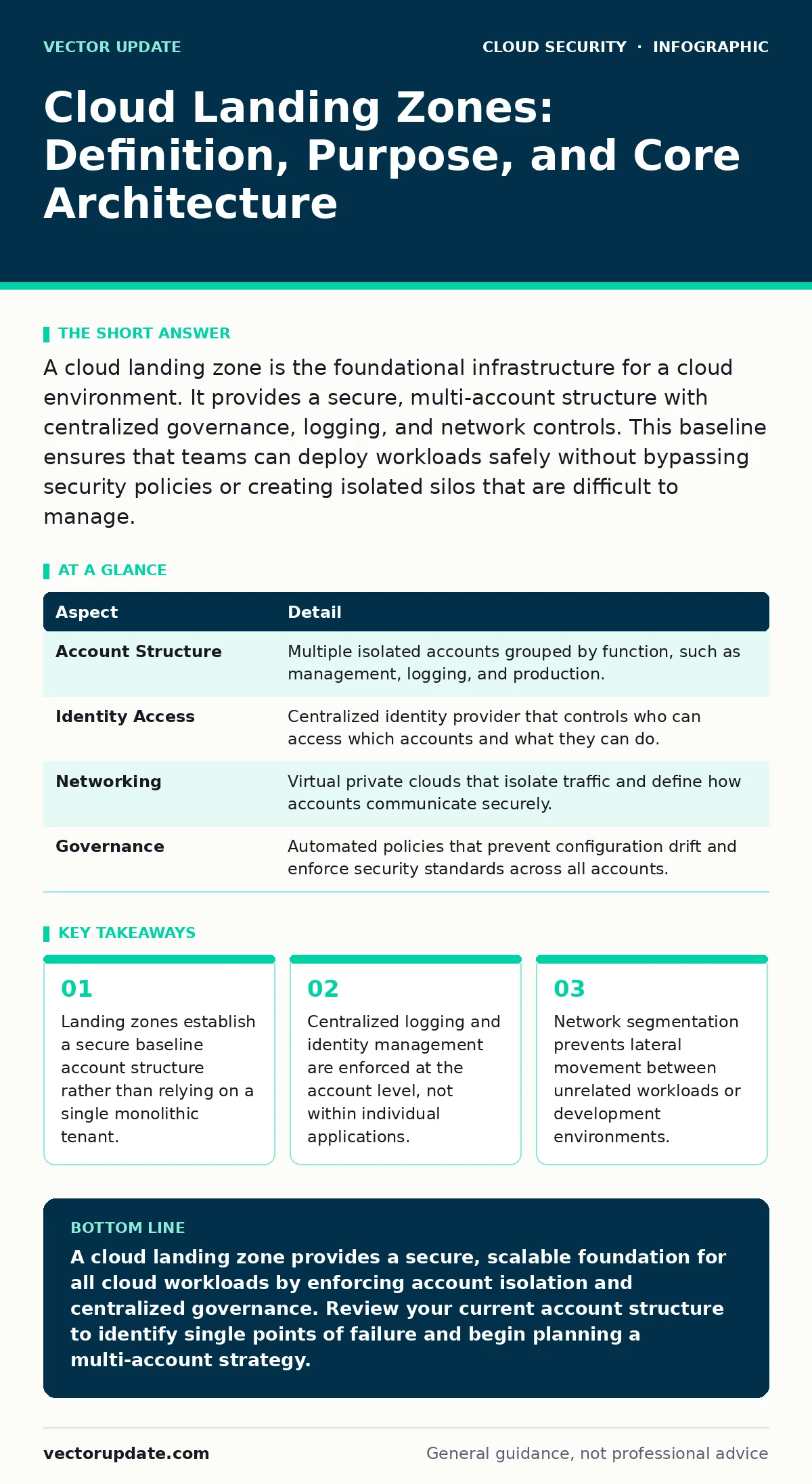
A cloud landing zone is the foundational infrastructure for a cloud environment. It provides a secure, multi-account structure with centralized governance, logging, and network controls. This baseline ensures that teams can deploy workloads safely without bypassing security policies or creating isolated silos that are difficult to manage.
The Digital Campsite Analogy
Imagine organizing a large outdoor festival. You do not let every attendee pitch their tent wherever they please. That creates tripping hazards, blocks emergency exits, and makes it impossible to provide reliable electricity or water. Instead, you designate specific zones. Each zone has pre-laid power cables, water hooks, and clear boundaries. Attendees still choose their tents and decorations, but the underlying infrastructure is safe, predictable, and managed.
A cloud landing zone operates on this same principle. It is the pre-configured environment where your organization begins its cloud journey. It defines the account structure, networking, security baselines, and governance model. You build your applications on top of this foundation, not inside a blank, unstructured cloud account.
The Problem of Unstructured Cloud Accounts
Many organizations start by creating a single cloud account for everything. Developers deploy test environments, production databases, and experimental projects into the same container. This creates a high-risk environment. If one service is compromised, the attacker has immediate access to all other resources in that account.
This monolithic approach also creates operational chaos. You cannot apply different security policies to a public-facing web server and an internal payroll database if they share the same identity and permission scope. You end up with open security groups that grant too much access because you cannot isolate the risk. A landing zone solves this by enforcing separation from day one.
Core Components of the Architecture
A landing zone is not a single product. It is a collection of interconnected services and configurations. The main parts include account structure, identity management, networking, and centralized logging.
| Aspect | Detail |
|---|---|
| Account Structure | Multiple isolated accounts grouped by function, such as management, logging, and production. |
| Identity Access | Centralized identity provider that controls who can access which accounts and what they can do. |
| Networking | Virtual private clouds that isolate traffic and define how accounts communicate securely. |
| Governance | Automated policies that prevent configuration drift and enforce security standards across all accounts. |
Account Structure and Isolation
The most critical part of a landing zone is the account structure. You create separate accounts for different purposes. One account handles management tasks. Another stores logs. Others host specific applications or environments like development and staging.
This isolation limits the blast radius. If an attacker gains control of a development account, they cannot automatically pivot to the production account. They must breach the boundaries between accounts, which are tightly controlled. This structure also simplifies billing and resource tracking, as costs are attributed to specific teams or projects.
Centralized Identity and Access
Identity is the new perimeter. In a cloud environment, you do not protect the network edge as much as you protect the identities that access the cloud. A landing zone integrates with an external identity provider. This means users log in with their corporate credentials, not cloud-specific passwords.
This integration allows you to enforce multi-factor authentication and role-based access control centrally. You define roles that grant the minimum permissions necessary for a task. When an employee leaves, you revoke their access in one place, and they lose access to all cloud accounts immediately. This reduces the risk of orphaned accounts and credential misuse.
See also: Cloud Asset Inventory Mistakes That Leave Data Exposed · Open Security Groups: 6 Myths Blocking Your Cloud Defense
Networking and Data Flow
Networking in a landing zone is designed to be secure by default. You create virtual private clouds that isolate your workloads. Traffic between these networks is filtered and monitored. You do not allow direct internet access to databases or internal services.
Instead, you use private endpoints and proxy servers to control outbound traffic. This prevents data exfiltration and stops compromised servers from calling home to command-and-control servers. The network design ensures that only authorized traffic flows between accounts. This complements cloud firewalls by providing a deeper layer of segmentation that application-level rules cannot achieve alone.
Governance and Policy Automation
Manual configuration does not scale. A landing zone uses automated tools to enforce policies. If a developer tries to create a resource that violates security standards, the system blocks it automatically. This prevents insecure cloud APIs from being exposed and stops the creation of overly permissive access rules.
These policies also ensure consistency. Every new account created in the landing zone inherits the same security baseline. This includes encryption settings, logging configurations, and network rules. You do not have to remind teams to enable cloud encryption or configure cloud logging and monitoring. The landing zone does it for them.
Common Misconceptions and Pitfalls
Many organizations treat the landing zone as a one-time project. They build it, deploy a few applications, and move on. This is a mistake. The cloud environment changes constantly. New services are added, and teams grow. The landing zone must evolve with them.
Another common error is over-engineering the initial design. Trying to accommodate every possible future use case creates a complex, fragile structure. Start with a simple, secure baseline. Add complexity only when you have a specific business need. Also, do not ignore shadow IT. If the landing zone is too difficult to use, teams will bypass it and create their own unmanaged accounts. Make the secure path the easy path.
Integration with Other Defenses
The landing zone is the foundation, but it is not the entire security strategy. It works in tandem with other defenses. For example, it provides the structure for cloud asset inventory, ensuring you know what resources exist and where they are. It supports cloud logging and monitoring by centralizing data collection.
It also mitigates risks like dictionary attacks by enforcing strong identity policies at the account level. However, it does not replace the need for application security or data protection. You still need to secure your code and encrypt your sensitive data. The landing zone ensures that the environment supporting those applications is secure and manageable.
Maintaining the Baseline
Security is a continuous process. You must regularly review your landing zone policies and account structures. Check for configuration drift, where resources deviate from the baseline. Automate remediation where possible.
Train your teams on how to use the landing zone. If they understand why the structure exists, they will respect it. Encourage feedback to improve the user experience. A well-maintained landing zone reduces risk and accelerates development. It gives teams the freedom to innovate within safe boundaries.
Key takeaways
- Landing zones establish a secure baseline account structure rather than relying on a single monolithic tenant.
- Centralized logging and identity management are enforced at the account level, not within individual applications.
- Network segmentation prevents lateral movement between unrelated workloads or development environments.
A cloud landing zone provides a secure, scalable foundation for all cloud workloads by enforcing account isolation and centralized governance. Review your current account structure to identify single points of failure and begin planning a multi-account strategy.
Frequently asked questions
How long does it take to build a cloud landing zone?
The timeline varies based on complexity and organizational size. A basic structure can be deployed in weeks, while a fully automated, enterprise-grade landing zone may take several months to design and implement.
Can I use a landing zone for multiple cloud providers?
Yes, the concept applies to all major cloud providers. However, the specific services and tools used to implement the landing zone will differ between providers. You may need separate landing zones for each cloud environment.
Do I need a landing zone if I only have one application?
Even with a single application, a multi-account structure provides benefits. It isolates management and logging, simplifies security, and prepares you for future growth. Starting with a single account often leads to costly refactoring later.
How does a landing zone help with compliance?
It enforces consistent security controls across all accounts. This makes it easier to audit your environment and prove that you meet regulatory requirements. Centralized logging and identity management are key components of many compliance frameworks.
How this guide was produced: written by the Vector Update editorial team with AI assistance, checked against the public references listed below, and reviewed when the facts change. See our editorial policy or report an error.