Payment Card Theft: Response and Recovery Steps for Systems
Immediate network isolation prevents data exfiltration faster than any forensic analysis or vendor call, limiting the total volume of stolen records before attackers move laterally.
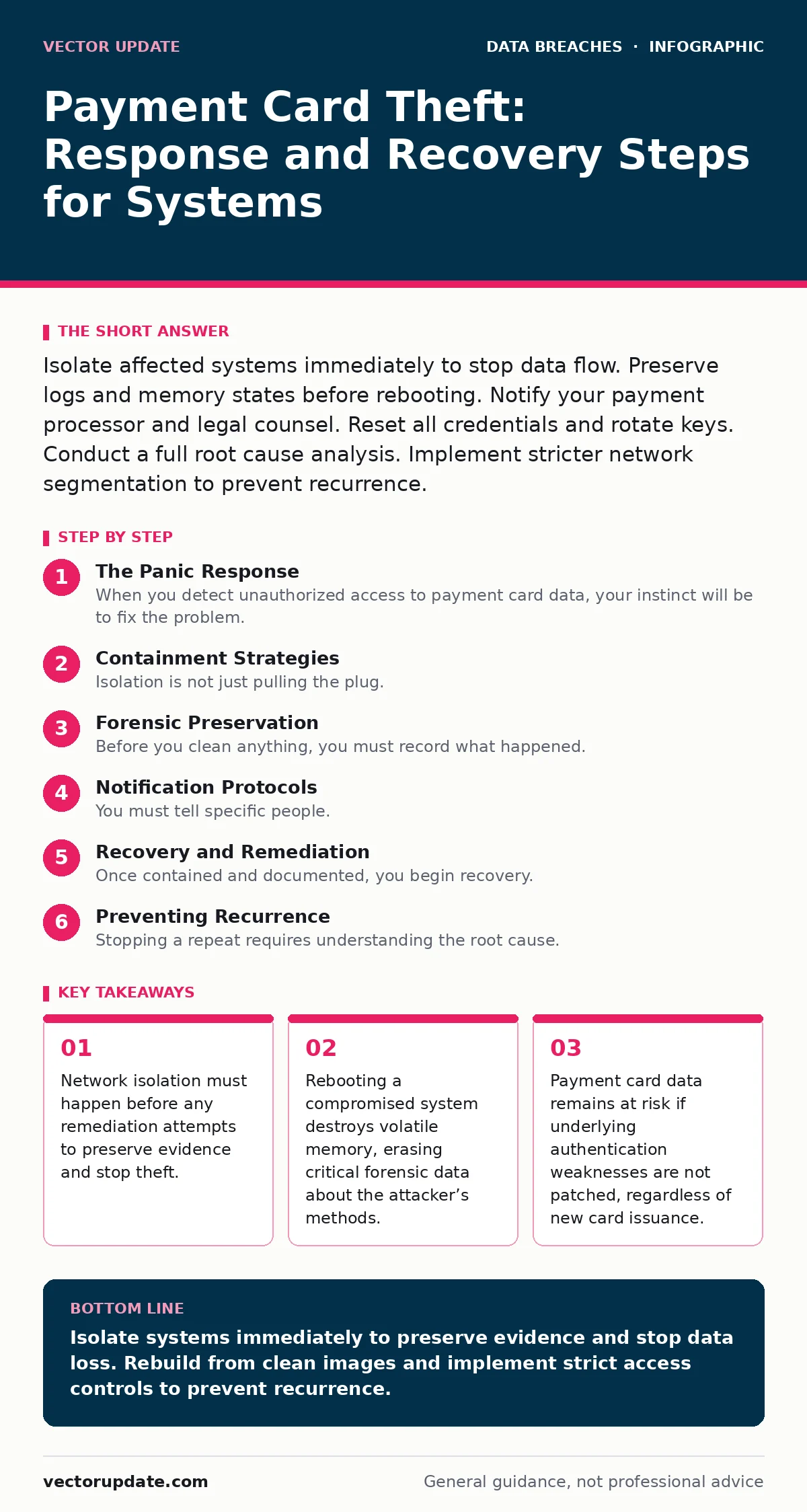
Isolate affected systems immediately to stop data flow. Preserve logs and memory states before rebooting. Notify your payment processor and legal counsel. Reset all credentials and rotate keys. Conduct a full root cause analysis. Implement stricter network segmentation to prevent recurrence.
The Panic Response
When you detect unauthorized access to payment card data, your instinct will be to fix the problem. This instinct is dangerous. Fixing implies changing state, which destroys evidence. Your first goal is not remediation; it is containment. You must stop the bleeding before you can diagnose the wound.
Imagine a breach where attackers are already exfiltrating data. If you reboot servers to "clear" the infection, you wipe the random access memory. RAM holds active process lists, encryption keys, and network connections. Once power cycles, that data is gone. You lose the ability to prove how the attacker entered or what they took.
First Hour Checklist
Execute these steps in order. Do not deviate.
- Disconnect affected systems from the network physically or via firewall rules.
- Disable compromised user accounts and API keys.
- Preserve system logs and memory images for forensic analysis.
- Notify your internal incident response team and legal counsel.
- Contact your payment processor to flag potentially compromised transactions.
Containment Strategies
Isolation is not just pulling the plug. It is surgical. You need to identify the scope. Attackers rarely stay in one place. They move laterally, seeking higher privileges and more data. If you isolate only the infected server, they may be waiting in the database or the backup system.
Use network segmentation to contain the blast radius. This involves dividing your network into smaller zones with strict access controls. If one zone is compromised, the attacker cannot easily move to others. This is a standard practice in network segmentation, but it is often implemented poorly. Many organizations create segments but leave management interfaces open across them.
Check your jump servers and administrative consoles. Attackers often pivot through these trusted systems. If you suspect a breach, assume your administrative credentials are compromised. Do not use them to investigate. Use out-of-band access methods that are not connected to the compromised network.
Forensic Preservation
Before you clean anything, you must record what happened. This is not just for legal reasons. It is to understand the attack vector so you can close it. If you do not know how they got in, they will get in again.
Collect memory dumps from all suspected hosts. Use write-blockers when imaging hard drives to prevent accidental modification. Document every action you take, including timestamps. This chain of custody is vital for any subsequent investigation or insurance claim.
Refer to your guide on cyber insurance to understand what documentation your policy requires. Most policies demand specific forensic reports. If you fail to preserve evidence correctly, you may void your coverage. Do not assume your provider will accept informal notes.
Notification Protocols
You must tell specific people. Not everyone. Too many notifications cause confusion and leak sensitive details. Start with your legal counsel and your payment processor. They will guide you on regulatory requirements.
Regulations like PCI DSS (Payment Card Industry Data Security Standard) mandate specific reporting timelines. Failure to report within these windows can result in heavy fines. Your legal team will determine which authorities need to be notified based on jurisdiction.
Do not announce the breach publicly until you have a clear picture. Premature announcements can cause panic and provide attackers with information about your response capabilities. Coordinate all external communications through a single point of contact.
Recovery and Remediation
Once contained and documented, you begin recovery. This is not just restoring from backups. Backups may be infected. You must verify the integrity of your backup systems before restoring data.
Rebuild affected systems from known-good images. Do not try to clean infected systems. It is nearly impossible to remove all traces of sophisticated malware. Rebuilding ensures a clean slate.
Update all software and firmware. Patch known vulnerabilities. Attackers often exploit unpatched flaws to gain initial access. If you have a guide on data encryption, review it now. Ensure that card data is encrypted at rest and in transit. Encryption does not prevent theft, but it renders stolen data useless without the keys.
See also: Account Takeover Fraud: The Step-by-Step Attack Chain · How Data Encryption Works: The Mechanics and Hidden Limits
Preventing Recurrence
Stopping a repeat requires understanding the root cause. Was it a weak password? A phishing email? A misconfigured cloud storage bucket?
Conduct a full access reviews of your systems. Remove unnecessary privileges. Follow the principle of least privilege. Users should only have access to the data they need to do their jobs.
Implement multi-factor authentication everywhere. This adds a layer of security that passwords alone cannot provide. Even if an attacker steals a password, they cannot log in without the second factor.
Review your monitoring capabilities. Did you detect the breach early? If not, improve your detection rules. Look for anomalies in network traffic and user behavior.
Long-Term Security Posture
Security is not a one-time fix. It is a continuous process. You must constantly evaluate and improve your defenses.
Regularly test your incident response plan. Simulate breaches to find gaps in your procedures. Update your plan based on lessons learned.
Stay informed about new threats. The tactics of attackers evolve. What worked yesterday may not work today. Keep your knowledge current.
Consider the impact of account takeover fraud on your systems. Attackers often target user accounts to gain access to payment data. Strengthen your identity management processes.
Review your digital footprint to minimize exposure. Reduce the amount of information available about your systems online. Less information means fewer targets for attackers.
Key takeaways
- Network isolation must happen before any remediation attempts to preserve evidence and stop theft.
- Rebooting a compromised system destroys volatile memory, erasing critical forensic data about the attacker’s methods.
- Payment card data remains at risk if underlying authentication weaknesses are not patched, regardless of new card issuance.
Isolate systems immediately to preserve evidence and stop data loss. Rebuild from clean images and implement strict access controls to prevent recurrence.
Frequently asked questions
How do I know if my payment card data was actually stolen?
Look for unusual outbound network traffic, especially to unknown IPs. Check for new administrative accounts or modified system files. Forensic analysis is required for confirmation.
Should I notify customers immediately?
Only after legal counsel advises. Premature notification can cause unnecessary panic. Ensure you have a clear remediation plan before communicating with customers.
Can I use antivirus to fix the breach?
No. Antivirus detects known malware. Advanced attackers use custom tools that bypass antivirus. Rebuild systems from clean images instead.
What if I don't have an incident response plan?
Start with immediate isolation and notification. Create a plan post-incident. Use this breach as a catalyst to build a formal response framework.
How this guide was produced: written by the Vector Update editorial team with AI assistance, checked against the public references listed below, and reviewed when the facts change. See our editorial policy or report an error.