How Data Encryption Works: The Mechanics and Hidden Limits
Encryption hides data using mathematical keys, but it fails completely if the encryption key itself is stolen or if the application is tricked into decrypting it prematurely.

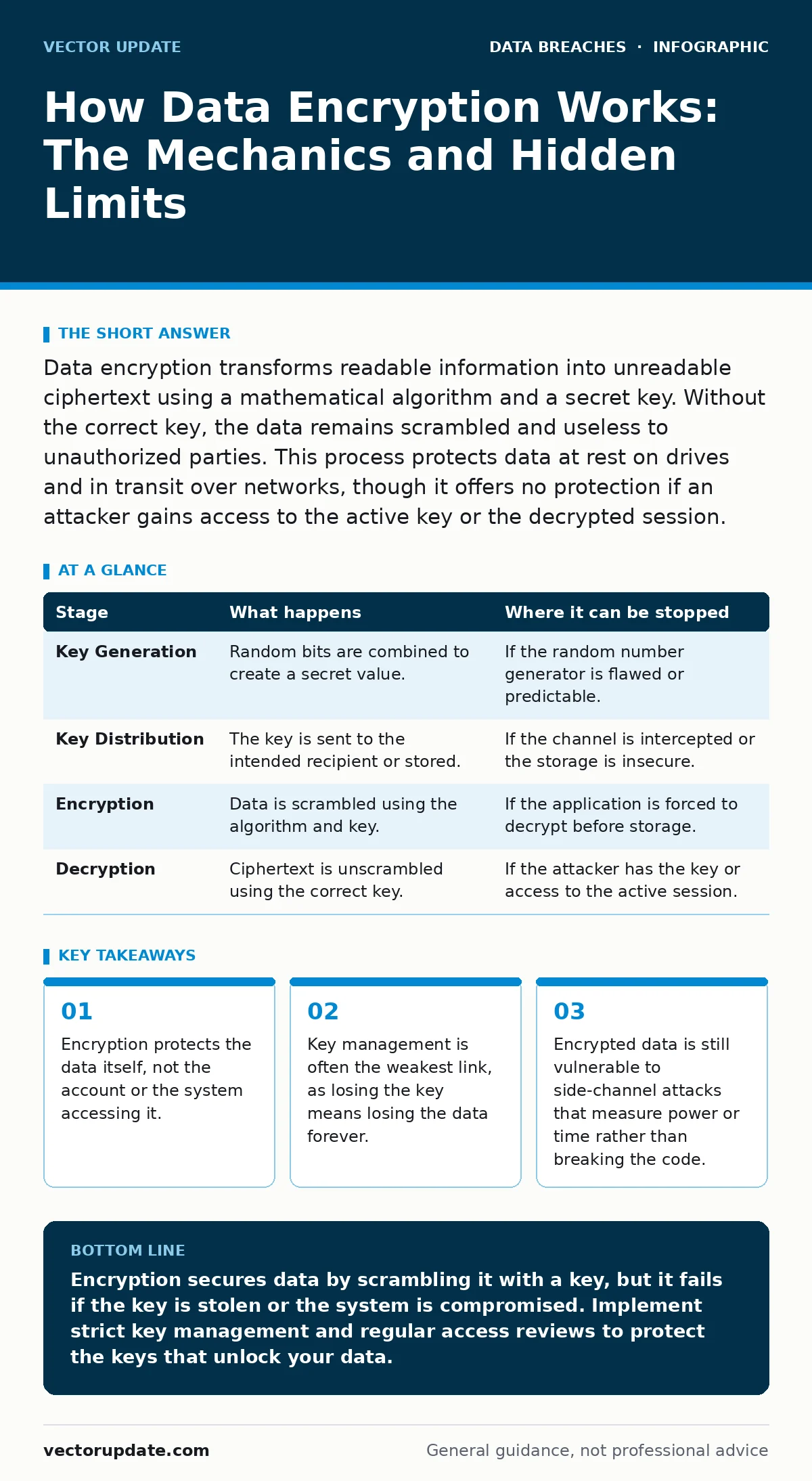
Data encryption transforms readable information into unreadable ciphertext using a mathematical algorithm and a secret key. Without the correct key, the data remains scrambled and useless to unauthorized parties. This process protects data at rest on drives and in transit over networks, though it offers no protection if an attacker gains access to the active key or the decrypted session.
The Core Mechanism of Transformation
Encryption is the process of converting plain text into ciphertext. Plain text is any data that is readable by humans or machines without special processing. Ciphertext is the scrambled output that looks like random noise. This transformation relies on a mathematical function called an algorithm and a secret value called a key. The algorithm defines the steps for scrambling, while the key determines the specific pattern of the scramble. Without the exact key, reversing the process is computationally infeasible for modern algorithms.
You might assume that strong algorithms are enough to secure your data. This is a common misconception. The algorithm is usually public and has been tested by thousands of cryptographers. The security rests entirely on the secrecy and strength of the key. If an attacker obtains the key, the algorithm becomes irrelevant. This is why key management is often more critical than the choice of encryption standard.
### Stage 1: Key Generation and Distribution
The process begins with the creation of cryptographic keys. In symmetric encryption, a single key is used for both encrypting and decrypting data. In asymmetric encryption, a pair of keys is generated: a public key for encryption and a private key for decryption. The private key must remain secret, while the public key can be shared openly. The strength of these keys depends on their length and randomness. Short keys or keys generated with predictable patterns are vulnerable to brute-force attacks.
Imagine you are setting up a secure communication channel. You generate a key pair on your server. The private key stays on the server, never leaving the hardware. The public key is sent to the client. This separation ensures that even if the transmission is intercepted, the attacker cannot decrypt the incoming messages. However, if the server is compromised and the private key is extracted, the entire system fails. This is why hardware security modules are often used to store private keys.
| Stage | What happens | Where it can be stopped |
|---|---|---|
| Key Generation | Random bits are combined to create a secret value. | If the random number generator is flawed or predictable. |
| Key Distribution | The key is sent to the intended recipient or stored. | If the channel is intercepted or the storage is insecure. |
| Encryption | Data is scrambled using the algorithm and key. | If the application is forced to decrypt before storage. |
| Decryption | Ciphertext is unscrambled using the correct key. | If the attacker has the key or access to the active session. |
### Stage 2: The Encryption Process
Once the keys are ready, the data undergoes transformation. The algorithm takes the plain text and the key as inputs. It applies a series of mathematical operations, such as substitution and permutation, to produce the ciphertext. The size of the ciphertext is usually similar to the original data, though some modes add padding. This padding ensures that the input fits the block size required by the algorithm. The output is meaningless without the key.
This step is often automated by the operating system or the application. You do not see the scrambling happening. It occurs in memory before the data is written to disk or sent over the network. This automation reduces the risk of human error but also hides the process from casual inspection. If the application has a bug, it might log the plain text before encryption. This is a frequent source of leaks.
### Stage 3: Storage and Transmission
Encrypted data is now safe to store or transmit. On disk, it appears as random bytes. On the network, it travels in encrypted packets. The storage medium does not need to be secure because the data is already protected. Similarly, the network path does not need to be private because the packets cannot be read by intermediaries. This allows you to store sensitive information on untrusted cloud servers or send it over public Wi-Fi.
However, the metadata often remains visible. An attacker can see who is communicating with whom, when, and how much data is being transferred. This information can be used to infer the nature of the communication. For example, large data transfers at specific times might indicate backup activities or exfiltration. This is why encryption does not provide anonymity. It only provides confidentiality.
### Stage 4: Decryption and Access
When authorized access is needed, the reverse process occurs. The recipient uses the correct key to decrypt the ciphertext. The algorithm applies the inverse operations to restore the original plain text. This happens in memory, where the data is readable and usable. Once the process is complete, the key must be cleared from memory to prevent extraction. This is known as key wiping.
If the key remains in memory, an attacker with access to the system can dump the memory and extract the key. This is a significant risk for servers handling large volumes of encrypted data. The window of vulnerability is the time between decryption and key wiping. Minimizing this window reduces the risk of key extraction. This is why high-security systems often use hardware to handle decryption, keeping the key out of the main memory.
See also: Account Takeover Fraud: The Step-by-Step Attack Chain · Map Your Digital Footprint to Stop Silent Data Loss
The Limits of Encryption
Encryption is not a silver bullet. It protects data from being read, but it does not protect the system that holds the keys. If an attacker compromises the server, they can decrypt the data in real-time. They do not need to break the encryption. They just need to wait for the system to do it for them. This is why endpoint protection is critical. It prevents the initial compromise that leads to key exposure.
Another limit is the human factor. Users often share keys or write them down. They might use weak passwords to protect the key container. This defeats the purpose of strong encryption. You must enforce strong authentication and limit access to keys. Regular access reviews can help identify unnecessary permissions. If an employee leaves, their access to keys must be revoked immediately.
Managing the Trade-offs
Strong encryption adds computational overhead. Encrypting and decrypting data takes processing power and time. This can slow down systems, especially those handling large volumes of data. You must balance security with performance. Using hardware acceleration can help, but it adds cost. You must also consider the complexity of key management. Losing a key means losing the data forever. There is no backdoor.
This is why data backup strategies must include key backups. If you lose both the data and the key, the data is gone. This risk is often overlooked. Organizations focus on protecting the data but forget to protect the keys that unlock it. You need a secure, redundant key management system. This system should allow for key rotation, which replaces old keys with new ones periodically. This limits the damage if a key is compromised.
Related Security Practices
Encryption works best when combined with other security measures. For instance, if source code is leaked, attackers might find hard-coded keys or weak implementations. This is why leaked source code is a serious threat. You must audit your code for security flaws. Similarly, account takeover fraud can give attackers access to the systems that manage the keys. Strong authentication is necessary to prevent this.
You should also consider your digital footprint. Even if the data is encrypted, the metadata can reveal sensitive information. Minimizing the data you collect and store reduces the risk. This is known as data minimization. It complements encryption by reducing the attack surface. Finally, remember that cyber insurance often requires specific security controls. Encryption is usually one of them. Ensure your implementation meets the policy requirements.
Key takeaways
- Encryption protects the data itself, not the account or the system accessing it.
- Key management is often the weakest link, as losing the key means losing the data forever.
- Encrypted data is still vulnerable to side-channel attacks that measure power or time rather than breaking the code.
Encryption secures data by scrambling it with a key, but it fails if the key is stolen or the system is compromised. Implement strict key management and regular access reviews to protect the keys that unlock your data.
Frequently asked questions
Does encryption prevent data breaches?
Encryption prevents the data from being readable if stolen, but it does not prevent the breach itself. Attackers can still access encrypted data if they compromise the system.
What is the difference between symmetric and asymmetric encryption?
Symmetric encryption uses one key for both encrypting and decrypting. Asymmetric encryption uses a pair of keys: one public and one private. Asymmetric is better for key exchange, while symmetric is faster for data encryption.
Can encrypted data be decrypted without the key?
With modern algorithms, it is computationally infeasible. However, if the implementation is flawed or the key is weak, it might be possible. Side-channel attacks can also bypass the need to break the algorithm.
How often should I rotate encryption keys?
You should rotate keys regularly, especially if there is a suspicion of compromise. The frequency depends on the sensitivity of the data and the risk environment. Annual rotation is a common baseline for many systems.
How this guide was produced: written by the Vector Update editorial team with AI assistance, checked against the public references listed below, and reviewed when the facts change. See our editorial policy or report an error.