Account Takeover Fraud: The Step-by-Step Attack Chain
Attackers rarely break encryption; they exploit the gap between authentication success and session validation to hijack active user contexts.

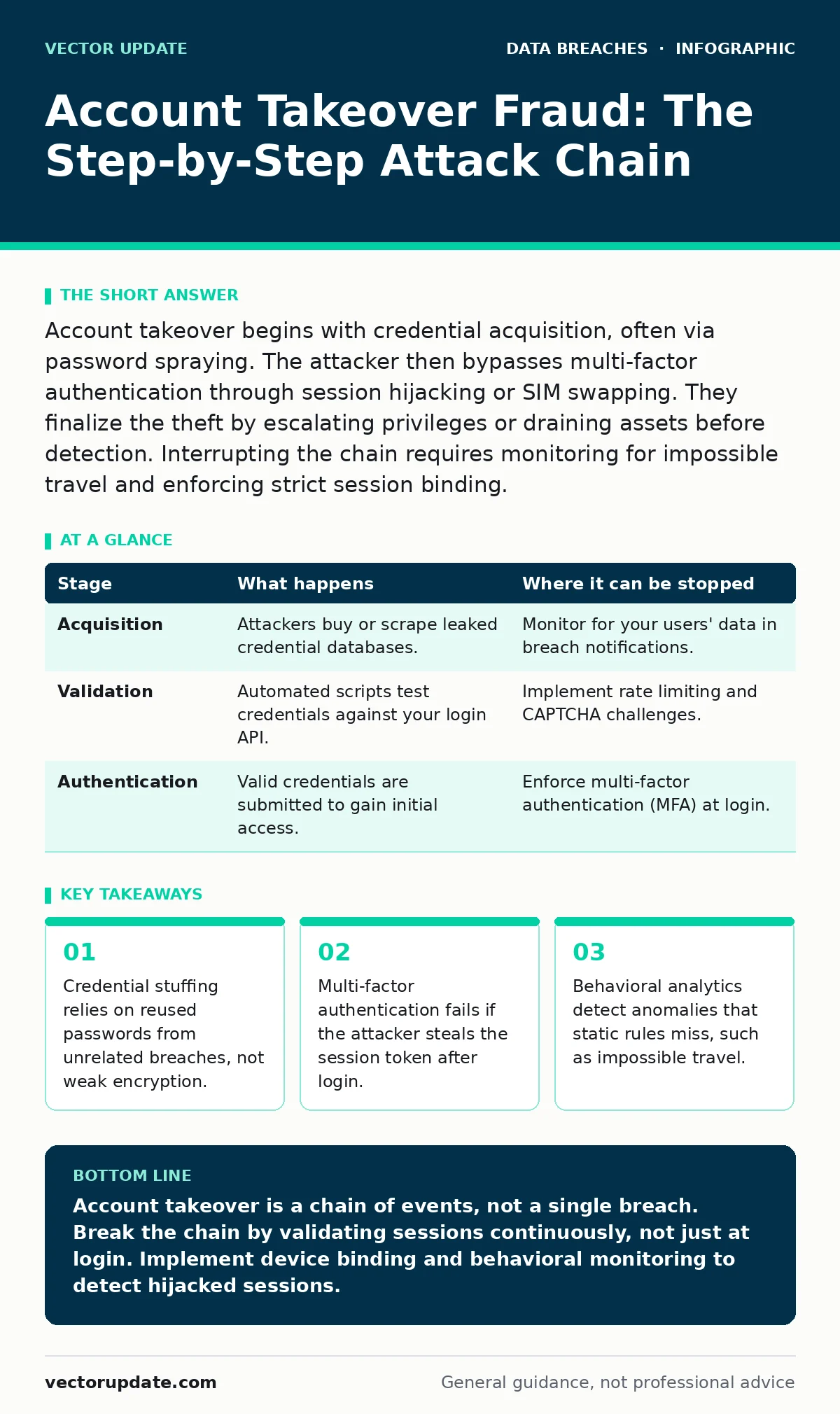
Account takeover begins with credential acquisition, often via password spraying. The attacker then bypasses multi-factor authentication through session hijacking or SIM swapping. They finalize the theft by escalating privileges or draining assets before detection. Interrupting the chain requires monitoring for impossible travel and enforcing strict session binding.
The Credential Harvesting Phase
The attack begins long before the target account is touched. Threat actors do not typically guess passwords from scratch. They rely on the fact that users reuse credentials across multiple services. When one service suffers a data breach, the stolen username and password pairs are sold on underground markets.
Attackers use these lists to attempt logins on your systems. This is known as credential stuffing. It is distinct from brute force attacks because it uses known valid combinations rather than random guesses. The mechanism relies on the absence of cross-service password rotation policies.
You might assume that requiring complex passwords stops this. It does not. A complex password is useless if it is the same password used on a forum that was compromised years ago. The flaw here is human habit, not cryptographic weakness.
Stage 1: Credential Acquisition and Validation
The attacker automates the process of testing millions of credential pairs against your login endpoint. They use residential proxies to mimic legitimate traffic, avoiding IP-based blocks. The goal is to find a single valid match.
| Stage | What happens | Where it can be stopped |
|---|---|---|
| Acquisition | Attackers buy or scrape leaked credential databases. | Monitor for your users' data in breach notifications. |
| Validation | Automated scripts test credentials against your login API. | Implement rate limiting and CAPTCHA challenges. |
| Authentication | Valid credentials are submitted to gain initial access. | Enforce multi-factor authentication (MFA) at login. |
The Authentication Bypass
Once valid credentials are found, the attacker faces a barrier: multi-factor authentication. MFA requires a second proof of identity, such as a code sent to a phone. Many administrators believe MFA prevents account takeover. This is a dangerous misconception.
MFA protects the login event, not the session. If an attacker can intercept the second factor, or if they can steal the session after the user has already passed MFA, the protection is bypassed. This is where the attack shifts from credential theft to session manipulation.
Stage 2: Second-Factor Interception
Attackers have several methods to bypass the second factor. One common method is SIM swapping. They trick a mobile carrier into transferring the victim's phone number to a SIM card the attacker controls. The text message containing the MFA code goes to the attacker instead.
Another method is man-in-the-middle attacks. The attacker hosts a fake login page that mirrors your real one. When the user enters their credentials and the MFA code, the attacker forwards them to your real server in real-time. The attacker captures the session cookie returned by your server. The user sees a successful login, but the attacker now holds the active session token.
Session Hijacking and Persistence
The most critical insight for system administrators is that authentication is a point-in-time event. Authorization is continuous. Most systems verify the user at login but trust the session token for subsequent requests. This trust is the vulnerability.
Attackers do not need to log in again once they have the session token. They simply replay the token in their HTTP headers. To your server, this looks like a normal request from an authenticated user. The server does not re-challenge the MFA because the session is already established.
Stage 3: Session Token Theft
This stage relies on the lack of session binding. Your system should bind the session to the device fingerprint, IP address, or TLS certificate. If it does not, the token is portable. The attacker can use it from a different location, browser, or device.
Imagine a user logs in from their office. They receive an MFA code and enter it. The server issues a session token. The attacker, running a proxy, captures this token. The user continues working. The attacker uses the token from a server in another country. Your server sees a valid token and grants access. It does not see the change in geolocation because it does not validate the session context on every request.
| Stage | What happens | Where it can be stopped |
|---|---|---|
| Interception | Attacker captures MFA code or session token. | Use phishing-resistant MFA like FIDO2/WebAuthn. |
| Hijacking | Attacker replays the token to start a new session. | Bind sessions to device fingerprints or TLS certs. |
| Persistence | Attacker maintains access via refresh tokens. | Invalidate all sessions on sensitive actions. |
Privilege Escalation and Data Extraction
With active access, the attacker moves quickly. They know their access may be short-lived. They prioritize actions that are irreversible or high-value. They may change the email address on the account to lock out the legitimate user. This is a common first step.
They may also add a new recovery phone number or generate API keys. These actions allow them to maintain access even if the original password is changed. The attacker is not just stealing data; they are stealing the identity of the account.
Stage 4: Asset Transfer and Covering Tracks
The final stage involves extracting value. In financial accounts, this is direct money transfer. In corporate accounts, it is data exfiltration. The attacker downloads sensitive files or copies customer databases. They may also use the account to send spam or phishing emails to the user's contacts, leveraging the trust relationship.
To avoid detection, they may clear browser history on their end or use automated tools that mimic human typing speeds. However, they often leave digital footprints in the form of unusual API calls or access from new devices.
Interrupting the Chain
You can interrupt this process at several points. The most effective defense is not stronger passwords, but better session management. Implement strict session binding. Tie the session token to the specific device and browser characteristics. If the characteristics change, invalidate the token.
Use behavioral analytics to detect impossible travel. If a user logs in from New York and then makes a transaction from London five minutes later, block the action. This requires logging and analyzing user behavior patterns. It is more complex than static rules but far more effective.
Consider the role of password spraying in this context. Attackers often try one common password against many users. Your defenses must detect this pattern. If one password fails ten times against different users, block that password globally for a period.
See also: How Data Encryption Works: The Mechanics and Hidden Limits · Map Your Digital Footprint to Stop Silent Data Loss
The Hidden Cost of Convenience
The trade-off in account security is always between convenience and friction. Every additional step you add to the login process increases the chance of user error. Users will write down passwords or reuse them if the process is too cumbersome.
However, the cost of an account takeover is far higher. It includes data loss, regulatory fines, and reputational damage. You must balance these factors. Do not rely on users to secure their accounts. Build security into the system architecture.
Review your access reviews regularly. Ensure that dormant accounts are disabled. Attackers often target accounts that are active but rarely used by the legitimate owner. These accounts have fewer eyes on them and are easier to compromise without immediate detection.
Key takeaways
- Credential stuffing relies on reused passwords from unrelated breaches, not weak encryption.
- Multi-factor authentication fails if the attacker steals the session token after login.
- Behavioral analytics detect anomalies that static rules miss, such as impossible travel.
Account takeover is a chain of events, not a single breach. Break the chain by validating sessions continuously, not just at login. Implement device binding and behavioral monitoring to detect hijacked sessions.
Frequently asked questions
Does multi-factor authentication stop account takeover?
MFA stops credential stuffing but does not prevent session hijacking or SIM swapping. It protects the login event, not the ongoing session.
How do I detect if my session is hijacked?
Monitor for impossible travel, new device logins, and sudden changes to account settings like email or recovery numbers.
Is changing passwords enough to stop an attacker?
No. If the attacker has changed the recovery email or generated API keys, changing the password does not remove their access.
What is the difference between credential stuffing and password spraying?
Credential stuffing uses many passwords for one user. Password spraying uses one password for many users. Both rely on reused credentials.
How this guide was produced: written by the Vector Update editorial team with AI assistance, checked against the public references listed below, and reviewed when the facts change. See our editorial policy or report an error.