How Advanced Persistent Threats Move: Step-by-Step Breakdown
Attackers often hide in plain sight by mimicking legitimate traffic, making detection depend on behavioral anomalies rather than signature matching alone.

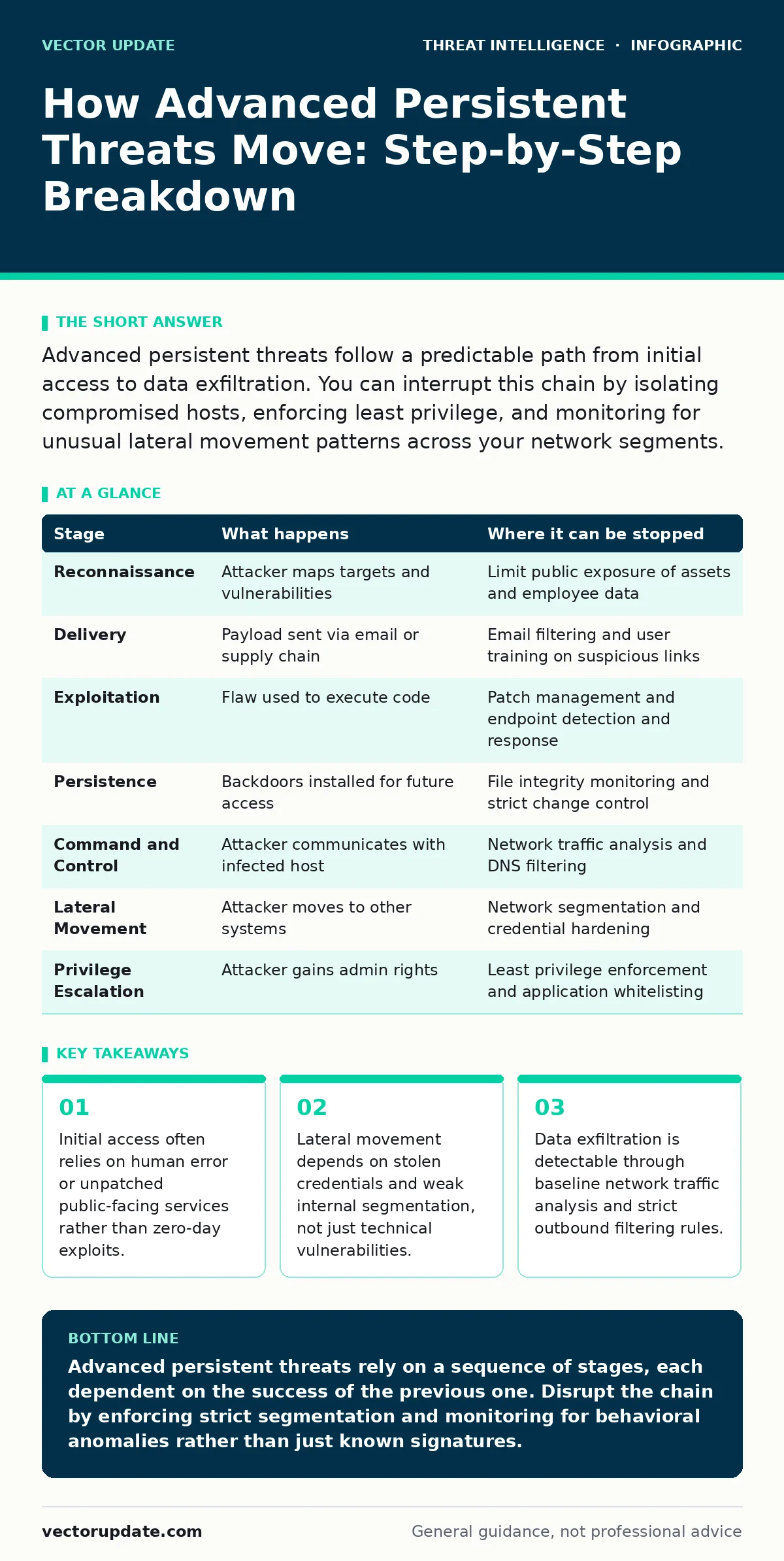
Advanced persistent threats follow a predictable path from initial access to data exfiltration. You can interrupt this chain by isolating compromised hosts, enforcing least privilege, and monitoring for unusual lateral movement patterns across your network segments.
The Anatomy of Long-Term Intrusion
Advanced persistent threats represent a specific class of intrusion characterized by patience and resourcefulness. Unlike opportunistic malware that strikes quickly and loudly, these operations prioritize stealth and longevity. The attacker seeks to remain undetected for months or even years while gathering intelligence or disrupting operations. Understanding the mechanics of this lifecycle allows you to identify weak points in your defense strategy. You do not need to stop every attempt, but you must disrupt the flow before the objective is met.
Stage 1: Reconnaissance and Weaponization
The process begins long before any packet hits your firewall. The attacker identifies high-value targets and maps out the organization’s digital footprint. They look for exposed services, employee social media profiles, and technology stacks. This phase relies on open-source intelligence and passive scanning techniques. Once a target is selected, the attacker creates a weaponized payload. This might be a malicious document, a compromised software update, or a tailored phishing kit. The goal is to craft an entry method that bypasses automated defenses while appearing legitimate to the recipient.
Stage 2: Initial Delivery and Exploitation
The attacker delivers the weaponized payload through a chosen channel. Email remains the most common vector, but supply chain compromises are increasingly prevalent. When the user interacts with the payload, the exploitation phase triggers. The exploit takes advantage of a flaw in the software or operating system to execute code. This step relies on the victim having an outdated version of a program or a misconfigured security setting. If the exploit fails, the attacker may try again with a different vector. Success grants the attacker a foothold, but only temporary access to a single endpoint.
Stage 3: Installation and Persistence
Having gained entry, the attacker must ensure they can return if the system reboots or the initial connection drops. They install backdoors and modify system configurations to maintain access. This stage relies on finding privileged accounts or exploiting weaknesses in update mechanisms. The attacker might create a new user account, modify startup scripts, or install a rootkit. A rootkit is software that hides the presence of other software from the operating system. Persistence mechanisms are often designed to mimic legitimate system processes. Detecting these changes requires monitoring for unauthorized modifications to critical system files.
Stage 4: Command and Control
The compromised host must communicate with the attacker to receive instructions and send back data. This communication channel is known as command and control, or C2. The attacker uses this link to manage the infection and coordinate further actions. Modern C2 channels often hide within legitimate traffic protocols like DNS or HTTPS. This technique, called domain generation algorithms or fast-flux DNS, makes the traffic look like normal web browsing. The attacker relies on the difficulty of distinguishing between legitimate and malicious encrypted traffic. Monitoring for unusual beaconing intervals or connections to unknown domains is key to disrupting this stage.
See also: Intrusion Detection Systems Best Practices for Network Security · Intrusion Prevention Systems: How IPS Blocks Threats in Real Time
Stage 5: Lateral Movement
With a foothold established, the attacker expands their reach within the network. They move from the initial compromised host to other systems that hold more valuable data or provide greater control. This stage relies heavily on credential theft and weak network segmentation. The attacker might use pass-the-hash techniques, where they reuse captured password hashes to authenticate to other machines. They also exploit trust relationships between servers and workstations. If your network is flat, meaning there are no internal barriers, the attacker can move freely. Implementing micro-segmentation limits the blast radius of a compromise.
Stage 6: Privilege Escalation
Access to a standard user account is rarely enough to achieve the attacker’s goals. They need administrative rights to access sensitive databases or modify security controls. Privilege escalation attacks exploit flaws in how the operating system handles permissions. This might involve exploiting a vulnerability in a local service or abusing misconfigured group policies. The attacker relies on the principle of least privilege not being enforced. If every user has admin rights, this stage becomes trivial. Restricting administrative access to specific, monitored accounts adds a significant hurdle.
Stage 7: Actions on Objectives
The final stage is where the attacker achieves their goal. This could be data exfiltration, system disruption, or the installation of destructive malware. The attacker collects the targeted data and transfers it off the network. This process often involves compressing and encrypting the data to avoid detection by content inspection tools. The attacker relies on the volume of normal outbound traffic to mask their activities. Large data transfers to unusual destinations or at odd hours are strong indicators of this stage. Blocking unauthorized outbound connections and monitoring for large data spikes can stop the final theft.
| Stage | What happens | Where it can be stopped |
|---|---|---|
| Reconnaissance | Attacker maps targets and vulnerabilities | Limit public exposure of assets and employee data |
| Delivery | Payload sent via email or supply chain | Email filtering and user training on suspicious links |
| Exploitation | Flaw used to execute code | Patch management and endpoint detection and response |
| Persistence | Backdoors installed for future access | File integrity monitoring and strict change control |
| Command and Control | Attacker communicates with infected host | Network traffic analysis and DNS filtering |
| Lateral Movement | Attacker moves to other systems | Network segmentation and credential hardening |
| Privilege Escalation | Attacker gains admin rights | Least privilege enforcement and application whitelisting |
| Actions on Objectives | Data stolen or systems destroyed | Outbound firewall rules and data loss prevention |
Disrupting the Cycle
You cannot prevent every reconnaissance effort, but you can make the subsequent stages difficult and noisy. The key is to assume breach and design your defenses accordingly. Focus on visibility and segmentation. If you can see what is happening on your network, you can respond. If you can limit where an attacker can go, you can contain the damage. Regularly review your cloud asset inventory to ensure no hidden entry points exist. Understanding the Unified Kill Chain helps you map your controls to each stage. By interrupting the flow at any point, you render the entire operation a failure.
Key takeaways
- Initial access often relies on human error or unpatched public-facing services rather than zero-day exploits.
- Lateral movement depends on stolen credentials and weak internal segmentation, not just technical vulnerabilities.
- Data exfiltration is detectable through baseline network traffic analysis and strict outbound filtering rules.
Advanced persistent threats rely on a sequence of stages, each dependent on the success of the previous one. Disrupt the chain by enforcing strict segmentation and monitoring for behavioral anomalies rather than just known signatures.
Frequently asked questions
How long do attackers typically stay in a network before detection?
Detection times vary widely, but attackers often remain undetected for months while they slowly expand their access and gather data.
Can firewalls stop advanced persistent threats?
Traditional firewalls block unauthorized inbound connections but often miss outbound command and control traffic or lateral movement within the network.
What is the difference between an APT and ransomware?
Ransomware aims for immediate financial gain through encryption, while APTs focus on long-term access for espionage or strategic disruption.
How do I detect lateral movement?
Monitor for unusual login patterns, such as a user accessing multiple servers at once or logging in from unexpected locations.
How this guide was produced: written by the Vector Update editorial team with AI assistance, checked against the public references listed below, and reviewed when the facts change. See our editorial policy or report an error.