XDR FAQ: How Extended Detection and Response Actually Works
Extended detection and response unifies siloed security data to correlate threats that single-point tools miss, but it demands significant storage and tuning overhead.

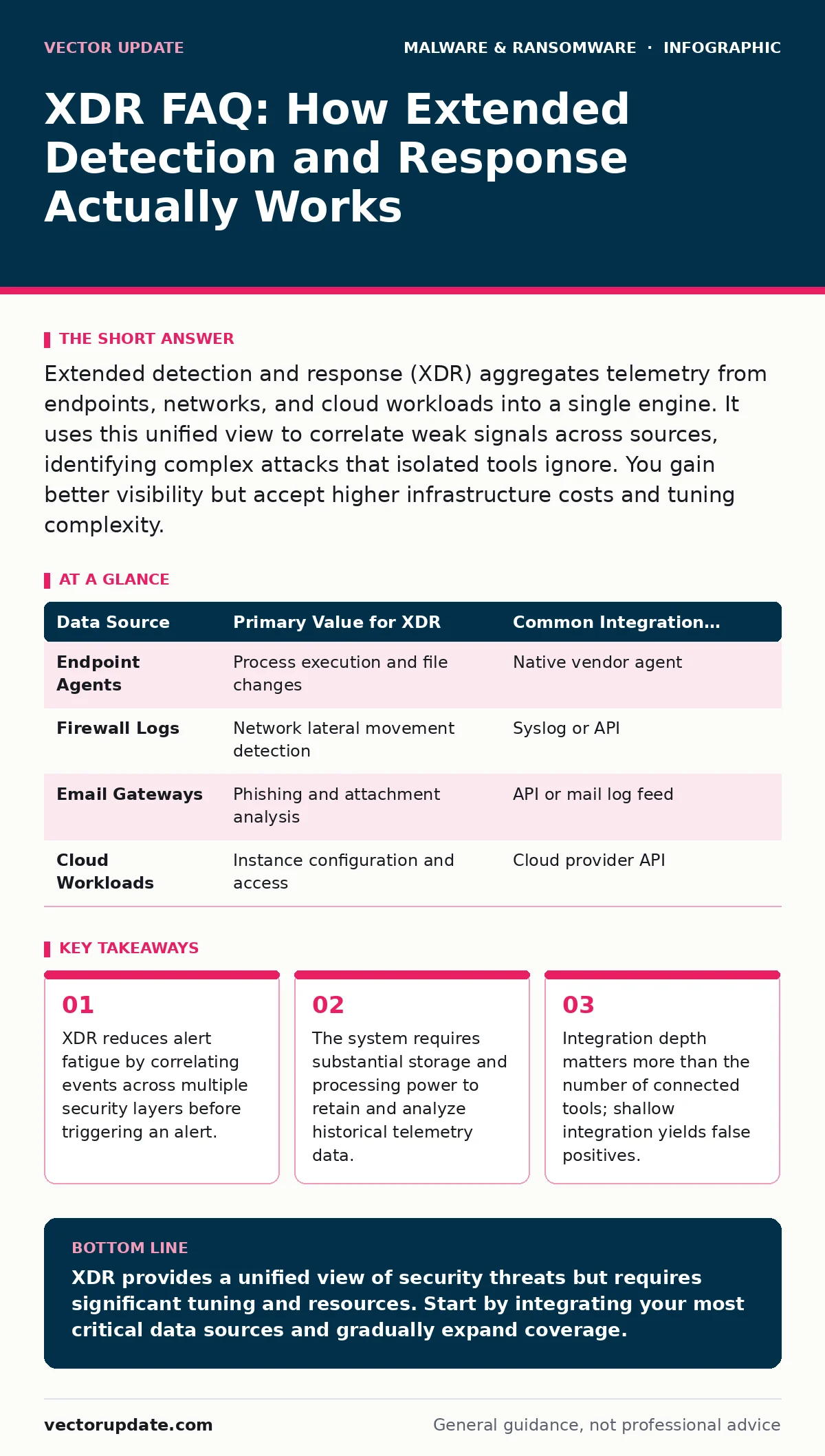
Extended detection and response (XDR) aggregates telemetry from endpoints, networks, and cloud workloads into a single engine. It uses this unified view to correlate weak signals across sources, identifying complex attacks that isolated tools ignore. You gain better visibility but accept higher infrastructure costs and tuning complexity.
What exactly is extended detection and response?
Extended detection and response is a unified security architecture that ingests data from endpoints, networks, servers, and cloud environments. Unlike point solutions that watch one layer, XDR correlates signals across all these sources. It identifies attack patterns that span multiple vectors, which isolated tools often miss.
How does XDR differ from endpoint detection and response?
Endpoint detection and response focuses solely on individual devices like laptops and servers. XDR expands this scope to include network traffic, email gateways, and identity logs. This broader view allows you to see how an initial compromise on a laptop spreads to the network.
Why do organizations choose XDR over traditional antivirus?
Traditional antivirus relies on known signatures to block malware. XDR uses behavioral analysis and telemetry correlation to detect unknown threats. It can identify suspicious activity even when no specific malware signature exists. This is particularly useful against novel attack methods.
What data sources does XDR typically connect?
XDR platforms integrate with endpoint agents, firewall logs, email security gateways, and cloud infrastructure logs. Some vendors build their own agents, while others use APIs to pull data from third-party tools. The depth of integration determines how well the system correlates events.
| Data Source | Primary Value for XDR | Common Integration Method |
|---|---|---|
| Endpoint Agents | Process execution and file changes | Native vendor agent |
| Firewall Logs | Network lateral movement detection | Syslog or API |
| Email Gateways | Phishing and attachment analysis | API or mail log feed |
| Cloud Workloads | Instance configuration and access | Cloud provider API |
How does XDR reduce alert fatigue?
Isolated tools generate alerts for every suspicious event, creating noise. XDR correlates these events into single incidents. For example, a failed login followed by a successful one and a file download becomes one incident. This reduces the number of alerts you must investigate.
See also: Business Continuity Mistakes: Why Your Plan Fails in a Crisis · Android Malware Removal: 7 Mistakes That Leave Threats Behind
What are the hidden costs of implementing XDR?
XDR requires significant storage and compute resources to process correlated data. You may need to upgrade your logging infrastructure or cloud storage. Tuning the correlation rules also demands skilled staff time. Poor tuning leads to false positives or missed threats.
Does XDR replace identity and access management?
No, XDR does not replace identity and access management solutions. It uses identity logs as one input for detection. Identity tools manage who has access; XDR monitors how that access is used. They serve different functions but work together effectively.
How does XDR handle cloud-native threats?
XDR platforms analyze cloud workload telemetry, including API calls and container activities. They detect misconfigurations and unauthorized access attempts in cloud environments. This helps you identify threats that traditional network tools cannot see. For deeper protection, consider how cloud encryption fits into your overall strategy.
What is the role of automation in XDR?
Automation allows XDR to respond to threats without human intervention. It can isolate infected endpoints, block malicious IPs, or disable compromised accounts. This speeds up containment but requires careful rule configuration. Automated actions must align with your business continuity planning to avoid disrupting operations.
How does XDR impact system performance?
XDR agents consume CPU, memory, and disk I/O on endpoints. Heavy telemetry collection can slow down devices, especially older hardware. You must balance data collection depth with system performance. Throttling data intake can reduce impact but may lower detection accuracy.
Can XDR detect fileless malware?
Yes, XDR detects fileless malware by analyzing process behavior and memory execution. Fileless malware runs in memory without writing files to disk. XDR correlates memory activity with network connections and user behavior. This helps identify threats that evade traditional signature-based detection.
What skills are needed to manage XDR?
Managing XDR requires skills in data analysis, network security, and incident response. You need to understand how to tune correlation rules and investigate complex incidents. Training staff on the specific platform is necessary. The role shifts from simple alert triage to deep forensic analysis.
How does XDR integrate with threat intelligence?
XDR platforms ingest threat intelligence feeds to enrich their data. This helps identify known malicious indicators in your telemetry. It also helps prioritize alerts based on external threat context. Integration ensures you are comparing your data against current global threat trends.
What happens if XDR misses a threat?
No detection system is perfect. XDR may miss threats that do not generate sufficient telemetry or that mimic normal behavior. You must maintain other security controls and monitoring. Regular red team exercises help identify gaps in your XDR coverage. For mobile-specific risks, review guides on malicious mobile apps or removing malware from an Android phone.
How does XDR handle false positives?
False positives occur when XDR incorrectly flags benign activity as malicious. Tuning correlation rules reduces this noise. You can whitelist known good behaviors and adjust sensitivity thresholds. Regular review of alerts helps refine the system over time.
Is XDR suitable for small organizations?
XDR can be suitable for small organizations if they use cloud-based versions. These versions offload the storage and processing costs. However, small teams may lack the staff to tune and manage the system. Consider the operational overhead before implementation.
How does XDR compare to security orchestration, automation and response?
Security orchestration, automation and response (SOAR) focuses on automating response workflows. XDR focuses on detection and correlation across data sources. They are complementary; XDR detects the threat, and SOAR automates the response. Many modern platforms combine both functions.
What are the limitations of XDR?
XDR depends on the quality and completeness of ingested data. If a source is not integrated, XDR cannot correlate events from it. It also requires significant tuning to avoid alert fatigue. It does not replace the need for strong identity management or network segmentation.
How does XDR help with ransomware detection?
Ransomware often involves multiple stages: initial access, lateral movement, and encryption. XDR correlates these stages across endpoints and networks. It can detect the early stages before encryption begins. This allows you to isolate systems and prevent data loss. For broader strategies, see guides on business continuity planning.
What is the future of XDR?
XDR platforms are increasingly incorporating artificial intelligence for anomaly detection. They are also expanding to include more cloud and identity data sources. The focus is shifting from detection to automated remediation. Expect tighter integration with other security tools in the future.
Key takeaways
- XDR reduces alert fatigue by correlating events across multiple security layers before triggering an alert.
- The system requires substantial storage and processing power to retain and analyze historical telemetry data.
- Integration depth matters more than the number of connected tools; shallow integration yields false positives.
XDR provides a unified view of security threats but requires significant tuning and resources. Start by integrating your most critical data sources and gradually expand coverage.
Frequently asked questions
Does XDR replace a SIEM?
XDR and SIEM serve different purposes. XDR focuses on correlation and response, while SIEM focuses on log aggregation and compliance. Many organizations use both.
How much storage does XDR need?
Storage needs vary based on data volume and retention policies. Cloud-based XDR handles storage, while on-premise versions require significant disk space.
Can XDR detect insider threats?
XDR can detect insider threats by correlating user behavior with access logs. It identifies anomalies in user activity that may indicate malicious intent.
Is XDR effective against nation-state cyber attacks?
XDR improves detection of sophisticated attacks but does not guarantee protection. It helps identify complex patterns that simpler tools miss.
How this guide was produced: written by the Vector Update editorial team with AI assistance, checked against the public references listed below, and reviewed when the facts change. See our editorial policy or report an error.