Warning Signs of Nation-State Cyber Attacks You Can Detect Now
Early indicators of state-sponsored intrusion often appear as routine network noise, hiding sophisticated access methods that bypass standard perimeter defenses.

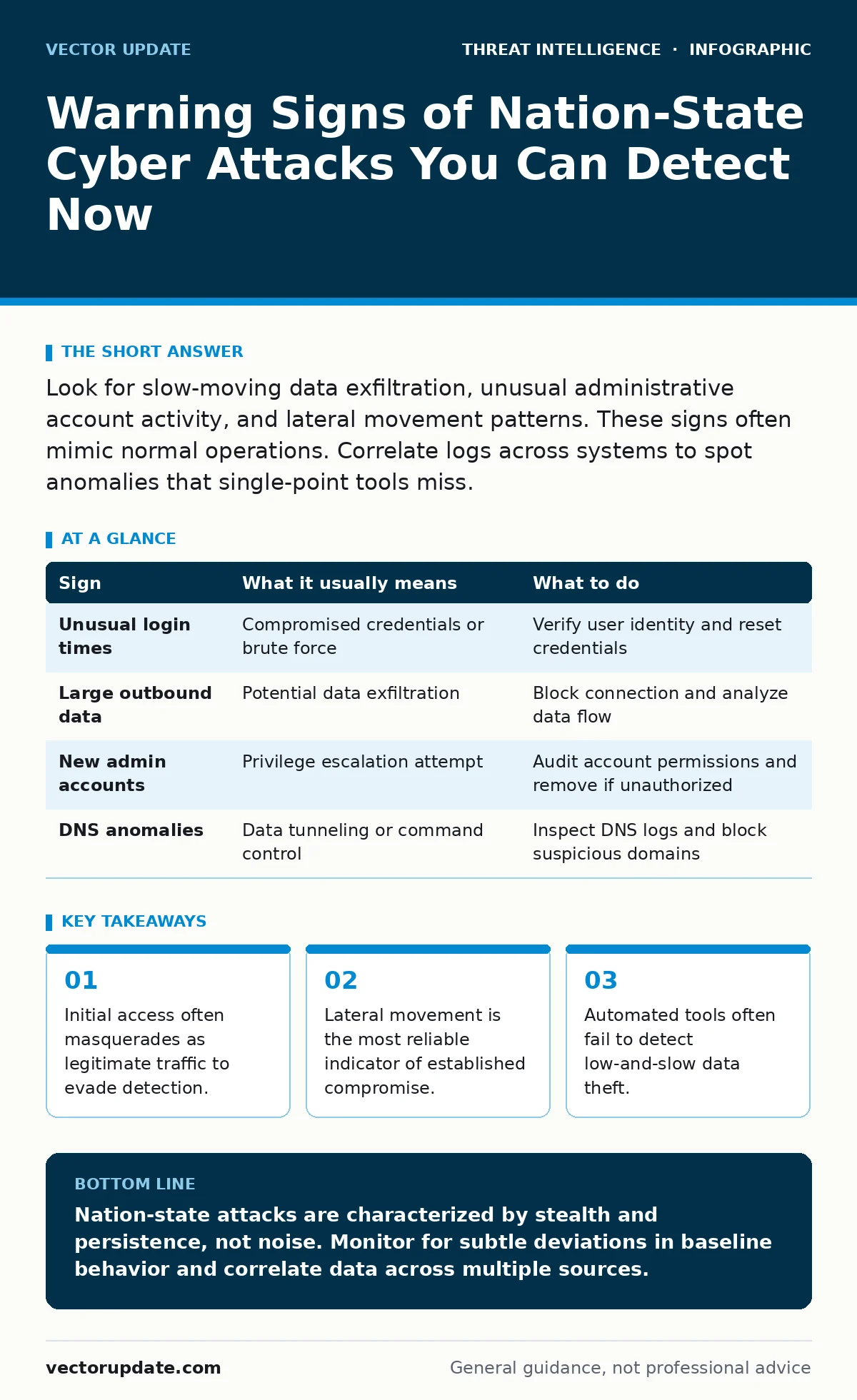
Look for slow-moving data exfiltration, unusual administrative account activity, and lateral movement patterns. These signs often mimic normal operations. Correlate logs across systems to spot anomalies that single-point tools miss.
Subtle Entry Points
State-sponsored attackers prioritize stealth over speed. They rarely launch loud, destructive campaigns immediately. Instead, they seek quiet footholds that allow long-term access. You will often see initial intrusion attempts that look like failed login attempts or benign web requests. These are not random noise. They are targeted probes for specific vulnerabilities or misconfigurations.
Attackers exploit trusted relationships between systems. They may use compromised credentials from a vendor or partner to enter your network. This method bypasses perimeter defenses because the traffic appears authorized. You must monitor for access from unexpected geographic locations or at unusual hours, even if the credentials are valid.
The Illusion of Normality
Once inside, adversaries move laterally to find high-value targets. They use legitimate administrative tools to blend in with normal system administration. This technique is known as living off the land. It leaves few forensic traces because the tools are already signed and trusted by your operating system.
You might notice slight increases in CPU or memory usage on servers. These changes are often attributed to routine maintenance or user error. However, persistent minor resource spikes can indicate data processing or encryption for exfiltration. Monitor baseline performance metrics closely. Deviations from the norm, even small ones, warrant investigation.
Hidden Data Exfiltration
Data theft is the primary goal of many nation-state operations. Attackers compress and encrypt stolen data before sending it out. This process can trigger alerts for large outbound transfers. However, they often split data into small chunks to avoid thresholds. This low-and-slow approach makes detection difficult.
Look for outbound connections to unknown external IP addresses. Check for DNS tunneling, where data is hidden within domain name requests. This method allows attackers to bypass firewalls that inspect only standard web traffic. You must analyze DNS query patterns for anomalies, such as unusually long domain names or high query volumes to a single resolver.
Detection Challenges
Standard security tools often miss these activities. Intrusion prevention systems focus on known signatures. They struggle with custom malware or legitimate tools used maliciously. You need a layered defense that includes behavioral analysis. This approach looks for deviations from expected user and system behavior rather than specific threats.
Correlate logs from multiple sources. A single alert might be false, but a pattern across email, endpoint, and network logs is significant. Use frameworks like the Unified Kill Chain to map observed activities to specific phases of an attack. This helps you understand the attacker’s intent and prioritize your response.
Response Protocols
When you detect suspicious activity, isolate affected systems immediately. Disconnect them from the network to prevent further lateral movement. Do not shut them down, as this destroys volatile memory evidence. Preserve the state for forensic analysis.
Document every step you take. Note timestamps, affected systems, and observed behaviors. This information is critical for understanding the scope of the breach. Coordinate with your security team to identify other potentially compromised assets. Assume the attacker has access until proven otherwise.
See also: Intrusion Prevention Systems: How IPS Blocks Threats in Real Time · XDR FAQ: How Extended Detection and Response Actually Works
Strategic Mitigation
Preventing nation-state attacks requires more than firewalls. You must reduce your attack surface. Implement least privilege access controls. This limits the damage an attacker can do if they gain access. Regularly review and update permissions to ensure they remain necessary.
Consider the risks of advanced persistent threats. These are long-term, stealthy intrusions that require persistent monitoring. Integrate threat intelligence feeds using standards like STIX and TAXII. This allows your systems to automatically update with known indicators of compromise. Stay informed about emerging tactics and techniques.
Operational Hygiene
Maintain strict patch management processes. Unpatched software is a common entry point. Apply firmware updates promptly, as these can contain backdoors that are difficult to detect. Monitor for privilege escalation attacks, which allow attackers to gain higher-level access.
Regularly test your incident response plans. Simulate scenarios to ensure your team can react quickly and effectively. Review and update your detection rules based on new findings. Security is an ongoing process, not a one-time fix.
| Sign | What it usually means | What to do |
|---|---|---|
| Unusual login times | Compromised credentials or brute force | Verify user identity and reset credentials |
| Large outbound data | Potential data exfiltration | Block connection and analyze data flow |
| New admin accounts | Privilege escalation attempt | Audit account permissions and remove if unauthorized |
| DNS anomalies | Data tunneling or command control | Inspect DNS logs and block suspicious domains |
Key takeaways
- Initial access often masquerades as legitimate traffic to evade detection.
- Lateral movement is the most reliable indicator of established compromise.
- Automated tools often fail to detect low-and-slow data theft.
Nation-state attacks are characterized by stealth and persistence, not noise. Monitor for subtle deviations in baseline behavior and correlate data across multiple sources.
Frequently asked questions
How do I distinguish a nation-state attack from a standard hack?
Nation-state attacks often involve longer dwell times, custom tools, and a focus on data theft rather than immediate disruption or ransom.
Can endpoint detection prevent these attacks?
Endpoint detection can help, but it must be combined with network monitoring and behavioral analysis to catch living-off-the-land techniques.
What is the role of threat intelligence?
Threat intelligence provides context on attacker tactics and indicators, helping you tune your defenses and detect known malicious activity.
How often should I review access controls?
Review access controls regularly, especially after employee changes or role transitions, to ensure least privilege principles are maintained.
How this guide was produced: written by the Vector Update editorial team with AI assistance, checked against the public references listed below, and reviewed when the facts change. See our editorial policy or report an error.