Differential Privacy Explained: How Data Privacy Works Without Secrets
Differential privacy adds mathematical noise to datasets so individual records become indistinguishable, allowing analysis without exposing personal information.
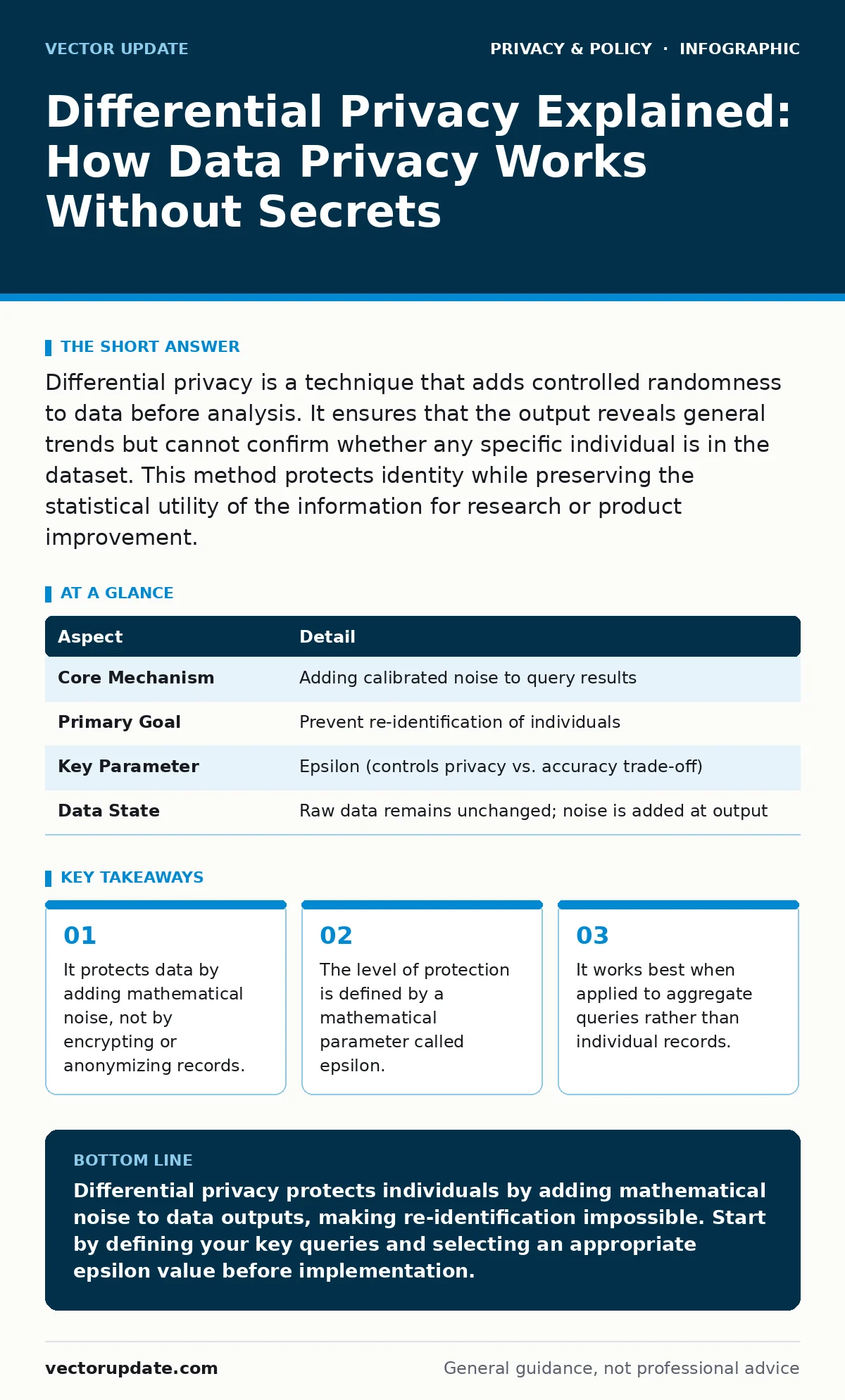
Differential privacy is a technique that adds controlled randomness to data before analysis. It ensures that the output reveals general trends but cannot confirm whether any specific individual is in the dataset. This method protects identity while preserving the statistical utility of the information for research or product improvement.
The Coin Flip Analogy
Imagine you want to know how many people in your office have a rare medical condition. You ask everyone to write yes or no on a slip of paper. If only one person says yes, you know exactly who it is. That is a privacy failure. Now, imagine you ask everyone to flip a coin first. If it lands heads, they write their true answer. If it lands tails, they flip again and write whatever the second flip shows. The second flip adds random noise. This is the core logic of differential privacy.
What Differential Privacy Actually Is
Differential privacy is a mathematical framework for measuring and limiting the information leakage from a dataset. It does not hide data through encryption or masking. Instead, it guarantees that the result of any query on the data will look statistically similar whether or not any single individual’s record is included. The system adds noise to the output of the query. This noise makes it impossible for an attacker to determine if a specific person contributed to the dataset. The protection holds even if the attacker already knows almost everything else about the individuals in the group.
| Aspect | Detail |
|---|---|
| Core Mechanism | Adding calibrated noise to query results |
| Primary Goal | Prevent re-identification of individuals |
| Key Parameter | Epsilon (controls privacy vs. accuracy trade-off) |
| Data State | Raw data remains unchanged; noise is added at output |
How The Mechanism Works in Practice
The system relies on a parameter called epsilon. Epsilon defines the privacy budget. A lower epsilon value means more noise is added. This provides stronger privacy but reduces the accuracy of the results. A higher epsilon value adds less noise, making the data more accurate but offering weaker protection. You must choose an epsilon value that balances these two needs. If the noise is too high, the data becomes useless for decision-making. If the noise is too low, an attacker might use other information to identify specific users. The noise is usually drawn from a Laplace or Gaussian distribution. These distributions ensure the noise is random but predictable in its overall shape.
Where You See It Daily
You likely interact with differential privacy systems without realizing it. Large technology companies use it to collect usage data for improving products. For instance, when a keyboard learns your typing habits, it might send anonymized usage patterns to a central server. These patterns are processed with differential privacy before being used to update the prediction model. This ensures that no one can reverse-engineer the data to see what you typed. It also helps in health research. Researchers can analyze large medical datasets to find disease trends without accessing patient records. This approach avoids the need for complex consent forms for every new analysis. It also reduces the risk of data breaches exposing sensitive health information.
The Hidden Cost of Privacy
There is a trade-off between privacy and utility. You cannot have perfect privacy and perfect accuracy at the same time. Adding noise inevitably degrades the quality of the data. For small datasets, this degradation can be severe. If you only have ten users, adding noise might make the average completely meaningless. Differential privacy works best with large datasets. The law of large numbers helps absorb the noise. In small groups, the noise dominates the signal. This is why differential privacy is rarely used for small, internal company reports. It is designed for large-scale data aggregation. Another hidden cost is computational overhead. Generating the right amount of noise and processing the queries requires more computing power. This can slow down data analysis pipelines.
See also: Tor Browser: Real Privacy Gains and Hidden Performance Costs · How Zero-Knowledge Encryption Works: Secrets the Provider Cannot See
What People Usually Get Wrong
Many people confuse differential privacy with anonymization. Anonymization removes direct identifiers like names and addresses. It does not protect against re-identification. An attacker can often link anonymized data with other public records to identify individuals. Differential privacy provides a mathematical guarantee against this. It does not matter if the attacker has other data. The noise ensures the query result does not change significantly based on one person’s data. Another common mistake is thinking differential privacy encrypts data. It does not. The data is still stored and processed in plain text. The protection happens at the point of query or release. This means you still need secure storage and access controls. Differential privacy complements other security measures. It does not replace them.
Integrating With Other Privacy Tools
Differential privacy is one tool in a broader privacy strategy. It works well alongside other methods. For example, you can use zero-knowledge encryption to protect data in transit and at rest. Then, you apply differential privacy when analyzing that data. This layered approach reduces risk. It also helps with regulatory compliance. Laws like CCPA require organizations to protect consumer data. Differential privacy provides a defensible standard for data usage. It shows that you have taken technical steps to prevent identification. It is not a magic bullet. You still need to manage data lifecycle and access permissions. But it solves a specific problem that traditional anonymization cannot. It protects against sophisticated re-identification attacks.
Practical Implementation Steps
Implementing differential privacy requires careful planning. First, define the queries you need to run. You cannot add noise to every possible question. You must predefine the analysis goals. Second, choose an epsilon value. Consult with privacy experts to set a value that meets your legal and ethical standards. Third, select a noise mechanism. Laplace noise is common for count queries. Gaussian noise is often used for sum or mean queries. Fourth, test the utility. Run the queries with and without noise to see the impact on accuracy. If the results are too distorted, you may need to collect more data or adjust your questions. Finally, document the process. Keep records of the epsilon values and noise mechanisms used. This documentation helps with audits and transparency.
Key takeaways
- It protects data by adding mathematical noise, not by encrypting or anonymizing records.
- The level of protection is defined by a mathematical parameter called epsilon.
- It works best when applied to aggregate queries rather than individual records.
Differential privacy protects individuals by adding mathematical noise to data outputs, making re-identification impossible. Start by defining your key queries and selecting an appropriate epsilon value before implementation.
Frequently asked questions
Does differential privacy violate user consent requirements?
It does not replace consent, but it can reduce the burden. Since the data cannot identify individuals, some regulations treat it as less sensitive, potentially simplifying consent processes.
Can I use differential privacy for small business data?
It is generally not recommended for small datasets. The noise required for privacy will likely make the data too inaccurate to be useful for business decisions.
How does this differ from data masking?
Data masking hides specific fields, like replacing a name with "User123". Differential privacy adds randomness to the entire query result, protecting against inference attacks even if identifiers are removed.
Is differential privacy effective against AI attacks?
Yes, because it provides a mathematical guarantee. Even advanced AI models cannot distinguish whether a specific individual is in the dataset if the privacy budget is properly managed.
How this guide was produced: written by the Vector Update editorial team with AI assistance, checked against the public references listed below, and reviewed when the facts change. See our editorial policy or report an error.