Differential Privacy: Why It Matters for Security and Data Safety
Adding mathematical noise to datasets prevents attackers from isolating individuals while preserving the statistical value of the information for analysis.
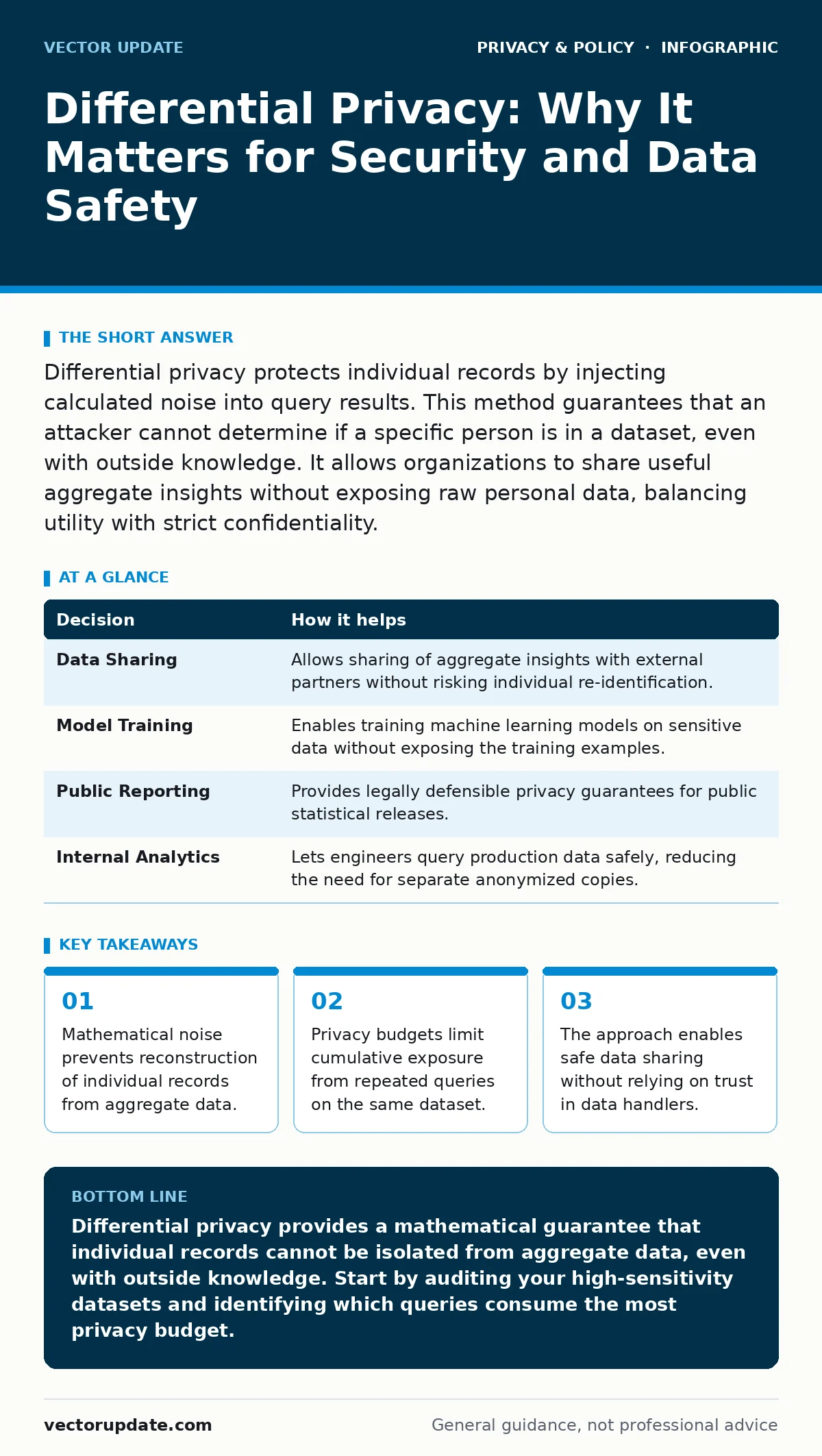
Differential privacy protects individual records by injecting calculated noise into query results. This method guarantees that an attacker cannot determine if a specific person is in a dataset, even with outside knowledge. It allows organizations to share useful aggregate insights without exposing raw personal data, balancing utility with strict confidentiality.
The Limits of Traditional Anonymization
Traditional data masking strips names and addresses from records. This method assumes that removing direct identifiers is enough to protect privacy. In practice, this assumption fails. Attackers often combine public records with anonymized datasets to re-identify individuals. This process, known as linkage attacks, exploits unique combinations of non-sensitive attributes like zip codes, birth dates, and gender.
Differential privacy addresses this failure mode. It does not rely on removing identifiers. Instead, it adds mathematical noise to the data or the results of queries. This noise ensures that the output looks statistically identical whether any single individual’s data is included or excluded. The protection is mathematical, not procedural. It holds up even if an attacker knows everything else about the dataset.
How Noise Protects Privacy
The core mechanism is the addition of random noise to query results. The amount of noise depends on the sensitivity of the query. A query that asks for the sum of salaries is more sensitive than one asking for the average. High sensitivity requires more noise to mask the contribution of any single record.
This noise creates a privacy guarantee. An observer cannot tell if a specific person contributed to the result. The system provides plausible deniability for every record. This is different from encryption, which hides data entirely. Differential privacy hides the presence of specific data points within a larger statistical context. It allows you to learn about the group without learning about the individual.
The Privacy Budget Constraint
You cannot add infinite noise. Too much noise renders the data useless for analysis. Too little noise fails to protect privacy. Teams manage this trade-off using a privacy budget. This budget represents the total amount of privacy loss allowed for a dataset.
Each query consumes a portion of this budget. Simple queries use less. Complex queries use more. Once the budget is exhausted, no further queries can be made on that dataset. This constraint forces teams to plan their analysis carefully. It prevents the slow erosion of privacy through repeated queries, a problem known as the composition effect.
Imagine a team that wants to analyze user behavior. They must decide which metrics are most valuable. They allocate their budget to those high-value metrics. Lower-value metrics are either dropped or analyzed with less precision. This discipline ensures that the data remains useful while staying within safe privacy bounds.
Decisions Informed by Privacy Guarantees
Differential privacy changes how teams approach data governance. It shifts the focus from access controls to statistical guarantees. Here is how it informs key decisions:
| Decision | How it helps |
|---|---|
| Data Sharing | Allows sharing of aggregate insights with external partners without risking individual re-identification. |
| Model Training | Enables training machine learning models on sensitive data without exposing the training examples. |
| Public Reporting | Provides legally defensible privacy guarantees for public statistical releases. |
| Internal Analytics | Lets engineers query production data safely, reducing the need for separate anonymized copies. |
This table shows the breadth of application. It is not just for public reports. It applies to internal development and external partnerships. The guarantee is consistent across these use cases.
What Goes Wrong Without It
Without differential privacy, teams often rely on k-anonymity or l-diversity. These methods group records so that each individual is indistinguishable from at least k-1 others. This sounds secure, but it has a hidden cost. It often discards valuable detail to achieve the grouping.
Worse, these methods are vulnerable to background knowledge. If an attacker knows that a specific person is in a certain hospital ward, they can often pinpoint that person in a k-anonymized dataset. Differential privacy does not care about background knowledge. The mathematical guarantee holds regardless of what the attacker knows.
Suppose a team releases a dataset of health records. They remove names and use k-anonymity. An attacker cross-references the data with public voter registration records. They identify a specific individual’s rare medical condition. This breach happens because k-anonymity does not account for the attacker’s external knowledge. Differential privacy would have added noise to prevent this linkage.
See also: How to Reduce Your Digital Footprint: The Mechanics of Data Minimization · Tor Browser: Real Privacy Gains and Hidden Performance Costs
How Teams Implement the Approach
Implementation requires a shift in workflow. Teams cannot just export raw data. They must query the data through a privacy-preserving interface. This interface adds the necessary noise before returning results.
Many teams use libraries that implement standard algorithms like the Laplace or Gaussian mechanism. These mechanisms add noise drawn from specific probability distributions. The choice of mechanism depends on the type of query. Sum queries often use Laplace noise. Mean queries might use Gaussian noise.
Teams must also train their analysts. Analysts need to understand that results are approximate. They must interpret confidence intervals and noise levels. This education reduces frustration and improves decision-making.
Integration with Broader Privacy Strategies
Differential privacy is a tool, not a silver bullet. It works best when combined with other privacy measures. For instance, it complements zero-knowledge encryption by protecting data in use, while encryption protects data at rest and in transit.
It also aligns with digital privacy rights by providing a technical basis for consent. Users can trust that their data contributes to aggregate insights without being individually tracked. This trust is harder to build with traditional anonymization, which has a history of failure.
Consider the role of workplace monitoring. Employers often collect data on employee productivity. Differential privacy allows them to analyze trends without monitoring individuals. This balance respects employee privacy while providing management with useful insights.
The Trade-off Between Utility and Privacy
The central challenge is balancing utility and privacy. High privacy guarantees require more noise, which reduces accuracy. Low privacy guarantees allow more accurate data but increase risk.
Teams must define acceptable error margins. This decision depends on the business context. It requires collaboration between data scientists, legal teams, and security engineers.
This trade-off is not static. As algorithms improve, teams can achieve higher utility for the same privacy cost. But the fundamental tension remains. You must choose how much truth to sacrifice for security.
Key takeaways
- Mathematical noise prevents reconstruction of individual records from aggregate data.
- Privacy budgets limit cumulative exposure from repeated queries on the same dataset.
- The approach enables safe data sharing without relying on trust in data handlers.
Differential privacy provides a mathematical guarantee that individual records cannot be isolated from aggregate data, even with outside knowledge. Start by auditing your high-sensitivity datasets and identifying which queries consume the most privacy budget.
Frequently asked questions
Does differential privacy slow down data analysis?
Yes, adding noise and managing privacy budgets adds computational overhead and requires careful query planning, which can slow down iterative analysis compared to raw data access.
Is differential privacy required by law?
No specific law mandates it, but it helps organizations comply with frameworks like CCPA by providing a technical method to demonstrate that individual privacy is preserved during data processing.
How does it differ from encryption?
Encryption hides the content of data, while differential privacy hides the presence of specific individuals within aggregate statistical results, allowing the data to be analyzed in plaintext.
How this guide was produced: written by the Vector Update editorial team with AI assistance, checked against the public references listed below, and reviewed when the facts change. See our editorial policy or report an error.