Privilege Escalation Attacks: How Attackers Steal Control
Privilege escalation transforms a minor foothold into total system control, bypassing the security boundaries you designed to contain initial breaches.

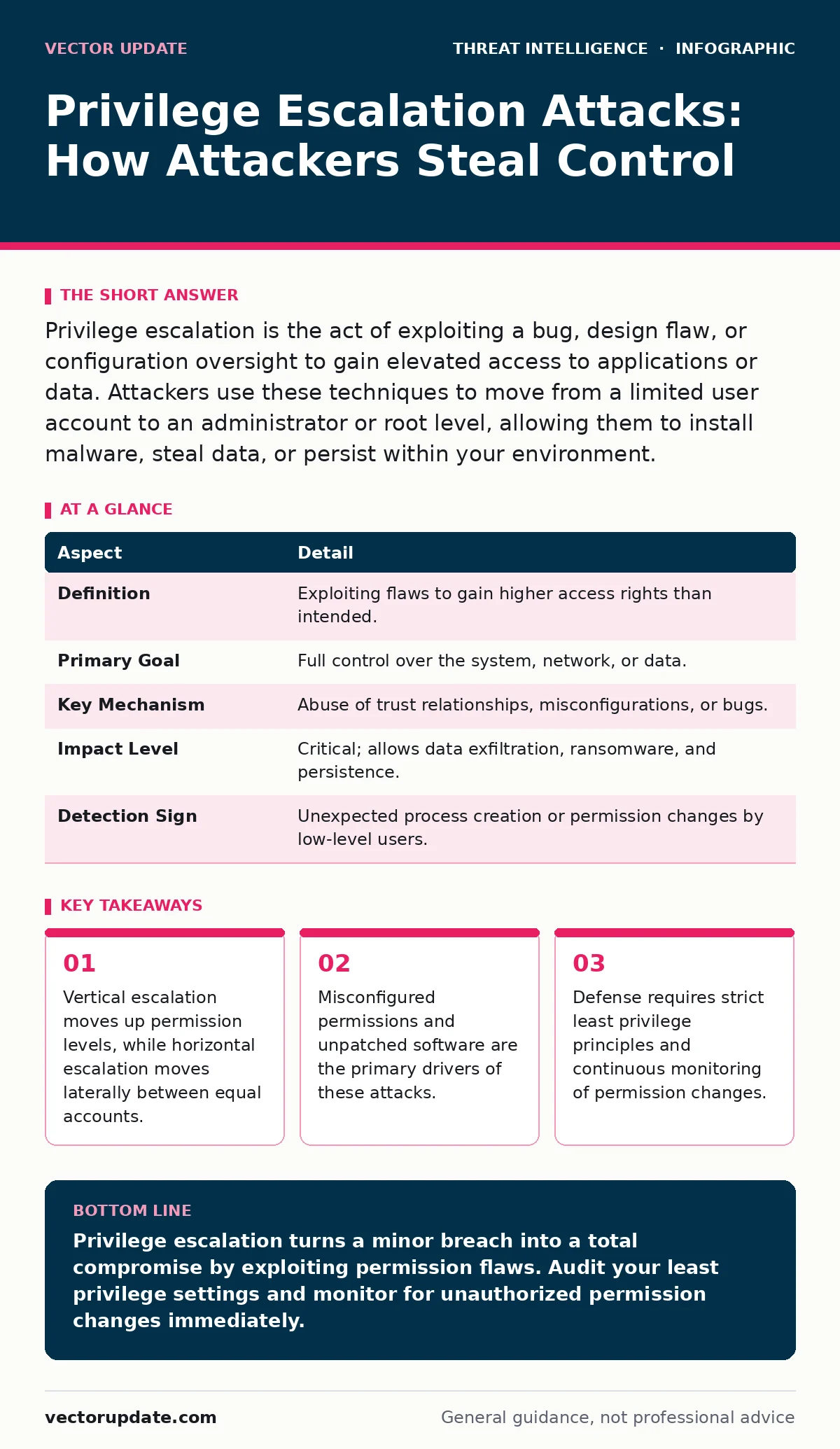
Privilege escalation is the act of exploiting a bug, design flaw, or configuration oversight to gain elevated access to applications or data. Attackers use these techniques to move from a limited user account to an administrator or root level, allowing them to install malware, steal data, or persist within your environment.
The Broken Elevator Analogy
Imagine a building where every tenant has a key to their own apartment. The elevator requires a special key to reach the penthouse, which houses the building’s master controls. A visitor arrives with a guest badge that only opens the ground floor lobby. They are stuck on level one.
Now suppose the maintenance crew left the elevator control panel unlocked in the stairwell. The visitor finds it, overrides the safety limit, and sends the elevator to the penthouse. They now hold the master key. The initial breach was just a foot in the door; the override was the escalation.
In computing, the visitor is the attacker. The guest badge is the initial compromised user account. The override is the privilege escalation vulnerability. The penthouse is the administrator or root account.
At a Glance
| Aspect | Detail |
|---|---|
| Definition | Exploiting flaws to gain higher access rights than intended. |
| Primary Goal | Full control over the system, network, or data. |
| Key Mechanism | Abuse of trust relationships, misconfigurations, or bugs. |
| Impact Level | Critical; allows data exfiltration, ransomware, and persistence. |
| Detection Sign | Unexpected process creation or permission changes by low-level users. |
How the Attack Unfolds
Privilege escalation is rarely the first step in an intrusion. It is the second. An attacker first gains a foothold, often through phishing or a remote code execution vulnerability. This initial access usually grants them the rights of a standard user.
Standard users cannot modify system files, install drivers, or view other users’ private data. The attacker needs more power. They scan the environment for weaknesses that allow them to break out of their sandbox.
They look for software running with higher privileges than necessary. They check for files that are writable by everyone but executed by the system. They examine the configuration of the operating system for errors in how it handles permissions.
Once they find a weakness, they execute code or modify a file in a way that tricks the system into granting them administrative rights. The system trusts the code or configuration, so it elevates the attacker’s status. The attacker now controls the machine.
Vertical vs. Horizontal Escalation
There are two distinct directions an attacker can move. Vertical privilege escalation is moving up the hierarchy. A standard user becomes an administrator. An administrator becomes a root user. This is the most common form discussed in security literature.
Horizontal privilege escalation is moving sideways. An attacker with access to User A’s account finds a way to access User B’s account. Both accounts have the same permission level, but User B has access to different data or systems.
Horizontal escalation is often harder to detect because the permission level does not change. Logging systems might flag a login from a new IP address, but they rarely flag a session that simply accesses a different user’s folder.
Both forms are dangerous. Vertical escalation gives you control of the system. Horizontal escalation gives you access to specific, high-value data or credentials that can be used for further vertical escalation elsewhere.
Common Vectors and Mechanisms
Attackers use several well-known techniques to climb the permission ladder. Understanding the mechanism helps you understand the risk.
Insecure File Permissions
Operating systems rely on file permissions to control access. If a system file is marked as writable by all users, an attacker can modify it. When the system runs that file with administrative privileges, the attacker’s modified code runs with administrative privileges.
This is often caused by lazy configuration. Administrators sometimes set permissions to "everyone" to avoid access errors. This convenience creates a permanent backdoor.
Unpatched Software Vulnerabilities
Software bugs can allow code to run outside its intended memory space. A buffer overflow, for example, allows an attacker to overwrite memory and redirect the flow of execution. If the vulnerable software is running as an administrator, the attacker’s code runs as an administrator.
Patching is the primary defense here. Unpatched systems are low-hanging fruit for attackers who use automated tools to scan for known vulnerabilities.
Misconfigured Services
Services like database engines or web servers often run with elevated privileges to function correctly. If these services are misconfigured, they may allow users to execute commands on the host system.
An attacker who compromises a web application might find that the underlying database allows them to run system commands. This bridges the gap from application user to system administrator.
See also: Unified Kill Chain: How to Map and Break Attack Stages
What People Usually Get Wrong
Many defenders focus entirely on keeping attackers out. They build high walls and strong gates. This is necessary, but it is not sufficient.
The mistake is assuming that a breach is the end of the story. In modern security, a breach is just the beginning. The attacker is already inside, waiting for a chance to move up.
Another common error is relying solely on antivirus software. Antivirus tools are good at stopping known malware, but they are often blind to the logic of a privilege escalation attack. The attacker is not running a virus; they are running a legitimate system command with elevated rights.
Defenders also often ignore the principle of least privilege. They give users and services more access than they need "just in case." This "just in case" access is exactly what attackers exploit.
Reducing the Risk
You cannot patch every vulnerability before it is found. You must design your systems to limit the damage when a vulnerability is exploited.
Enforce Least Privilege
Every user, process, and service should have the minimum permissions required to perform its function. No standard user should be able to install software. No web server should run as root.
Review permissions regularly. Remove access that is no longer needed. This limits the attacker’s ability to move up the ladder.
Patch Management
Keep all software updated. This includes the operating system, applications, and libraries. Unpatched software is the easiest path to escalation.
Automate patching where possible. Manual patching is slow and prone to human error.
Monitor for Anomalies
Set up monitoring for unusual permission changes. If a low-privileged user suddenly runs an administrative command, alert immediately.
Look for processes that are spawned by unexpected parents. A web server process should not spawn a command shell.
Integrating with Broader Security
Privilege escalation is a stage in the attack lifecycle. Understanding it helps you contextualize other threats.
For example, advanced persistent threats often use privilege escalation to maintain long-term access without detection. They move slowly and carefully to avoid triggering alarms.
Similarly, nation-state cyber attacks frequently target privilege escalation vulnerabilities in critical infrastructure to gain persistent control.
While frameworks like the Unified Kill Chain help you visualize these stages, the technical reality is that escalation happens quickly. You must have detection in place for the specific behaviors associated with permission changes.
Don't confuse this with AS-REP roasting, which is a specific authentication attack. Privilege escalation is broader and applies to any system where permissions are mishandled.
Also consider insecure cloud APIs, which can allow attackers to escalate privileges in cloud environments by misconfiguring access roles.
Key takeaways
- Vertical escalation moves up permission levels, while horizontal escalation moves laterally between equal accounts.
- Misconfigured permissions and unpatched software are the primary drivers of these attacks.
- Defense requires strict least privilege principles and continuous monitoring of permission changes.
Privilege escalation turns a minor breach into a total compromise by exploiting permission flaws. Audit your least privilege settings and monitor for unauthorized permission changes immediately.
Frequently asked questions
How do I know if I am vulnerable to privilege escalation?
You cannot know with certainty. However, you can scan for common misconfigurations, unpatched software, and overly permissive file systems to reduce the likelihood.
Is privilege escalation the same as lateral movement?
No. Lateral movement is moving between systems or accounts. Privilege escalation is gaining higher permissions on a single system. They often happen together.
Can antivirus software stop privilege escalation?
Antivirus can stop known malware used in the attack, but it cannot stop the logical exploitation of a permission flaw. You need behavioral monitoring and strict permission controls.
What is the difference between local and remote privilege escalation?
Local escalation requires the attacker to already have access to the system. Remote escalation allows the attacker to gain higher privileges from outside the system, often through a network service.
How this guide was produced: written by the Vector Update editorial team with AI assistance, checked against the public references listed below, and reviewed when the facts change. See our editorial policy or report an error.