Nation-State Cyber Attacks: Definition, Methods, and Defense
State-sponsored intrusions rarely seek immediate profit, instead using prolonged access to reshape economic or political outcomes without triggering military conflict.

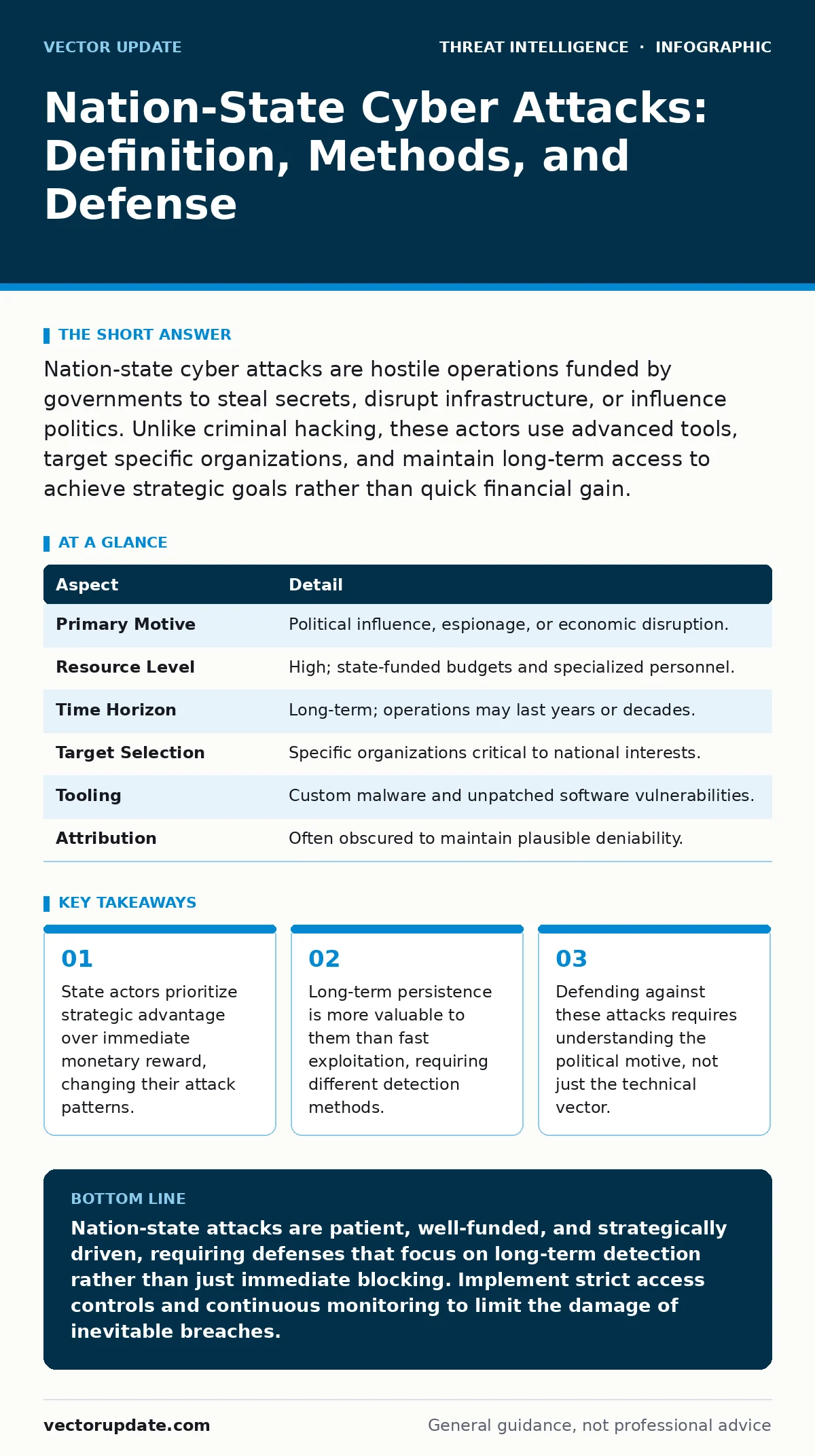
Nation-state cyber attacks are hostile operations funded by governments to steal secrets, disrupt infrastructure, or influence politics. Unlike criminal hacking, these actors use advanced tools, target specific organizations, and maintain long-term access to achieve strategic goals rather than quick financial gain.
The Strategic Weapon
Imagine a locksmith who does not break into a house to steal jewelry. Instead, they spend months copying blueprints, changing the thermostat settings, and subtly altering the layout of the rooms. The owner notices nothing until the structure itself is compromised. This is the core difference between common cybercrime and nation-state cyber attacks.
A nation-state cyber attack is a hostile digital operation conducted by or on behalf of a government. The goal is rarely direct theft of money. The objective is strategic: gaining intelligence, disrupting services, or influencing public opinion. These operations are funded by national budgets, allowing attackers to spend years on a single target.
The attacker has resources that criminal groups lack. They can purchase zero-day vulnerabilities, which are previously unknown software flaws, before the vendor can patch them. They can hire specialized teams to craft custom malware. The scale of effort makes these attacks distinct from opportunistic hacks.
| Aspect | Detail |
|---|---|
| Primary Motive | Political influence, espionage, or economic disruption. |
| Resource Level | High; state-funded budgets and specialized personnel. |
| Time Horizon | Long-term; operations may last years or decades. |
| Target Selection | Specific organizations critical to national interests. |
| Tooling | Custom malware and unpatched software vulnerabilities. |
| Attribution | Often obscured to maintain plausible deniability. |
How the Intrusion Happens
The process usually begins with reconnaissance. The attacker identifies a target that holds value for their government. This could be a defense contractor, an energy provider, or a legislative body. They map the network, identify key personnel, and find weak entry points.
Access is often gained through social engineering. The attacker sends a spear-phishing email that appears to come from a trusted colleague. The email contains a malicious attachment or link. When the user clicks it, the attacker gains a foothold in the system. This initial step is low-tech but highly effective.
Once inside, the attacker moves laterally. They use privilege escalation attacks to gain higher-level access. This allows them to move from a standard user account to an administrator account. With these rights, they can access sensitive data and install persistent backdoors.
The attacker then establishes persistence. They modify system configurations to ensure they can return even if the initial entry point is closed. This phase requires careful operation to avoid triggering alarms. The goal is to remain invisible while gathering intelligence or preparing for a larger disruption.
Who Faces the Threat
These attacks do not target everyone. They focus on sectors that hold strategic value. Government agencies are obvious targets for cyber espionage. Intelligence agencies seek diplomatic cables, defense plans, and policy drafts.
Critical infrastructure is another major target. Power grids, water treatment facilities, and transportation networks are vulnerable. Disrupting these services can cause widespread chaos without firing a single shot. The attacker aims to degrade the nation's ability to function.
Private companies in defense, aerospace, and technology are also at risk. These firms hold intellectual property that gives a nation an economic edge. Stealing trade secrets allows the attacking state to replicate technology without the cost of research and development.
Common Attack Forms
Advanced persistent threats describe the behavior of these attackers. They are advanced because they use sophisticated tools. They are persistent because they stay hidden for long periods. They are threats because they actively seek to cause harm.
One common form is data theft. The attacker copies sensitive files and exfiltrates them over slow, encrypted channels. This avoids bandwidth spikes that might alert security teams. The data may not be used immediately, but it is stored for future leverage.
Another form is disruption. The attacker deploys ransomware or logic bombs that destroy data at a specific time. This can halt production lines or shut down servers. The goal is to cause economic pain or political embarrassment.
A third form is influence. The attacker compromises social media accounts or news outlets to spread disinformation. This shapes public opinion and undermines trust in institutions. It is a soft power tool that complements hard military power.
What People Usually Get Wrong
Many defenders assume that nation-state attacks are always high-tech. They expect complex code and invisible exploits. In reality, the initial breach is often simple. A weak password or an unpatched server is frequently the entry point. The sophistication lies in the follow-up, not the entry.
Another mistake is assuming attribution is clear. Attackers use false flags to make the attack look like it came from a different country or a criminal group. This creates confusion and delays the response. Do not rely on initial indicators to determine the source.
Defenders also underestimate the patience of state actors. Criminal hackers want money quickly. State actors can wait years for the right moment. A dormant account that seems harmless today may be activated tomorrow. Long-term monitoring is necessary.
See also: Cloud Firewall Mistakes That Expose Your Infrastructure · Privilege Escalation Attacks: How Attackers Steal Control
Reducing the Risk
Defense against these attacks requires a shift in mindset. You cannot rely on perimeter defenses alone. Assume the attacker is already inside. Design your network to limit movement. Use segmentation to isolate critical systems.
Monitoring is key. Implement network monitoring to detect unusual traffic patterns. Look for connections to known command-and-control servers. Watch for large data transfers at odd hours. These anomalies often indicate an active exfiltration.
Use standard frameworks to share threat data. STIX and TAXII are protocols that allow organizations to exchange information about threats. By sharing indicators of compromise, you can detect attacks that others have already seen. This collective defense raises the cost for the attacker.
Regularly review access rights. Remove unnecessary privileges. Ensure that only authorized personnel can access sensitive data. This limits the damage if an account is compromised. Test your incident response plans regularly. Speed matters when facing a determined adversary.
The Human Element
Technology alone cannot stop these attacks. The human factor remains the weakest link. Employees must be trained to recognize social engineering attempts. They should know how to report suspicious emails.
Management must support security initiatives. Budgets should reflect the reality of the threat. Security is not a cost center; it is a business enabler. Without proper funding, defenses will fail.
Communication is vital. When an attack occurs, clear communication prevents panic. Have a plan for notifying stakeholders, customers, and regulators. Transparency builds trust, even in difficult situations.
Moving Forward
The landscape of cyber conflict is evolving. New tools and techniques emerge constantly. Defenders must adapt quickly. Continuous learning is necessary.
Collaboration between organizations strengthens defense. Share lessons learned and best practices. Isolation leaves you vulnerable. By working together, you create a stronger barrier against state-sponsored attacks.
Stay informed about geopolitical tensions. Understanding the political context helps predict potential targets. This intelligence informs your defensive posture.
Key takeaways
- State actors prioritize strategic advantage over immediate monetary reward, changing their attack patterns.
- Long-term persistence is more valuable to them than fast exploitation, requiring different detection methods.
- Defending against these attacks requires understanding the political motive, not just the technical vector.
Nation-state attacks are patient, well-funded, and strategically driven, requiring defenses that focus on long-term detection rather than just immediate blocking. Implement strict access controls and continuous monitoring to limit the damage of inevitable breaches.
Frequently asked questions
How do nation-state attacks differ from regular hacking?
State attacks are motivated by political or strategic goals rather than profit, often using more resources and maintaining longer-term access to targets.
Can small businesses be targets of nation-state attacks?
Yes, if they supply critical components to larger targets or hold specific data that interests a foreign government, regardless of their size.
What is the first sign of a nation-state intrusion?
Often there is no immediate sign, but unusual network traffic, unexpected privilege changes, or dormant accounts becoming active can indicate a breach.
How can I share threat information legally?
Use standardized protocols like STIX and TAXII to exchange threat data with other organizations, ensuring compliance with data privacy laws.
How this guide was produced: written by the Vector Update editorial team with AI assistance, checked against the public references listed below, and reviewed when the facts change. See our editorial policy or report an error.