Unified Kill Chain: How to Map and Break Attack Stages
The Unified Kill Chain separates technical indicators from human behavior, letting you stop attacks before they reach the network perimeter.
The Unified Kill Chain extends traditional models by adding reconnaissance and delivery phases that occur outside your network. You can detect these early stages using behavioral analytics and email filtering. This approach prevents breaches that bypass perimeter defenses by addressing the human and infrastructure layers before malware executes.
The Problem with Traditional Models
Traditional attack models focus heavily on what happens after an intruder breaches your perimeter. They assume the attacker is already inside the network when the clock starts ticking. This view leaves a blind spot during the critical hours or days the adversary spends preparing their approach. You cannot defend against a threat you do not see until it is too late.
The Unified Kill Chain addresses this gap by mapping the entire lifecycle of an intrusion. It includes phases that occur entirely outside your infrastructure, such as initial reconnaissance and weaponization. By extending the timeline, you gain visibility into the attacker’s intent before they deploy code. This shift changes your defense from reactive cleanup to proactive disruption.
Stage 1: Reconnaissance
The attacker begins by gathering information about your organization. This phase involves open-source intelligence gathering, social media scraping, and website mapping. The goal is to identify high-value targets and potential entry points. At this stage, no technical interaction with your systems has occurred.
You can detect this activity by monitoring for unusual interest in your public-facing assets. Look for spikes in web traffic from new or suspicious geographic regions. Analyze mentions of your brand or employees on public forums and job sites. Early warning signs often appear in the public domain before any digital contact.
Stage 2: Weaponization
The attacker combines malicious code with a delivery mechanism. This process creates a file or payload that appears legitimate but contains hidden instructions. The weapon is often disguised as a document, software update, or common media file. The goal is to bypass initial security checks and user suspicion.
Detection here relies on analyzing file structures and behavioral patterns. Sandboxing can reveal malicious intent without executing the code in your live environment. Monitoring for the creation of unusual file types in your development or testing environments can also raise alarms. The weapon is inert until delivered, giving you a window for intervention.
Stage 3: Delivery
The attacker sends the weapon to the target. This usually happens via email attachments, phishing links, or compromised websites. The delivery method must bypass email filters and user scrutiny. The attacker often uses social engineering to persuade the recipient to open the file or click the link.
You can stop this stage by implementing strict email security policies. Advanced filtering can detect known malicious signatures and suspicious sender behaviors. User training helps identify social engineering cues that automated systems might miss. Blocking the delivery vector prevents the payload from ever reaching the endpoint.
Stage 4: Exploitation
The malicious code executes on the target system. This phase exploits vulnerabilities in software, operating systems, or browser configurations. The goal is to gain initial access and execute commands. If the system is patched and configured correctly, this step fails.
Monitoring for unusual process behavior is key here. Look for attempts to exploit known vulnerabilities or run scripts in unexpected locations. Endpoint detection and response tools can halt execution if the behavior matches known exploit patterns. Keeping software updated reduces the surface area for successful exploitation.
See also: Privilege Escalation Attacks: How Attackers Steal Control · Nation-State Cyber Attacks: Definition, Methods, and Defense
Stage 5: Installation
The attacker installs a persistent backdoor on the system. This ensures they can return even if the initial entry point is closed. The installation may modify system files, create new services, or drop additional malware components. The goal is to establish a foothold within your network.
Detecting installation requires deep visibility into system changes. File integrity monitoring alerts you to unauthorized modifications. Comparing current system states against known good baselines can reveal hidden components. Preventing installation requires stopping the exploitation phase or detecting the initial access attempt.
Stage 6: Command and Control
The compromised system establishes communication with the attacker’s server. This channel allows the attacker to send commands and receive data. The communication often mimics normal traffic to avoid detection. The goal is to maintain control over the compromised system.
Network monitoring can identify this stage by detecting unusual outbound connections. Look for traffic to unknown external IPs or domains with suspicious patterns. Encrypted traffic analysis can reveal anomalies even if the content is hidden. Disrupting this channel cuts off the attacker’s ability to control the system.
Stage 7: Actions on Objectives
The attacker achieves their final goal. This could be data exfiltration, ransomware encryption, or lateral movement to other systems. The specific actions depend on the attacker’s intent, which may include cyber espionage or financial gain. This stage represents the actual damage to your organization.
Preventing this stage requires stopping the attack at earlier phases. Once the attacker has control, mitigation becomes difficult and costly. Data loss prevention tools can alert on large outbound transfers. Isolating compromised systems limits the spread of the attack within your network.
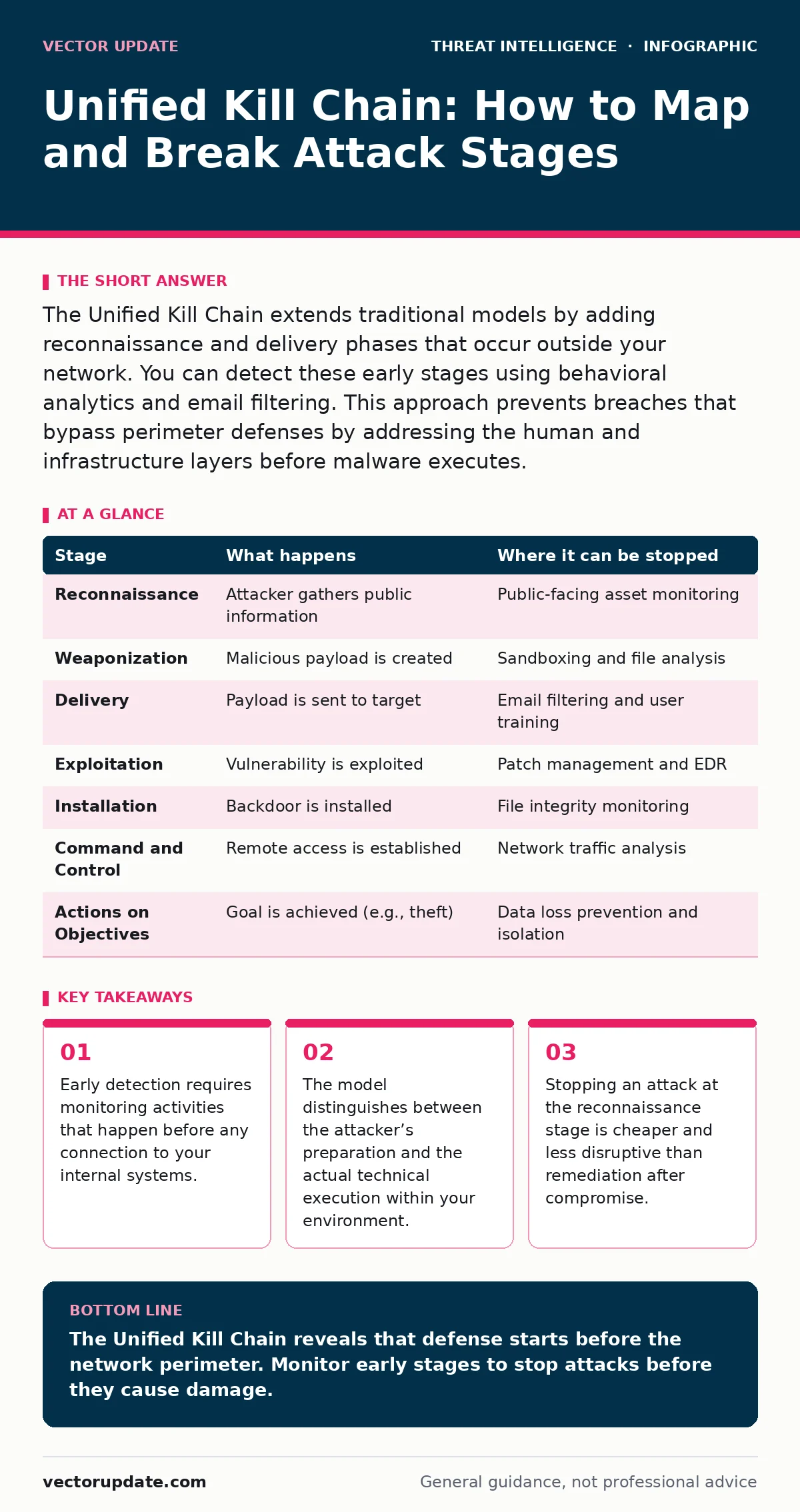
| Stage | What happens | Where it can be stopped |
|---|---|---|
| Reconnaissance | Attacker gathers public information | Public-facing asset monitoring |
| Weaponization | Malicious payload is created | Sandboxing and file analysis |
| Delivery | Payload is sent to target | Email filtering and user training |
| Exploitation | Vulnerability is exploited | Patch management and EDR |
| Installation | Backdoor is installed | File integrity monitoring |
| Command and Control | Remote access is established | Network traffic analysis |
| Actions on Objectives | Goal is achieved (e.g., theft) | Data loss prevention and isolation |
Understanding the Unified Kill Chain helps you prioritize your defenses. It clarifies where to invest resources for maximum impact. You can also use this framework to communicate risk to stakeholders. See how STIX and TAXII can help share this intelligence with other organizations.
Key takeaways
- Early detection requires monitoring activities that happen before any connection to your internal systems.
- The model distinguishes between the attacker’s preparation and the actual technical execution within your environment.
- Stopping an attack at the reconnaissance stage is cheaper and less disruptive than remediation after compromise.
The Unified Kill Chain reveals that defense starts before the network perimeter. Monitor early stages to stop attacks before they cause damage.
Frequently asked questions
How does this differ from the MITRE ATT&CK framework?
The Unified Kill Chain focuses on the chronological stages of an attack, while MITRE ATT&CK catalogs specific tactics and techniques used by adversaries.
Can this model detect insider threats?
It is less effective for insider threats because the reconnaissance and delivery stages may not involve external actors or typical attack patterns.
Does this apply to IoT devices?
Yes, but the exploitation and installation stages may differ due to the limited resources and unique operating systems of **Internet of Things** devices.
How do I implement this in my current environment?
Start by mapping your existing monitoring tools to each stage. Identify gaps and add controls to improve visibility in those areas.
How this guide was produced: written by the Vector Update editorial team with AI assistance, checked against the public references listed below, and reviewed when the facts change. See our editorial policy or report an error.