Insecure AI Plugins and Agents: 8 Critical Questions Answered
AI agents execute code with your permissions, turning a simple prompt into a full system compromise without human approval.
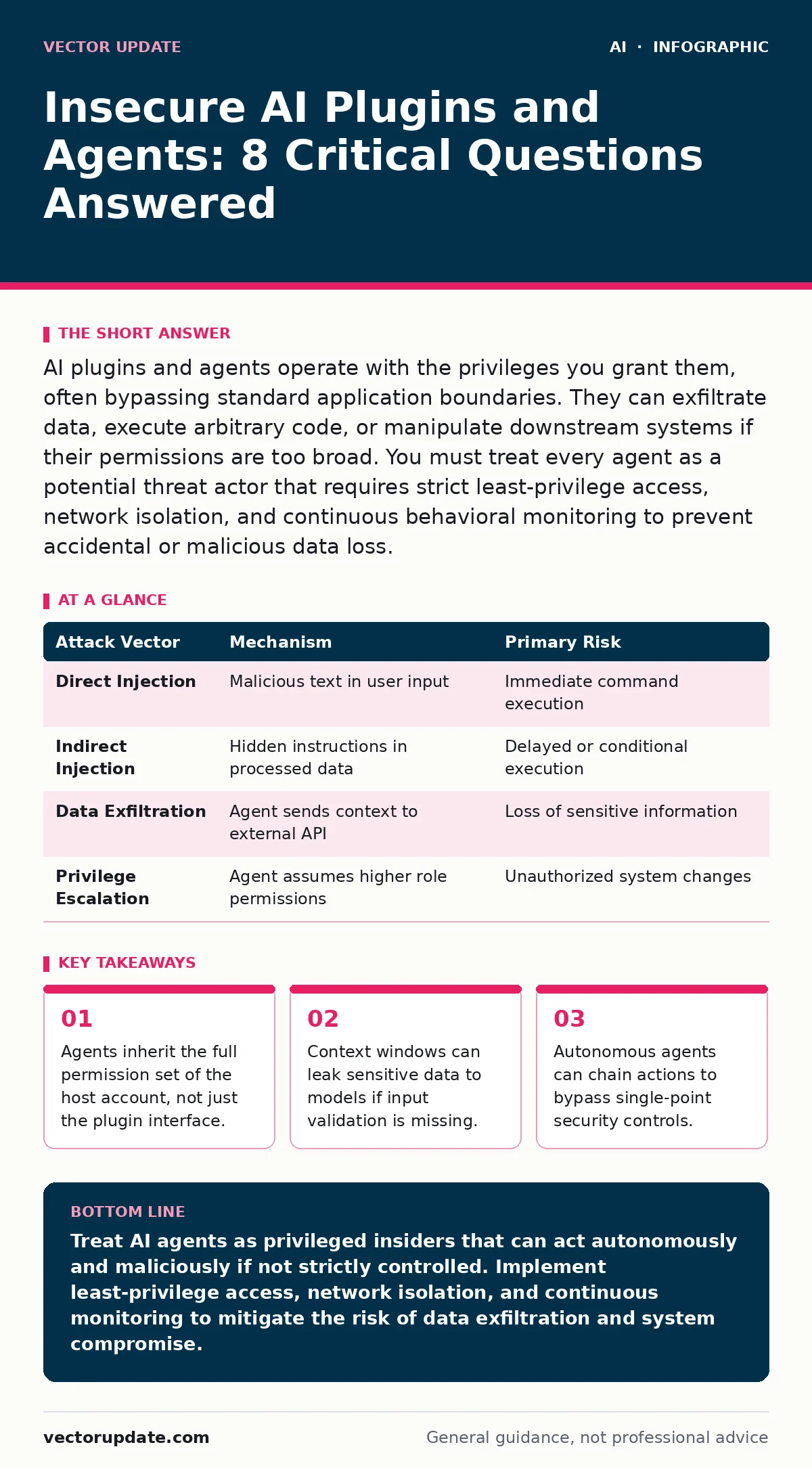
AI plugins and agents operate with the privileges you grant them, often bypassing standard application boundaries. They can exfiltrate data, execute arbitrary code, or manipulate downstream systems if their permissions are too broad. You must treat every agent as a potential threat actor that requires strict least-privilege access, network isolation, and continuous behavioral monitoring to prevent accidental or malicious data loss.
What is the difference between a plugin and an agent?
A plugin is a static tool that extends functionality, while an agent is an autonomous system that plans and executes tasks. Plugins wait for a user command to perform a specific action, such as translating text or summarizing a document. Agents, however, can break complex goals into sub-tasks, call multiple tools, and make decisions without further human input. This autonomy is the primary security risk because an agent can chain actions in ways the developer did not explicitly anticipate.
Why do agents inherit dangerous permissions?
Agents run within the context of the user or service account that invoked them. If you log into an AI platform with administrative rights to your email and file storage, the agent operating on your behalf has those same rights. It does not matter if the agent only needs to read a single document; it can access anything your account can touch. This means a compromised agent can read, modify, or delete any resource within your permission scope, not just the data you intended it to process.
How do context windows create data leaks?
The context window is the limited amount of text an AI model can process at one time. When you paste large documents or code snippets into a chat interface, that data enters the model’s processing memory. If the platform retains this data for training or if the agent sends it to external APIs for analysis, sensitive information leaves your controlled environment. Even with strict retention policies, the act of processing the data creates a transient copy that could be intercepted or logged by intermediate services.
Can an agent bypass application firewalls?
Traditional firewalls inspect network traffic based on ports and protocols, but agents often operate within allowed application channels. Suppose an agent uses an authorized API key to pull data from a database; the firewall sees this as legitimate application traffic. The agent can then manipulate that data or send it to an unauthorized endpoint using the same established connection. This technique, known as tunneling, allows data exfiltration to occur within the bounds of permitted application behavior, evading standard network perimeter defenses.
What is prompt injection and how does it affect agents?
Prompt injection occurs when an attacker embeds malicious instructions within data that the AI processes. If an agent reads an email containing hidden commands to ignore its safety rules, it may execute those commands instead of its intended task. This is distinct from traditional code injection because the "code" is natural language that manipulates the model’s reasoning process. Agents are particularly vulnerable because they often process untrusted data from the web or user inputs without sufficient sanitization.
| Attack Vector | Mechanism | Primary Risk |
|---|---|---|
| Direct Injection | Malicious text in user input | Immediate command execution |
| Indirect Injection | Hidden instructions in processed data | Delayed or conditional execution |
| Data Exfiltration | Agent sends context to external API | Loss of sensitive information |
| Privilege Escalation | Agent assumes higher role permissions | Unauthorized system changes |
See also: AI in Security Operations: 8 Best Practices for Real-World Defense · How AI Security Operations Work: Mechanisms, Limits, and Blind Spots
How do agents chain actions to escalate privileges?
Autonomous agents can perform a sequence of actions that, individually, seem benign but collectively achieve a malicious goal. Imagine an agent tasked with updating a user profile; it might first read a configuration file, then modify a permission setting, and finally restart a service to apply the change. If any step in this chain lacks proper authorization checks, the agent can inadvertently or maliciously elevate its own privileges. This chaining behavior makes it difficult to detect anomalies because each step appears valid in isolation.
Why is input validation insufficient for AI agents?
Traditional input validation checks for known bad patterns, such as SQL injection strings or script tags. AI agents, however, process natural language and semantic meaning, which is far more complex than structured code. An agent might interpret a seemingly innocent request in a way that triggers unintended behavior due to the model’s reasoning capabilities. Furthermore, agents often generate their own inputs for subsequent API calls, bypassing initial validation checks. You must validate the intent and outcome of the agent’s actions, not just the raw input data.
How can you secure agents against unauthorized actions?
You must enforce least-privilege access by granting agents only the minimum permissions necessary for their specific tasks. Use separate service accounts for different agent functions, rather than sharing a high-privilege account across multiple tools. Implement network segmentation to restrict where agents can send data and which internal services they can reach. Additionally, monitor agent behavior for anomalies, such as unusual data volumes or unexpected API calls, to detect compromised or misbehaving agents early. For deeper technical strategies, see securing AI agents.
What role does human oversight play in agent security?
Human oversight provides a critical check against automated errors and malicious manipulation. While full manual review of every action is impractical, humans must define the boundaries of agent autonomy and review high-risk operations. This includes approving access to sensitive data, validating the results of complex tasks, and intervening when the agent encounters ambiguous situations. Without this layer of oversight, agents can drift from their intended purpose, leading to data leaks or system instability. Refer to responsible AI practices for frameworks on integrating human judgment into automated workflows.
How do regulatory frameworks address AI plugin risks?
Regulations like the EU AI Act classify AI systems based on their risk level, with autonomous agents often falling into higher-risk categories. These frameworks require transparency, risk assessments, and human oversight for systems that interact with users or make decisions affecting them. Compliance often means implementing technical safeguards, such as logging all agent actions and providing clear explanations of how decisions were made. Ignoring these requirements can lead to legal liability, especially if an agent causes harm through data leakage or incorrect actions.
Key takeaways
- Agents inherit the full permission set of the host account, not just the plugin interface.
- Context windows can leak sensitive data to models if input validation is missing.
- Autonomous agents can chain actions to bypass single-point security controls.
Treat AI agents as privileged insiders that can act autonomously and maliciously if not strictly controlled. Implement least-privilege access, network isolation, and continuous monitoring to mitigate the risk of data exfiltration and system compromise.
Frequently asked questions
Can I use public AI models for internal corporate data?
Only if you can guarantee that the data is not retained or used for training. Most public models process data on external servers, creating a risk of data leakage. Use private, on-premises models or dedicated instances with strict data isolation policies.
How do I detect if an agent has been compromised?
Monitor for unusual API call patterns, unexpected data transfers, or actions that deviate from the agent’s defined scope. Implement logging that captures the agent’s decision-making process and inputs for forensic analysis.
Are open-source AI agents more secure than commercial ones?
Open-source agents allow you to audit the code, which can reveal vulnerabilities. However, they require you to maintain security patches and configurations. Commercial solutions may offer built-in security features but can be black boxes. The security level depends on your ability to manage and monitor the system.
What is the biggest risk of using AI plugins in browsers?
Browser plugins often have access to your browsing history, cookies, and active sessions. A compromised plugin can hijack your session tokens, allowing attackers to access your accounts without needing your password. This is a significant risk if the plugin is not regularly updated or vetted.
How this guide was produced: written by the Vector Update editorial team with AI assistance, checked against the public references listed below, and reviewed when the facts change. See our editorial policy or report an error.