Password Spraying Attacks: How They Work and How to Stop Them
Password spraying avoids account lockouts by using one common password against many users, making detection harder than brute-force attacks.

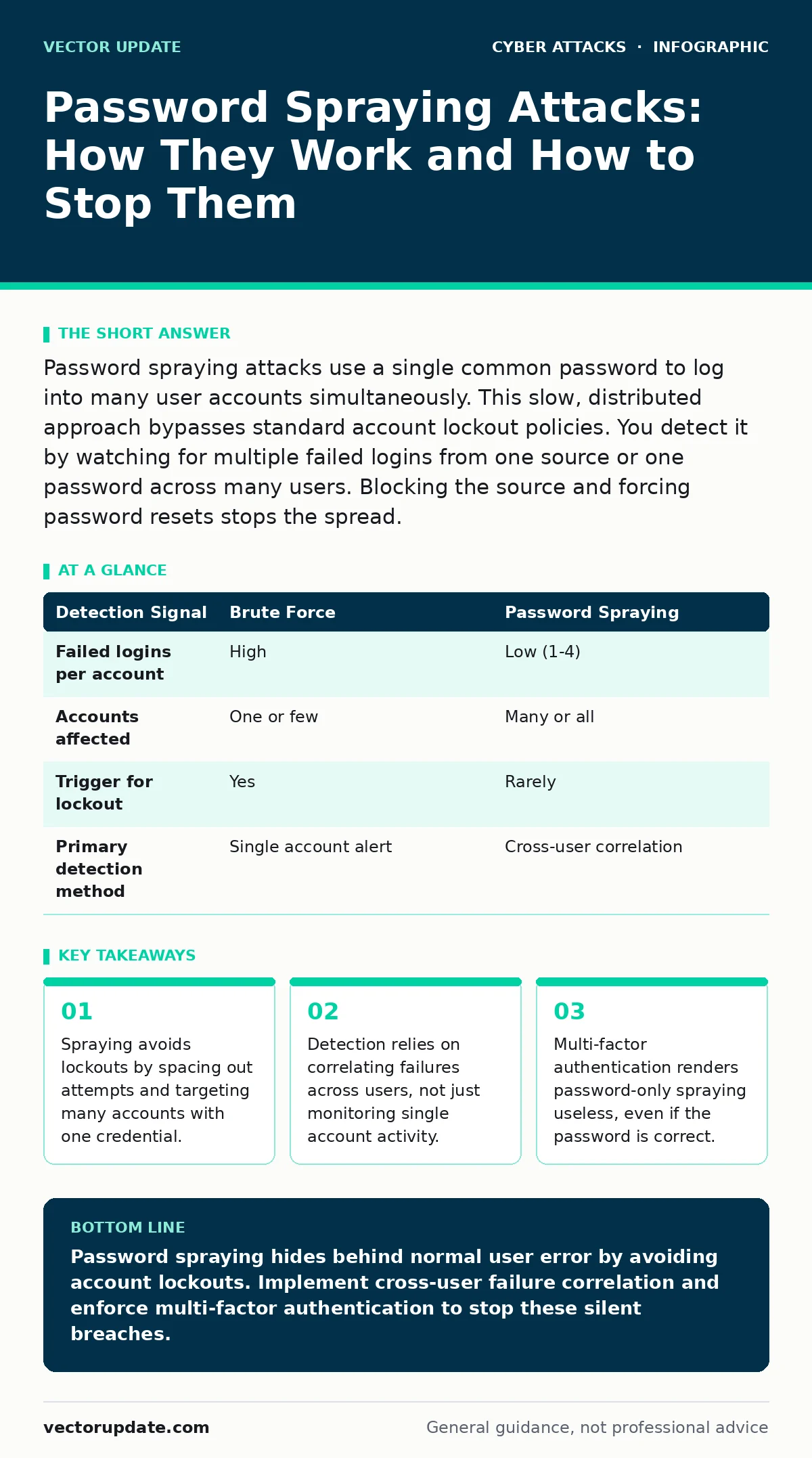
Password spraying attacks use a single common password to log into many user accounts simultaneously. This slow, distributed approach bypasses standard account lockout policies. You detect it by watching for multiple failed logins from one source or one password across many users. Blocking the source and forcing password resets stops the spread.
What is password spraying and how does it differ from brute force?
Password spraying is an attack where an adversary tries one common password against a large number of user accounts. This differs from a brute force attack, which tries many passwords against a single account. Brute force triggers immediate account lockouts, alerting administrators to the breach attempt. Spraying moves slowly to stay under the radar of those same lockout thresholds.
Why do attackers choose spraying over other login attacks?
Attackers choose spraying because it is stealthy and efficient. Standard security configurations lock an account after three or five failed attempts. If an attacker tries ten passwords on one user, the account locks and security teams notice. If they try the word "Summer2024" against ten thousand users, each user only fails once. No single account locks, and no alarm sounds until the attacker finds a match.
How does the attacker select which passwords to use?
The attacker uses a short list of highly probable credentials. These often include seasonal words, company names, or simple patterns like "Password123". The goal is not to guess your unique secret, but to find the users who reuse weak secrets. This technique relies on human behavior rather than computational power.
Can account lockout policies stop a spraying attack?
Standard account lockout policies usually fail to stop spraying. If your policy locks an account after five failures, the attacker simply stops at four. They move to the next user and repeat the process. This creates a low rate of failure that looks like normal user error. Lockout policies protect against single-account targeting, not distributed credential testing.
How do you detect a password spraying attack in progress?
You detect spraying by looking for patterns across the entire user base, not just one account. Monitor for a single source IP address triggering failed logins for many different users. Also watch for many users failing to log in with the same password hash. These correlations reveal the distributed nature of the attack. Without cross-user correlation, the failures look like random typos.
| Detection Signal | Brute Force | Password Spraying |
|---|---|---|
| Failed logins per account | High | Low (1-4) |
| Accounts affected | One or few | Many or all |
| Trigger for lockout | Yes | Rarely |
| Primary detection method | Single account alert | Cross-user correlation |
See also: How to Detect Dictionary Attacks in System Logs · Detect Account Takeover: Signals in Logs, Behavior, and Blind Spots
Does multi-factor authentication prevent password spraying?
Multi-factor authentication stops the final step of a spraying attack. The attacker may guess the password correctly, but they cannot provide the second factor. This renders the stolen credential useless for accessing the account. However, MFA does not prevent the attacker from discovering that the password is correct. They may record the valid credential for later use or for phishing campaigns.
What is the hidden cost of a successful spray?
The hidden cost is the lateral movement and persistence the attacker gains. Once inside one account, the attacker maps the network from the inside. They look for administrative privileges or sensitive data stores. This initial foothold is often the start of a larger compromise. The initial login is just the entry point for deeper system infiltration.
How do you respond when you detect a spray?
Immediate isolation of the source IP address is the first step. Block the IP at the firewall to stop further attempts. Then, force a password reset for all accounts that experienced failed login attempts. This assumes some users may have had their password guessed. Finally, review the successful logins from that IP to identify compromised accounts.
Can intrusion detection systems identify this threat?
Intrusion detection systems can identify spraying if they are configured correctly. They must analyze authentication logs for the specific pattern of low-frequency, high-volume failures. Basic network monitoring may miss this if it only looks for traffic volume. You need log analysis tools that understand authentication semantics. Without proper tuning, IDS tools ignore these slow, quiet attacks.
Why is email filtering relevant to this attack?
Email filtering helps because attackers often use spraying to gain access to email accounts. Once inside, they use the email to send phishing messages to colleagues. This extends the attack chain beyond the initial compromise. Blocking external emails that look like internal replies can stop this secondary phase. It limits the damage even if the initial spray succeeds.
How does this relate to account takeover?
Password spraying is a primary method for account takeover. It allows attackers to claim ownership of user identities without triggering alarms. Once they control the account, they can reset other passwords or add recovery emails. This shifts control of the identity from the user to the attacker. Preventing the initial login is the only way to stop this takeover.
Key takeaways
- Spraying avoids lockouts by spacing out attempts and targeting many accounts with one credential.
- Detection relies on correlating failures across users, not just monitoring single account activity.
- Multi-factor authentication renders password-only spraying useless, even if the password is correct.
Password spraying hides behind normal user error by avoiding account lockouts. Implement cross-user failure correlation and enforce multi-factor authentication to stop these silent breaches.
Frequently asked questions
Is password spraying illegal?
Yes, attempting to access computer systems without authorization is illegal in most jurisdictions. Even if no data is stolen, the act of testing credentials constitutes unauthorized access.
Can 2FA be bypassed after a successful spray?
Some attackers use MFA fatigue attacks or SIM swapping to bypass 2FA. However, the initial password spray is just the first step. Strong 2FA methods like FIDO2 keys are resistant to these follow-up attacks.
Should I disable password resets for compromised accounts?
No, you must force a password reset. The attacker knows the old password is valid. Keeping the old password active leaves the account vulnerable to immediate re-entry.
How often should I rotate passwords?
Regular rotation is less effective than using unique, complex passwords and MFA. Forcing frequent changes often leads to weaker passwords. Focus on detecting unauthorized access rather than arbitrary time-based changes.
How this guide was produced: written by the Vector Update editorial team with AI assistance, checked against the public references listed below, and reviewed when the facts change. See our editorial policy or report an error.