Detect Account Takeover: Signals in Logs, Behavior, and Blind Spots
Account takeover often hides in plain sight within normal traffic patterns, requiring correlation of disparate log sources rather than reliance on single-point alerts.

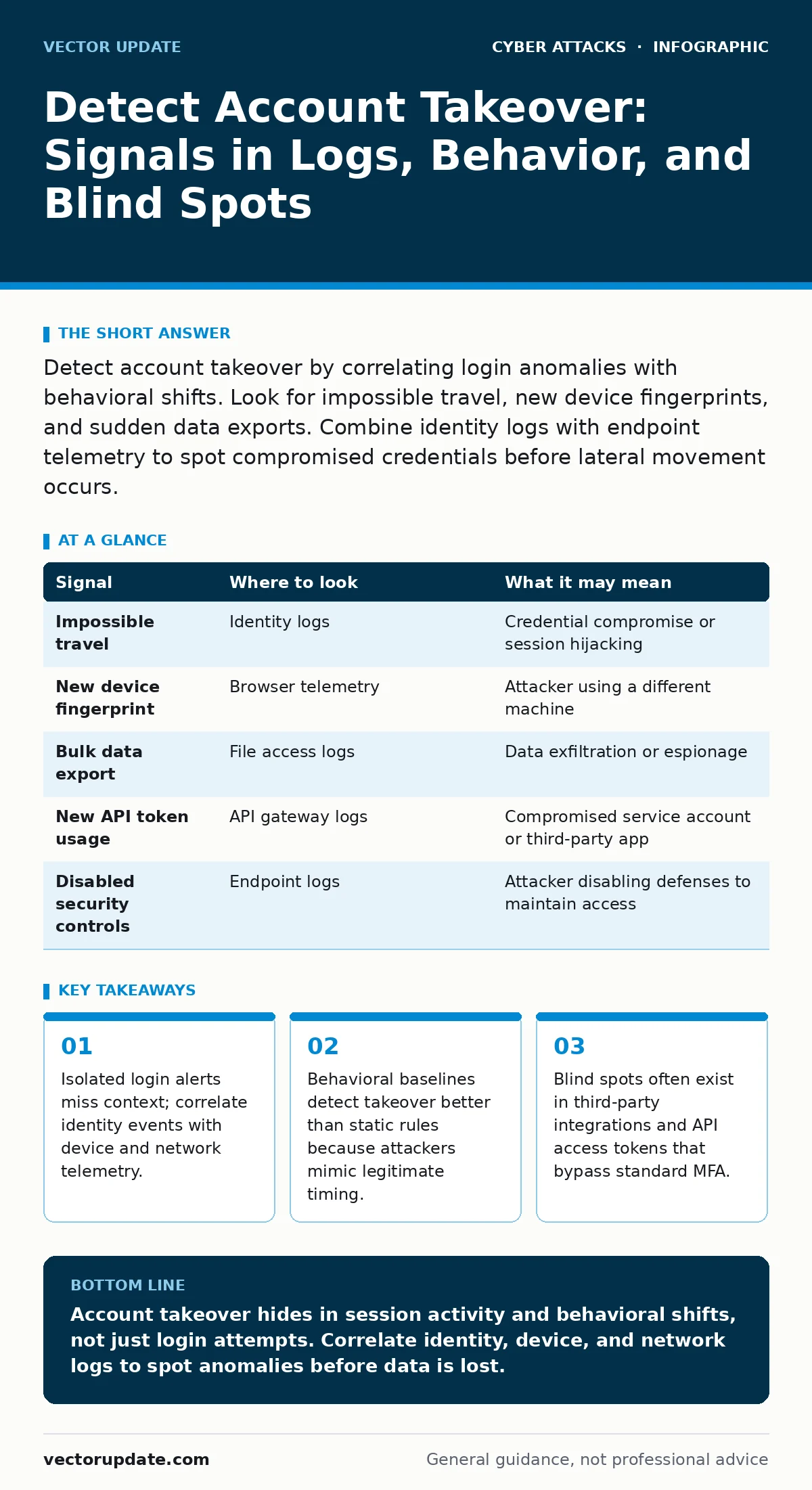
Detect account takeover by correlating login anomalies with behavioral shifts. Look for impossible travel, new device fingerprints, and sudden data exports. Combine identity logs with endpoint telemetry to spot compromised credentials before lateral movement occurs.
The Silence After the Storm
Most teams focus on the moment of entry. They watch for failed login attempts and brute force patterns. This focus is understandable but incomplete. By the time an attacker succeeds, the real damage is already in motion. You need to look at what happens immediately after authentication.
Silence is a signal. If a user logs in from a new location and then performs no actions, that is suspicious. If they immediately download a large archive of contacts, that is also suspicious. The gap between authentication and action contains the evidence. You must track the session lifecycle, not just the login event.
Identity Logs and Impossible Travel
Identity logs record who accessed the system and when. These logs are the primary source for detecting credential compromise. Look for geolocation anomalies that defy physical reality. This is known as impossible travel.
Suppose a user logs in from New York at 9:00 AM. Ten minutes later, a second login occurs from Berlin. No commercial flight covers that distance in that time. This indicates two different actors using the same credentials.
Do not rely solely on IP addresses. VPNs and cloud services obscure true location. Combine IP data with device fingerprinting. If the operating system or browser version changes along with the location, the risk increases.
Device Fingerprinting and Browser Telemetry
Every device sends a unique set of attributes during a connection. This is called a device fingerprint. It includes screen resolution, installed fonts, and browser plugins. Legitimate users rarely change their entire digital footprint overnight.
When an attacker takes over an account, they use their own machine. The fingerprint will differ from the user’s historical baseline. Even if they use the same browser, the underlying hardware signals change.
Monitor for sudden shifts in user-agent strings. A shift from a mobile iOS agent to a desktop Windows agent in the same session is a red flag. Some attackers try to spoof these headers, but inconsistencies often remain in the TLS handshake or cookie behavior.
Behavioral Baselines and Data Movement
Users have habits. They access specific folders at specific times. They download certain file types. Deviations from these patterns often indicate account takeover. This is behavioral analytics.
Look for unusual data access patterns. A marketing user suddenly accessing engineering source code is an anomaly. A finance user exporting customer lists to a personal email address is another. These actions may be authorized by the system but are unauthorized by policy.
Check for new device registrations. Attackers often add their own devices to trusted lists to bypass future security checks. Review logs for device enrollment events following a successful login from an unusual source.
API Access and Third-Party Integrations
Modern applications rely on APIs. Attackers target API tokens because they often bypass standard user-facing security controls. An API key may have broader permissions than the user who generated it.
Look for API calls that originate from unfamiliar IP ranges. Check for tokens that are used in conjunction with new devices. If a service account suddenly accesses resources it never touched before, investigate immediately.
Review third-party application authorizations. Users often grant access to apps that later become compromised. If a social media integration suddenly starts posting from a corporate account, trace the token back to its origin.
See also: Intrusion Detection Systems Best Practices for Network Security · How to Detect Dictionary Attacks in System Logs
Common Blind Spots in Detection
Most detection systems have gaps. Understanding these gaps prevents false confidence. The most common blind spot is the assumption that MFA equals security. MFA protects the login, not the session.
Once an attacker has a valid session cookie, they do not need to log in again. They can act as the user until the cookie expires. This bypasses login-based detection entirely. You must monitor session activity, not just authentication events.
Another blind spot is privileged accounts. Administrators have broad access, so their actions often look normal to automated systems. An admin downloading a user database might be flagged, but an admin querying a database might not. Context is missing.
Correlating Signals Across Systems
No single log source tells the whole story. You must correlate identity logs with network traffic and endpoint data. This requires a unified view of security events.
If an identity log shows a login from a new device, check the endpoint protection logs on that device. Is the device clean? If endpoint protection is missing or disabled, the risk is higher.
Use intrusion detection systems to monitor for known attack patterns. However, these systems often miss novel techniques. Combine them with behavioral analytics to catch unknown threats.
| Signal | Where to look | What it may mean |
|---|---|---|
| Impossible travel | Identity logs | Credential compromise or session hijacking |
| New device fingerprint | Browser telemetry | Attacker using a different machine |
| Bulk data export | File access logs | Data exfiltration or espionage |
| New API token usage | API gateway logs | Compromised service account or third-party app |
| Disabled security controls | Endpoint logs | Attacker disabling defenses to maintain access |
Refining Your Detection Strategy
Detection improves with refinement. Start by establishing baselines for your users. What is normal behavior? What devices do they use? What times do they work?
Update these baselines regularly. User behavior changes. New software is installed. Travel is common. Static rules become noise quickly.
Integrate login alerts with other security tools. If a login alert fires, automatically check for related endpoint alerts. This reduces the time to respond.
Remember that prevention is not enough. Assume compromise. Build processes to detect and respond to account takeover quickly. This minimizes damage and preserves trust.
Key takeaways
- Isolated login alerts miss context; correlate identity events with device and network telemetry.
- Behavioral baselines detect takeover better than static rules because attackers mimic legitimate timing.
- Blind spots often exist in third-party integrations and API access tokens that bypass standard MFA.
Account takeover hides in session activity and behavioral shifts, not just login attempts. Correlate identity, device, and network logs to spot anomalies before data is lost.
Frequently asked questions
How do I distinguish between a legitimate user traveling and an attacker?
Look for device consistency. A traveling user usually keeps their device. An attacker often uses a new device or IP range that does not match the user’s history.
Can multi-factor authentication prevent account takeover?
MFA prevents unauthorized login
How this guide was produced: written by the Vector Update editorial team with AI assistance, checked against the public references listed below, and reviewed when the facts change. See our editorial policy or report an error.