Map Your Digital Footprint to Stop Silent Data Loss
Your external digital footprint reveals hidden attack paths that internal audits miss, exposing gaps before attackers exploit them.
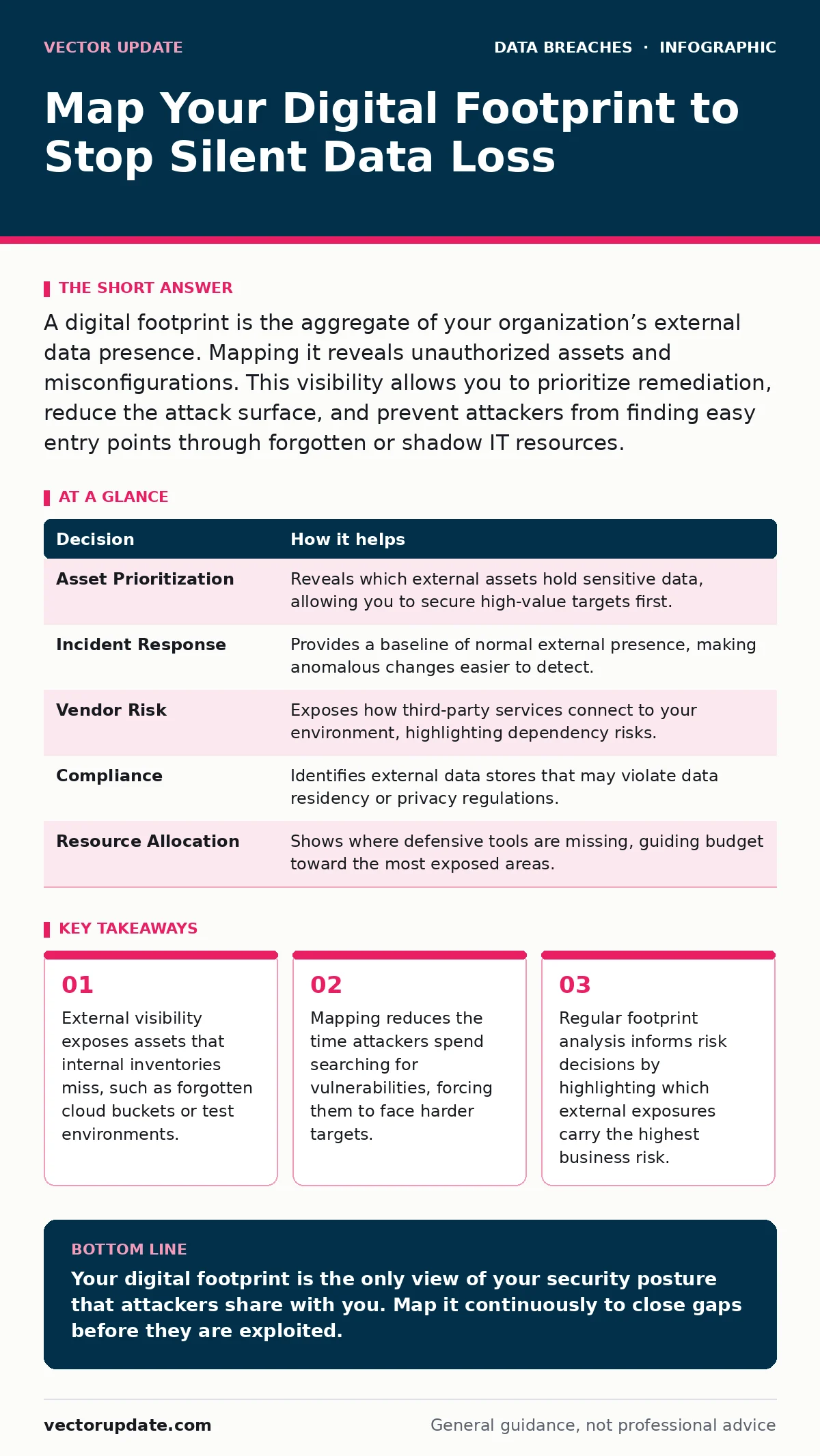
A digital footprint is the aggregate of your organization’s external data presence. Mapping it reveals unauthorized assets and misconfigurations. This visibility allows you to prioritize remediation, reduce the attack surface, and prevent attackers from finding easy entry points through forgotten or shadow IT resources.
The Hidden Surface
Your organization does not exist in a vacuum. Every server, API endpoint, and employee profile creates a trace on the public internet. This collection of traces is your digital footprint. Most teams focus on internal security controls. They patch servers, configure firewalls, and monitor logs. These measures are necessary but insufficient. Attackers do not start inside your network. They start by observing what you have left exposed.
If you cannot see your own footprint, you cannot protect it. Imagine a developer pushes a test database to the cloud. They forget to set access controls. The database is now part of your footprint. Internal audits may not catch it because it is not on the official asset list. External scanners will find it within hours. This gap between what you think you have and what the world can see is where breaches begin.
Why Internal Audits Fail
Internal asset inventories are static. They rely on manual updates or automated discovery tools that only scan known networks. They miss shadow IT. They miss decommissioned assets that still resolve in DNS. They miss third-party integrations that expose your data. A digital footprint map is dynamic. It reflects the reality of the internet. It shows what is visible to anyone, anywhere.
Consider the difference between a closed door and a window. Internal audits check the locks on the doors. They do not check if the windows are open. Attackers prefer open windows. They are easier to exploit and often lack monitoring. Your footprint tells you which windows are open. It allows you to close them before someone looks in. This shift from internal assumption to external reality is the core of modern defense.
Decisions Informed by Visibility
Knowing your footprint changes how you allocate resources. You stop guessing where the risk is. You start seeing it. This clarity informs specific security decisions. It moves the conversation from abstract risk to concrete exposure.
| Decision | How it helps |
|---|---|
| Asset Prioritization | Reveals which external assets hold sensitive data, allowing you to secure high-value targets first. |
| Incident Response | Provides a baseline of normal external presence, making anomalous changes easier to detect. |
| Vendor Risk | Exposes how third-party services connect to your environment, highlighting dependency risks. |
| Compliance | Identifies external data stores that may violate data residency or privacy regulations. |
| Resource Allocation | Shows where defensive tools are missing, guiding budget toward the most exposed areas. |
This table illustrates how visibility drives action. Without it, decisions are based on fear or outdated lists. With it, they are based on evidence. You can justify spending on specific controls because you can point to the specific exposure they mitigate.
The Cost of Blindness
What happens when you ignore your footprint? You leave the door open. Attackers use automated tools to scan the internet. They look for misconfigurations, default credentials, and exposed interfaces. If you do not know you have an exposed admin panel, you will not patch it. You will not monitor it. You will not restrict access to it.
Imagine a team that relies solely on internal scans. They believe their perimeter is secure. An attacker finds an old API endpoint that was never decommissioned. The endpoint accepts unauthenticated requests. The attacker exfiltrates data. The team is shocked. They did not know the endpoint existed. This is not a failure of technology. It is a failure of visibility. The cost is not just the data loss. It is the erosion of trust and the regulatory penalties that follow.
How Teams Use Footprint Data
Security teams use footprint data for continuous monitoring. They do not wait for an audit. They set up alerts for changes. A new DNS record triggers an investigation. A new open port triggers a review. This proactive stance reduces the window of opportunity for attackers.
Operations teams use it for hygiene. They identify stale records. They clean up cloud storage buckets. They ensure that decommissioned services are truly gone. This reduces noise. It makes genuine threats easier to spot. When the background noise is low, the signal is clear.
Risk teams use it for quantification. They assign risk scores to external assets. They prioritize remediation based on exposure and value. This aligns security with business goals. It shows that security is not just a cost center. It is a risk management function.
See also: How Data Encryption Works: The Mechanics and Hidden Limits · Cyber Insurance Best Practices That Actually Reduce Claims
Integrating with Broader Strategy
Footprint management does not exist in isolation. It connects to other security disciplines. For example, if your footprint reveals exposed credentials, you must address account takeover fraud. If it reveals unencrypted data stores, you must implement data encryption. If it reveals critical infrastructure dependencies, you must update your business continuity planning.
These connections matter. A footprint map is a diagnostic tool. It tells you what is wrong. Other controls tell you how to fix it. You cannot fix what you cannot see. But seeing it is not enough. You must act. The integration of visibility with remediation is what closes the loop.
The Human Element
Technology alone does not manage the footprint. People do. Developers create assets. Administrators configure them. Managers approve them. Each step introduces risk. Each step introduces opportunity for error. You need processes that catch these errors early.
Implement code review gates that check for exposed secrets. Require approval for new external-facing services. Train developers on secure configuration. Make visibility a shared responsibility. When everyone understands the impact of their actions on the external footprint, the overall risk drops. It is not just a security problem. It is an operational discipline.
Building a Sustainable Process
Sustainability requires automation. Manual scanning is too slow. It is too error-prone. You need tools that continuously monitor your external presence. You need integration with your ticketing systems. You need workflows that route findings to the right owners.
Define clear ownership. Who is responsible for each asset? Who fixes misconfigurations? Who approves changes? Document these roles. Enforce them. Without accountability, findings sit in a queue. They never get fixed. The footprint grows. The risk grows.
Regular reviews are necessary. Quarterly audits of the footprint process ensure it remains effective. Adjust thresholds. Update alert rules. Refine the asset classification. The process must evolve with the environment. It must stay relevant. It must stay useful.
Key takeaways
- External visibility exposes assets that internal inventories miss, such as forgotten cloud buckets or test environments.
- Mapping reduces the time attackers spend searching for vulnerabilities, forcing them to face harder targets.
- Regular footprint analysis informs risk decisions by highlighting which external exposures carry the highest business risk.
Your digital footprint is the only view of your security posture that attackers share with you. Map it continuously to close gaps before they are exploited.
Frequently asked questions
How often should I scan my digital footprint?
Continuously. The internet changes rapidly. Daily or real-time scanning ensures you catch new exposures quickly. Weekly is the minimum for smaller environments.
What tools can I use to map my footprint?
Use external attack surface management tools. These specialize in discovering and monitoring external assets. They integrate with existing security stacks.
Is footprint mapping enough to prevent breaches?
No. It identifies exposures. You must still patch, secure, and monitor those assets. Visibility is the first step, not the last.
How do I handle false positives in footprint data?
Establish a verification process. Cross-reference findings with internal asset lists. Use contextual data to filter noise. Refine your rules over time.
How this guide was produced: written by the Vector Update editorial team with AI assistance, checked against the public references listed below, and reviewed when the facts change. See our editorial policy or report an error.