Cyber Insurance Best Practices That Actually Reduce Claims
Most policies deny claims because you failed to meet the specific technical controls required by the contract, not because of the attack itself.

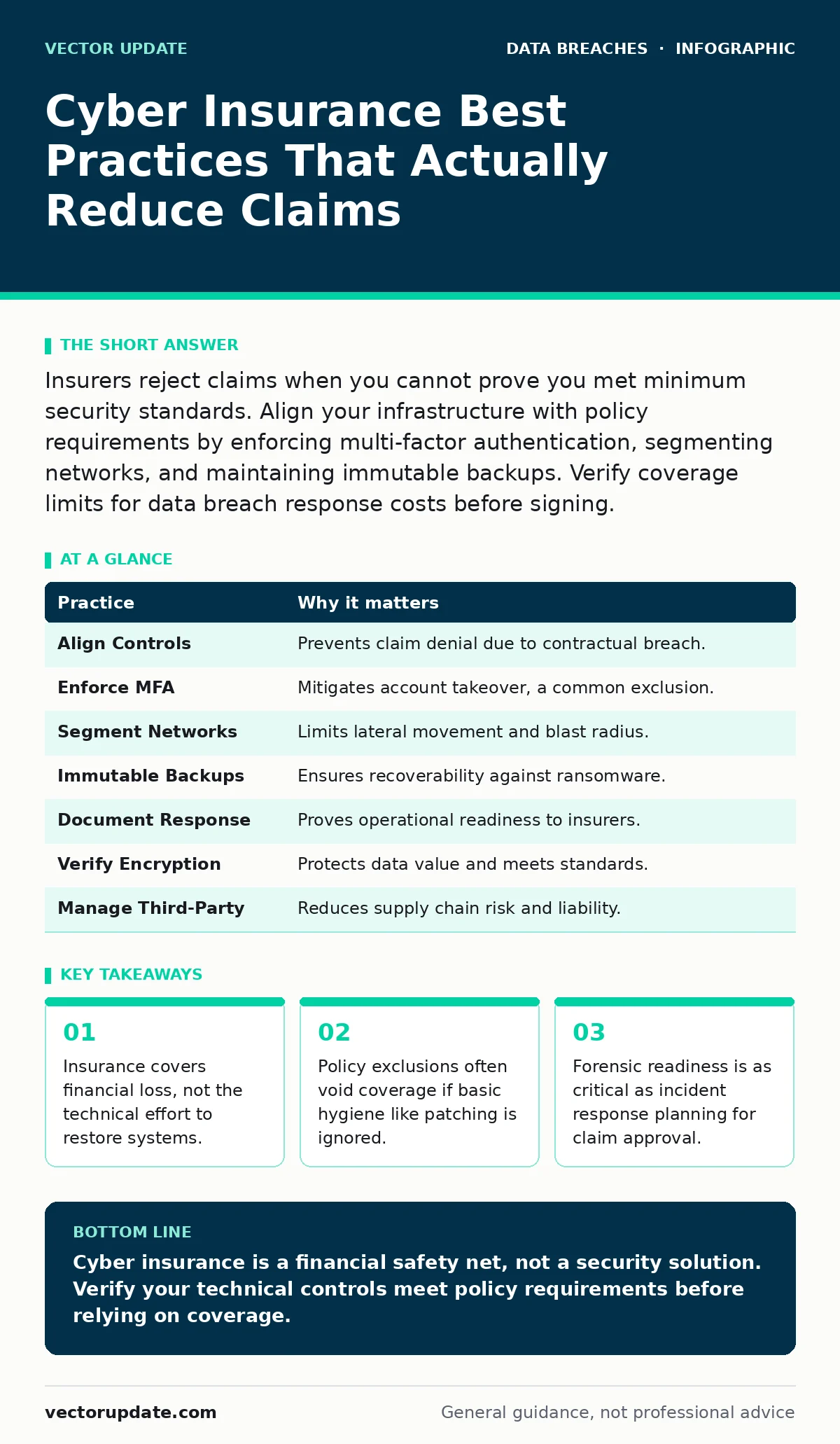
Insurers reject claims when you cannot prove you met minimum security standards. Align your infrastructure with policy requirements by enforcing multi-factor authentication, segmenting networks, and maintaining immutable backups. Verify coverage limits for data breach response costs before signing.
1. Align Controls with Policy Exclusions
Cyber insurance does not cover every loss. Policies contain exclusion clauses that void coverage if you fail to maintain specific security controls. If your contract requires multi-factor authentication (MFA) and you lack it, the insurer can deny the claim entirely. This is not a negotiation; it is a contractual breach. You must map your technical controls to the policy requirements before signing.
Tip: Create a checklist of every technical requirement in the insurance policy. Audit your environment against this list quarterly.
2. Enforce Multi-Factor Authentication Everywhere
Single-factor authentication is a primary exclusion trigger. Attackers bypass passwords easily, and insurers view this as negligence. MFA adds a second layer of verification, such as a hardware token or biometric scan. This makes account takeover significantly harder. Even if a password is stolen, the attacker cannot access the account without the second factor.
Tip: Disable SMS-based MFA where possible. SIM swapping attacks can intercept text messages. Use authenticator apps or hardware keys instead.
3. Segment Networks to Limit Blast Radius
Flat networks allow attackers to move freely once they breach the perimeter. If a laptop is compromised, the attacker can reach the database server. Network segmentation divides your infrastructure into isolated zones. Traffic between zones requires explicit permission. This limits the damage of a single breach. Insurers prefer segmented environments because they reduce potential liability.
Tip: Use virtual local area networks (VLANs) to separate guest Wi-Fi from corporate devices. Block all traffic between these segments by default.
4. Maintain Immutable Backups
Ransomware encrypts active data. If your backups are connected to the network, ransomware encrypts them too. Immutable backups cannot be changed or deleted for a set period. This ensures you have a clean copy to restore from. Insurance policies often require proof of immutable or offline backups. Without them, you may face extended downtime and higher claim costs.
Tip: Test your backup restoration process monthly. A backup you cannot restore is useless during a crisis.
5. Document Incident Response Procedures
Insurers require proof that you can respond to incidents effectively. A vague plan is not enough. You need step-by-step procedures for containment, eradication, and recovery. Document who does what and when. This documentation demonstrates operational readiness. It also speeds up the forensic investigation, which is often required for claim validation.
Tip: Conduct table-top exercises twice a year. Simulate a breach scenario and walk through your response plan with key staff.
See also: Access Reviews Explained: The Hidden Cost of Stale Permissions · Account Takeover Fraud: The Step-by-Step Attack Chain
6. Verify Data Encryption Standards
Encryption protects data at rest and in transit. If unencrypted data is breached, the financial impact is higher. Insurers look for strong encryption algorithms. Weak encryption can be cracked, leading to data exposure. Ensure you use industry-standard algorithms like AES-256. This applies to databases, file servers, and endpoints.
Tip: Review your data encryption practices regularly. Ensure keys are stored securely and rotated periodically.
7. Manage Third-Party Risk
Your vendors are your weak links. If a vendor suffers a breach, your data may be exposed. Insurers often limit coverage for third-party incidents. You must assess the security posture of your vendors. Require them to provide security certifications. Monitor their compliance continuously. This reduces the risk of supply chain attacks.
Tip: Include security requirements in your vendor contracts. Define the level of protection expected and the consequences of non-compliance.
8. Track Employee Training Records
Human error causes many breaches. Phishing attacks trick employees into revealing credentials. Insurers require proof of security awareness training. One-time training is insufficient. You need ongoing education. Track completion rates and test results. This shows you are actively reducing human risk.
Tip: Log every training session. Keep records of who completed it and when. This documentation supports your claim if an employee falls for a phishing attack.
9. Understand Coverage Limits and Deductibles
Insurance policies have limits on how much they will pay. There is also a deductible, the amount you pay before coverage kicks in. Understand these numbers before you sign. A low limit may not cover a major breach. A high deductible shifts more cost to you. Calculate your maximum potential loss. Ensure your coverage matches that risk.
Tip: Review your policy annually. Update limits as your data volume and value grow.
| Practice | Why it matters |
|---|---|
| Align Controls | Prevents claim denial due to contractual breach. |
| Enforce MFA | Mitigates account takeover, a common exclusion. |
| Segment Networks | Limits lateral movement and blast radius. |
| Immutable Backups | Ensures recoverability against ransomware. |
| Document Response | Proves operational readiness to insurers. |
| Verify Encryption | Protects data value and meets standards. |
| Manage Third-Party | Reduces supply chain risk and liability. |
| Track Training | Demonstrates reduction of human error risk. |
| Understand Limits | Ensures financial coverage matches actual risk. |
10. Regularly Review Access Permissions
Excessive access increases risk. Employees who leave often retain access. Insurers look for strict access controls. Conduct access reviews regularly. Remove unnecessary permissions. This reduces the attack surface. It also simplifies incident response by limiting who could have accessed sensitive data.
Tip: Automate access provisioning and de-provisioning. Trigger revocation when an employee leaves or changes roles.
11. Monitor for Account Takeover Signs
Account takeover fraud is a common attack vector. Attackers use stolen credentials to access accounts. Monitor for unusual login patterns. Flag logins from new locations or devices. Promptly investigate these anomalies. Early detection limits damage. Insurers appreciate proactive monitoring.
Tip: Set up alerts for impossible travel. If a user logs in from two distant locations in a short time, block the session.
12. Protect Source Code Repositories
Leaked source code can reveal vulnerabilities and business logic. Attackers use this to craft targeted attacks. Secure your repositories with strict access controls. Enable audit logs. Monitor for unauthorized commits or downloads. This protects your intellectual property. It also prevents attackers from finding hidden flaws.
Tip: Use private repositories. Restrict push access to authorized developers only.
13. Keep Software Updated
Unpatched software is a known vulnerability. Attackers exploit these flaws frequently. Insurers may deny claims if you fail to patch critical vulnerabilities. Keep your operating systems and applications updated. Automate patch management where possible. This reduces the window of exposure. It shows diligence in risk management.
Tip: Prioritize patches based on risk. Apply critical security updates immediately. Schedule non-critical updates during maintenance windows.
14. Assess Your Digital Footprint
Your digital footprint reveals information about your infrastructure. Attackers use this for reconnaissance. Minimize exposed information. Remove unnecessary public records. Secure your DNS settings. A smaller footprint means fewer targets for attackers. It also reduces the likelihood of being targeted.
Tip: Use threat intelligence services to monitor for exposed assets. Remove any unintended public exposures.
15. Detect Synthetic Media Attacks
Deepfake detection is becoming critical. Attackers use AI to impersonate executives. This can lead to fraudulent transfers or data leaks. Train staff to recognize signs of deepfakes. Verify requests through multiple channels. This adds a layer of security against social engineering. Insurers are beginning to look at this risk.
Tip: Establish a verification protocol for high-value transactions. Always confirm via a secondary channel.
16. Protect Payment Card Data
Payment card theft is costly. If you store card data, you must comply with security standards. Encryption and tokenization reduce risk. Regular audits ensure compliance. This protects your customers and your business. Insurers require proof of compliance for card-related claims.
Tip: Minimize the data you store. Use tokenization to replace sensitive data with non-sensitive equivalents.
17. Keep Browsers Updated
Browsers are a common entry point. Outdated browsers contain known vulnerabilities. Browser updates patch these flaws. Enforce automatic updates. Block outdated versions via policy. This reduces the risk of drive-by downloads. It shows basic hygiene to insurers.
Tip: Use a mobile device management solution to enforce browser updates across all devices.
Key takeaways
- Insurance covers financial loss, not the technical effort to restore systems.
- Policy exclusions often void coverage if basic hygiene like patching is ignored.
- Forensic readiness is as critical as incident response planning for claim approval.
Cyber insurance is a financial safety net, not a security solution. Verify your technical controls meet policy requirements before relying on coverage.
Frequently asked questions
Does cyber insurance cover ransom payments?
Most policies exclude ransom payments due to legal restrictions. Some may cover negotiation fees, but this varies by provider and jurisdiction.
How long does it take to get a claim paid?
Claim processing times vary. It depends on the complexity of the incident and the thoroughness of your documentation. Expect weeks or months.
Can I get insurance if I have had a breach?
It is harder but possible. You must disclose the breach and show improved controls. Premiums may be higher.
Does cyber insurance cover lost revenue?
Many policies include business interruption coverage. This covers lost income during downtime. Check your specific policy limits.
How this guide was produced: written by the Vector Update editorial team with AI assistance, checked against the public references listed below, and reviewed when the facts change. See our editorial policy or report an error.