Hiding your location on X and the reality of platform tracking
Platform location privacy requires understanding metadata beyond simple profile settings because applications infer geography through multiple covert channels.

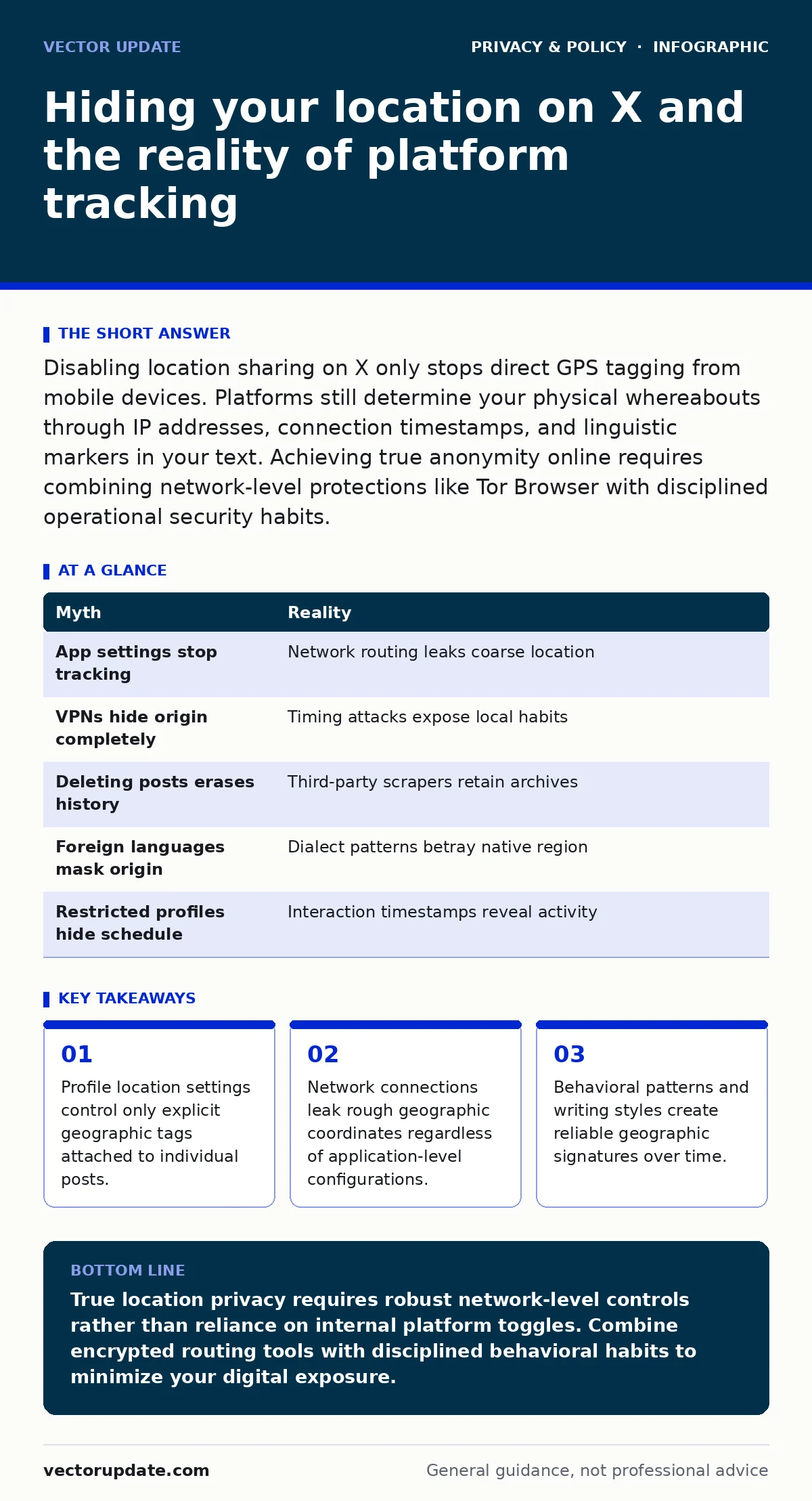
Disabling location sharing on X only stops direct GPS tagging from mobile devices. Platforms still determine your physical whereabouts through IP addresses, connection timestamps, and linguistic markers in your text. Achieving true anonymity online requires combining network-level protections like Tor Browser with disciplined operational security habits.
Myth: Disabling precise location in app settings stops all tracking
Reality: Platform applications gather coarse geographic data from your network connection even when device-level GPS permissions are completely revoked by the user. Mobile operating systems relay cellular tower IDs and local wireless network identifiers directly to application servers during standard background synchronization routines, bypassing explicit user constraints entirely.
Disabling permissions prevents the operating system from handing over exact latitude and longitude coordinates. Application developers design fallback mechanisms that estimate your vicinity using the nearest internet routing nodes. Protecting your physical location demands broader measures such as reducing your digital footprint across every connected service you utilize.
Myth: Using a virtual private network completely hides your country of origin
Reality: Network routing tools obscure your source IP address, but browser fingerprinting and behavioral timing attacks frequently expose your actual timezone and regional affiliation. Service providers analyze your typing cadence, active hours, and interaction speeds to construct a reliable profile of your daily habits regardless of your connection mask.
Routing your traffic through commercial privacy services shifts your apparent network endpoint to a different data center. Sophisticated correlation algorithms match your local connection drops against global routing tables to pinpoint your real country. Effective anonymity often depends on specialized software configurations like Tor Browser to mask these persistent network-level timing signatures.
Myth: Deleting old geotagged posts removes all historical location data
Reality: Removing content from your public timeline only hides it from standard user interfaces while backend data retention policies keep the original records intact indefinitely. Third-party archive scrapers ingest platform streams continuously, capturing every coordinate long before the original author decides to delete the offending material from the live database.
Platform databases maintain immutable transaction logs for auditing and analytics purposes long after individual entries disappear from public view. Archival services index these snapshots permanently, making historical cleanup largely ineffective against targeted reconnaissance. Users frequently pair network tools like VPNs with proactive posting habits to prevent permanent geographic leaks from occurring initially.
Myth: Writing in a foreign language masks your actual physical location
Reality: Linguistic analysis algorithms examine syntax, local slang usage, and regional dialect patterns to identify your native country regardless of the vocabulary you choose. Automated parsers evaluate 3 distinct linguistic markers within short text samples to determine your likely geographic origin with high confidence during standard metric processing runs.
Translating your thoughts into an unfamiliar tongue fails to disguise the underlying structural rhythms of your native speech patterns. Computational models easily separate artificial phrasing from authentic regional dialects by analyzing common grammatical mistakes. Masking your identity requires altering fundamental behavioral routines rather than simply changing the words you post online.
Myth: Restricting profile visibility keeps your timezone and active hours private
Reality: Public engagement metrics reveal your exact schedule because platform activity timestamps display the precise moments you interact with content. Observers record every post, reply, and like to map your local sleep cycles and working hours accurately over 2 weeks of continuous passive monitoring without breaking a sweat.
Hiding your profile contents behind privacy gates prevents casual browsing but leaves interaction endpoints exposed to automated collection scripts. Bots harvest public activity streams to build comprehensive behavioral models without ever viewing a locked profile page. Consistent operational security demands managing your active hours alongside your network connection settings.
Myth: Platform privacy toggles replace network-level security controls
Reality: Application settings manage interface visibility while underlying infrastructure protocols control data transmission security across public networks. Relying solely on internal platform menus leaves your connection vulnerable to ambient data collection by network intermediaries and transit providers who monitor traffic routing paths constantly.
| Myth | Reality |
|---|---|
| App settings stop tracking | Network routing leaks coarse location |
| VPNs hide origin completely | Timing attacks expose local habits |
| Deleting posts erases history | Third-party scrapers retain archives |
| Foreign languages mask origin | Dialect patterns betray native region |
| Restricted profiles hide schedule | Interaction timestamps reveal activity |
Key takeaways
- Profile location settings control only explicit geographic tags attached to individual posts.
- Network connections leak rough geographic coordinates regardless of application-level configurations.
- Behavioral patterns and writing styles create reliable geographic signatures over time.
True location privacy requires robust network-level controls rather than reliance on internal platform toggles. Combine encrypted routing tools with disciplined behavioral habits to minimize your digital exposure.
Frequently asked questions
Can internet service providers see what I post on X?
Network providers monitor the domain names and connection endpoints you visit unless you use encrypted routing protocols. They see the volume and timing of your traffic but cannot read encrypted message payloads directly.
Do mobile phone sensors leak location data to social media apps?
Mobile operating systems share coarse Wi-Fi and cell tower proximity data with applications whenever background services are active. This telemetry bypasses simple GPS toggles embedded inside individual app menus.
How do third-party archives capture deleted social media posts?
Automated data collection bots ingest public platform streams in real time and store the raw payloads in permanent off-site databases. Deleting content from your profile merely removes it from the primary public interface.
Does changing your timezone setting hide your physical location?
Profile timezone configurations have no effect on the network routing metadata or behavioral timing patterns that automated systems analyze. Observers rely on your active hours rather than manual profile settings to determine your region.
How this guide was produced: written by the Vector Update editorial team with AI assistance, checked against the public references listed below, and reviewed when the facts change. See our editorial policy or report an error.