Why Digital Privacy Rights Strengthen Your Security Posture
Privacy rights force systems to minimize data collection, which shrinks the attack surface and limits the damage when a breach occurs.
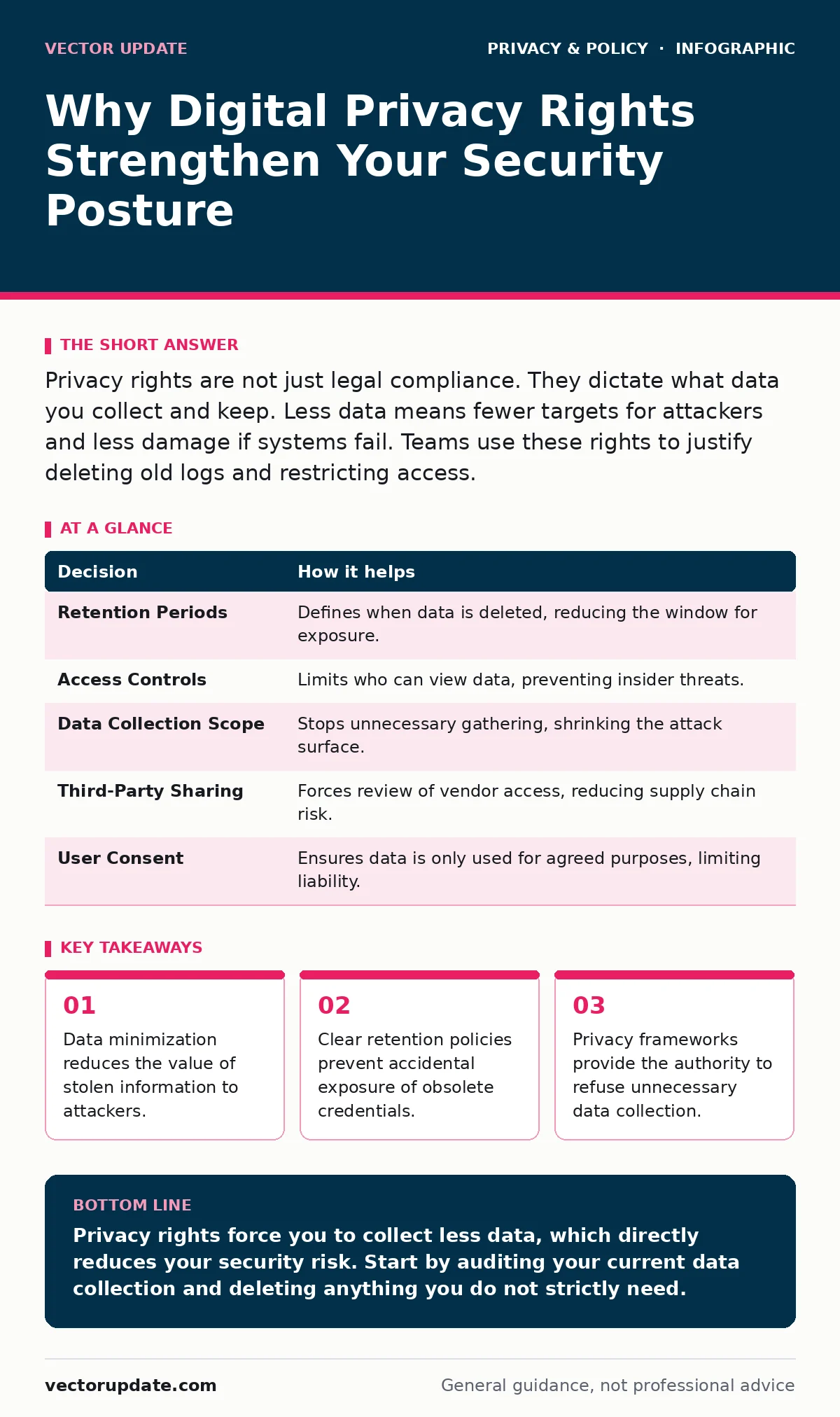
Privacy rights are not just legal compliance. They dictate what data you collect and keep. Less data means fewer targets for attackers and less damage if systems fail. Teams use these rights to justify deleting old logs and restricting access.
The Security Value of Saying No
Most organizations treat privacy as a legal hurdle. They view it as a set of rules from regulators like the CCPA or GDPR that legal teams must satisfy. This view misses the operational benefit. Privacy rights give engineering teams the authority to say no to data collection. When you refuse to collect data you do not need, you remove it from your environment. An attacker cannot steal what you do not have.
This approach changes how you design systems. Instead of asking "Can we collect this?" you ask "Do we need this?" The answer is often no. This shift reduces storage costs, simplifies backups, and lowers risk. It turns privacy from a constraint into a security feature.
Decisions Informed by Privacy Rights
Privacy rights inform technical decisions that directly impact security. They provide the framework for data minimization, which is the practice of collecting only the data strictly necessary for a specific purpose. Without this framework, engineers often collect data "just in case." This leads to bloated databases and unclear ownership.
| Decision | How it helps |
|---|---|
| Retention Periods | Defines when data is deleted, reducing the window for exposure. |
| Access Controls | Limits who can view data, preventing insider threats. |
| Data Collection Scope | Stops unnecessary gathering, shrinking the attack surface. |
| Third-Party Sharing | Forces review of vendor access, reducing supply chain risk. |
| User Consent | Ensures data is only used for agreed purposes, limiting liability. |
These decisions create a structured approach to data handling. They replace ad-hoc habits with documented policies. This structure makes audits easier and security reviews more thorough.
What Goes Wrong Without It
Imagine a team that ignores privacy rights. They collect every click, every location ping, and every device identifier. They store this data indefinitely because "it might be useful later." This creates a massive repository of sensitive information. When a vulnerability is found in their logging system, the attacker gains access to years of user behavior.
The damage is not just financial. The exposure of detailed user habits allows for sophisticated phishing attacks. Attackers use this data to craft messages that seem personal and trustworthy. This bypasses traditional email filters. The team also faces regulatory fines and loss of trust. But the technical debt is worse. The system is now complex and hard to secure because it holds too much.
How Teams Use Privacy Rights
Teams use privacy rights to push back on feature requests. When a product manager asks for new tracking, the security team cites privacy principles. This stops the collection of data that adds little value but high risk. It also helps in workplace monitoring debates. Teams can define clear boundaries on what employee activity is tracked. This prevents the accidental collection of sensitive personal information from company devices.
Privacy rights also guide incident response. When a breach occurs, teams know exactly what data was at risk because they documented it. This clarity speeds up notification and remediation. It also helps in forensic analysis. Investigators focus on the relevant data sets rather than sifting through irrelevant logs.
The Edge Case of Anonymization
Many teams believe that anonymizing data solves privacy issues. They remove names and email addresses from logs. However, differential privacy shows that this is often insufficient. Attackers can combine anonymized data with other public sources to re-identify individuals. This is called linkage attacks.
True privacy requires more than removing identifiers. It requires adding noise to the data so that individual records cannot be distinguished. This is complex to implement. Most teams do not do it correctly. They assume that stripping names is enough. It is not. This false sense of security leads to further data exposure.
See also: How Zero-Knowledge Encryption Works: Secrets the Provider Cannot See · Differential Privacy: Why It Matters for Security and Data Safety
Hidden Costs of Compliance
Implementing privacy rights has hidden costs. One is the loss of data utility. When you minimize data, you have less for analytics. This can slow down product development. Teams must balance security with business needs. Another cost is the complexity of consent management. You must track who consented to what and when. This requires robust systems.
There is also the cost of deletion. Deleting data is not just removing a file. You must ensure it is gone from backups, caches, and third-party services. This requires careful coordination. If you fail to delete data properly, you are still liable. This makes data lifecycle management a critical skill.
Integrating with Other Controls
Privacy rights work best when combined with other security controls. For example, zero-knowledge encryption ensures that even if data is stolen, it cannot be read. This complements data minimization. If you collect less data and encrypt what you keep, you create a strong defense.
Teams should also consider ISP tracking when designing privacy policies. Users may be tracked by their internet providers regardless of your practices. Educating users on this helps manage expectations. You can also recommend tools like Tor Browser for users who need higher anonymity. However, you cannot control external tracking. Your focus must be on your own data handling.
The Long-Term Benefit
The long-term benefit of privacy rights is resilience. Systems that collect less data are simpler. Simpler systems are easier to secure. They have fewer dependencies and less complex logic. This reduces the chance of bugs and vulnerabilities. Over time, this leads to a more stable and secure environment.
It also builds trust with users. When users know you respect their privacy, they are more likely to engage with your services. This trust is a competitive advantage. It is not just about avoiding fines. It is about building a sustainable business model. Privacy rights provide the foundation for this model.
Key takeaways
- Data minimization reduces the value of stolen information to attackers.
- Clear retention policies prevent accidental exposure of obsolete credentials.
- Privacy frameworks provide the authority to refuse unnecessary data collection.
Privacy rights force you to collect less data, which directly reduces your security risk. Start by auditing your current data collection and deleting anything you do not strictly need.
Frequently asked questions
Does following privacy laws guarantee security?
No. Privacy laws reduce data exposure but do not prevent all attacks. You still need strong encryption and access controls.
How do I handle legacy data that violates current privacy standards?
You must delete or anonymize it. Keep records of the deletion process for audits. Do not ignore it.
Can I use data for security monitoring if users did not consent?
Generally, yes. Security monitoring is often considered a legitimate interest or necessary for service provision. Check local laws.
What is the first step to implementing privacy rights?
Map your data flows. Identify what you collect, where it goes, and why. This reveals unnecessary collection.
How this guide was produced: written by the Vector Update editorial team with AI assistance, checked against the public references listed below, and reviewed when the facts change. See our editorial policy or report an error.