Domain Name Security Extensions: How DNSSEC Stops Hijacking
Domain Name System Security Extensions add cryptographic signatures to domain records, proving that the address your computer receives actually came from the rightful owner.

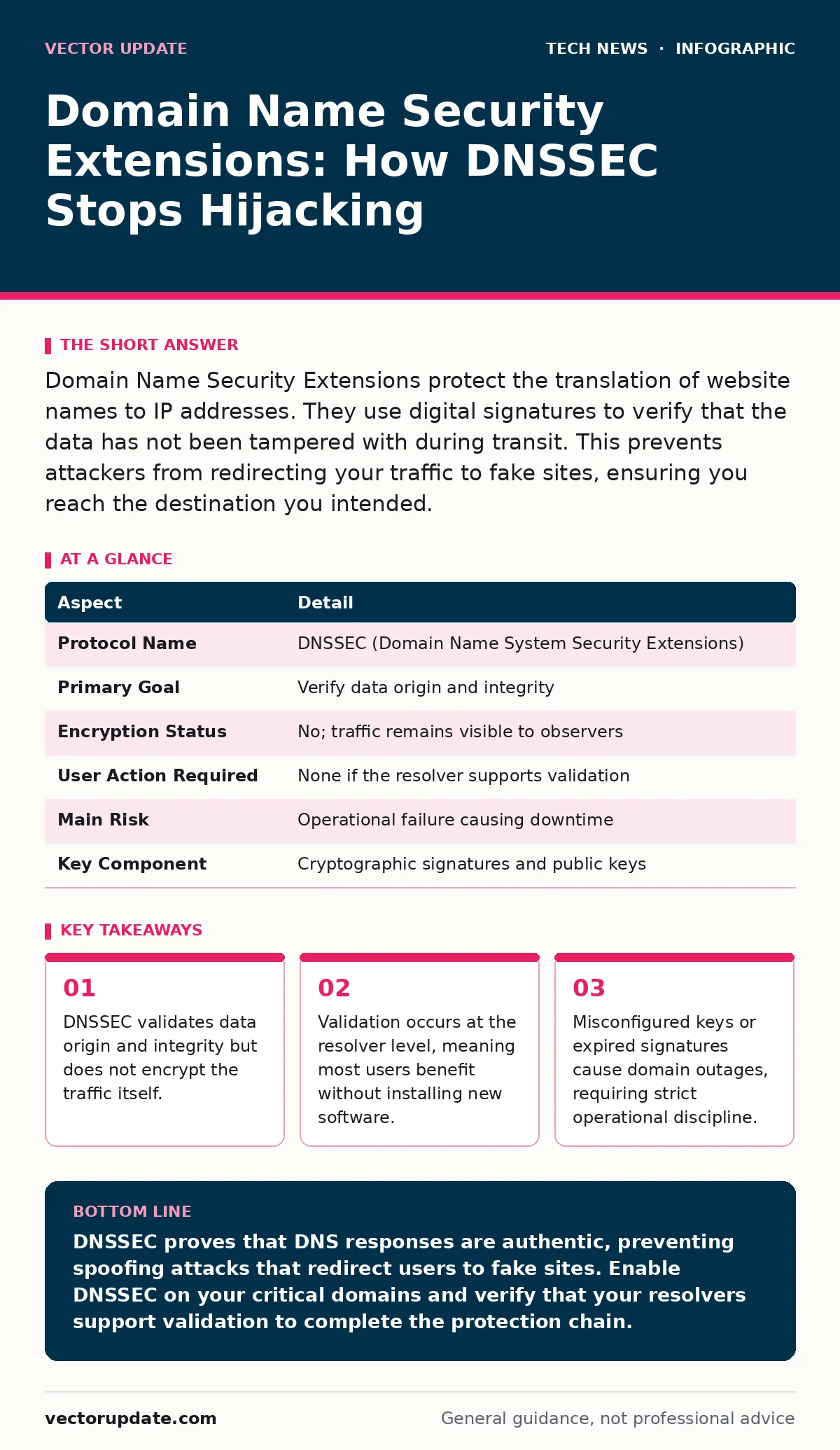
Domain Name Security Extensions protect the translation of website names to IP addresses. They use digital signatures to verify that the data has not been tampered with during transit. This prevents attackers from redirecting your traffic to fake sites, ensuring you reach the destination you intended.
The Phonebook Analogy
Imagine you are looking up a phone number in a public directory. Someone could tear out the page and replace it with a different number. When you call, you reach a stranger, not the person you wanted. Domain Name Security Extensions work like a wax seal on that directory page. The seal proves the page has not been removed or altered since it was last verified by the authority.
This mechanism protects the Domain Name System, which translates human-readable names into machine-readable IP addresses. Without this protection, an attacker can intercept the query and provide a false address. This is called DNS spoofing or cache poisoning. The user sees the correct website name in their browser bar, but the traffic flows to a malicious server.
At a glance
| Aspect | Detail |
|---|---|
| Protocol Name | DNSSEC (Domain Name System Security Extensions) |
| Primary Goal | Verify data origin and integrity |
| Encryption Status | No; traffic remains visible to observers |
| User Action Required | None if the resolver supports validation |
| Main Risk | Operational failure causing downtime |
| Key Component | Cryptographic signatures and public keys |
How Domain Name Security Extensions work
The system relies on a chain of trust that starts at the root zone. Each zone signs its data with a private key. The corresponding public key is stored in the parent zone. When your computer asks for a website address, the resolver checks the signature against the public key. If the signature matches, the data is valid. If it does not match, the resolver discards the data and returns an error.
This process happens automatically in the background. You do not see the cryptographic math. The resolver performs the check before handing the IP address to your browser. If the check fails, you see a connection error. This is better than a silent redirect to a phishing site. The trade-off is complexity. Managing keys requires precise timing and coordination between registrars and hosting providers.
What people usually get wrong
Many administrators assume that enabling DNSSEC encrypts their traffic. It does not. The data travels in plain text. Anyone on the network can see which domains you are querying. DNSSEC only proves that the answer you received is authentic. It does not hide your activity. For privacy, you need a separate mechanism like DNS over TLS or DNS over HTTPS.
Another common error is believing that DNSSEC protects against all attacks. It does not stop Distributed Denial of Service attacks. If an attacker floods the DNS servers with traffic, the service goes down regardless of signatures. It also does not protect against man-in-the-middle attacks if the initial connection is not validated by other means. You must combine it with other security layers.
Who it affects and why it matters
Every internet user benefits from DNSSEC, even if they do not know it is active. Recursive resolvers, operated by ISPs or public services, perform the validation. If your resolver supports DNSSEC, you are protected when visiting signed domains. The burden falls on domain owners to sign their zones. This includes businesses, governments, and large organizations.
The impact is significant for brand reputation and user safety. If a domain is not signed, users can be redirected to counterfeit sites. These sites steal credentials or install malware. The victim sees the legitimate domain name. They have no reason to suspect fraud. Signing the domain creates a verifiable link between the name and the content. This reduces the attack surface for phishing campaigns.
Suppose a bank enables DNSSEC on its primary domain. A customer types the bank's address. The resolver verifies the signature. Even if an attacker intercepts the query, they cannot provide a fake IP address without the private key. The customer connects to the real bank server. The transaction proceeds securely. The attacker is blocked at the routing layer.
Operational costs and hidden risks
Signing a domain is not a one-time task. It requires ongoing management. Keys must be rotated regularly. If a private key is compromised, the entire chain of trust breaks. You must publish a new key and wait for it to propagate across the internet. During this window, the domain may be unreachable. This is called a denial of service by misconfiguration.
The cost is not just technical. It is procedural. Teams must coordinate key rollovers. Mistakes in configuration are common. A single typo in a signature can take down a global service. For smaller organizations, this overhead can be daunting. Some registrars offer managed DNSSEC services to reduce this burden. These services handle the key management for you, but you lose direct control over the cryptographic parameters.
Consider the risk of key expiration. If a key expires and is not replaced, the domain becomes invalid. Users cannot access the site. This is worse than a hack. It is a self-inflicted outage. Regular testing and automated rollover tools mitigate this risk. You must verify that your DNS provider supports these features before committing to DNSSEC.
Integrating with other security measures
DNSSEC is one piece of a larger puzzle. It works best when combined with other standards. For instance, you should use TLS for all web traffic. This ensures that even if DNSSEC fails, the data channel remains encrypted. You should also implement HSTS to prevent downgrade attacks. These layers complement each other.
For developers, understanding DNSSEC helps in building resilient applications. You can check DNSSEC validation results in your code. This allows you to fail securely. If validation fails, your application can warn the user. This is similar to how browsers handle certificate errors. It adds a layer of defense in depth.
What to do about it today
Start by checking if your domains are signed. Most registrars provide a status page. If they are not, consider enabling the service. It is often free or low-cost. Ensure your DNS provider supports automated key rollover. This reduces the operational risk.
Next, verify that your recursive resolvers support validation. Most public resolvers do. Your internal network resolvers may not. Update your server configurations to use validating resolvers. This ensures that internal services also benefit from DNSSEC.
Finally, educate your team on the difference between DNSSEC and encryption. This prevents false assumptions about security posture. Document your key management procedures. Test your rollback plan. Regular drills ensure that you can recover from misconfigurations quickly. This discipline protects your users and your reputation.
Key takeaways
- DNSSEC validates data origin and integrity but does not encrypt the traffic itself.
- Validation occurs at the resolver level, meaning most users benefit without installing new software.
- Misconfigured keys or expired signatures cause domain outages, requiring strict operational discipline.
DNSSEC proves that DNS responses are authentic, preventing spoofing attacks that redirect users to fake sites. Enable DNSSEC on your critical domains and verify that your resolvers support validation to complete the protection chain.
Frequently asked questions
Does DNSSEC hide my browsing history from my ISP?
No, DNSSEC does not encrypt DNS queries. Your ISP can still see which domains you are looking up. You need DNS over TLS or DNS over HTTPS to hide query content from network observers.
Can I enable DNSSEC on a domain that is already live?
Yes, you can enable DNSSEC on an existing domain. The process involves generating keys and adding signatures to your zone files. It does not require changing the domain name or IP addresses, but you must test thoroughly before propagation.
What happens if my DNSSEC keys expire?
If your keys expire and are not renewed, your domain becomes unreachable. Resolvers will reject the unsigned data as invalid. Users will see connection errors. You must rotate keys before expiration to prevent this outage.
Do I need to change my web server settings for DNSSEC?
No, DNSSEC operates at the DNS level, not the web server level. Your web server configuration remains unchanged. However, you should ensure your web server still presents valid TLS certificates for secure communication.
How this guide was produced: written by the Vector Update editorial team with AI assistance, checked against the public references listed below, and reviewed when the facts change. See our editorial policy or report an error.