AI governance vs data governance: the structural difference
Data governance protects the raw material, but AI governance manages the unpredictable behavior of the system that consumes it.

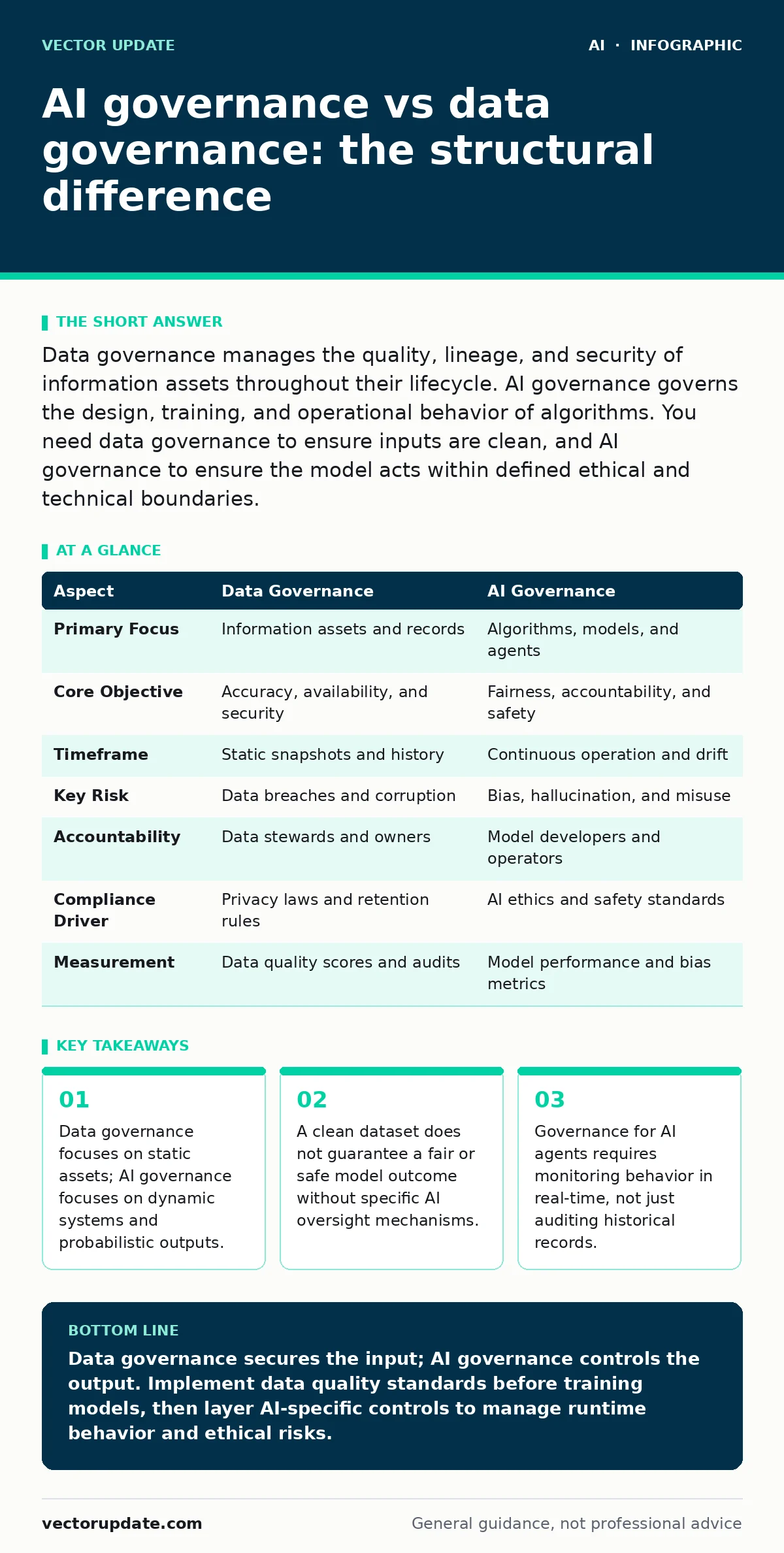
Data governance manages the quality, lineage, and security of information assets throughout their lifecycle. AI governance governs the design, training, and operational behavior of algorithms. You need data governance to ensure inputs are clean, and AI governance to ensure the model acts within defined ethical and technical boundaries.
The core difference between AI and data governance
Data governance establishes the rules for how an organization collects, stores, and uses information. It treats data as a tangible asset with a clear lifecycle. AI governance establishes the rules for how algorithms learn, decide, and interact with users. It treats the model as a dynamic agent with potential side effects. The fundamental distinction lies in predictability.
Data is deterministic; the same record remains unchanged unless updated. AI models are probabilistic; they may produce different outputs for similar inputs based on context or drift. You cannot govern a model using only data policies because the model introduces new variables, such as bias amplification or hallucination, that do not exist in the raw source material.
What data governance actually covers
Data governance defines ownership and quality standards for information. It ensures that the data feeding into your systems is accurate, consistent, and compliant with privacy regulations. This framework maps the lineage of data from its origin to its final destination. It enforces access controls, ensuring that only authorized personnel can view sensitive records.
It also manages data retention, determining when information must be deleted to reduce liability. Without this foundation, any downstream process operates on uncertain inputs. Poor data governance leads to corrupted datasets, which inevitably degrade the performance of any analytical tool or machine learning model that relies on them.
What AI governance must address
AI governance extends beyond the input data to manage the model itself. It covers the entire lifecycle of an algorithm, from initial design and training to deployment and ongoing monitoring. This framework addresses model fairness, ensuring that outputs do not discriminate against protected groups. It requires transparency measures, such as model cards, that document the intended use cases and known limitations of the system. AI governance also mandates continuous monitoring for model drift, where the model’s accuracy degrades as real-world data patterns change. It establishes protocols for human oversight, defining when an algorithmic decision must be reviewed by a person before execution.
Point-by-point comparison of frameworks
| Aspect | Data Governance | AI Governance |
|---|---|---|
| Primary Focus | Information assets and records | Algorithms, models, and agents |
| Core Objective | Accuracy, availability, and security | Fairness, accountability, and safety |
| Timeframe | Static snapshots and history | Continuous operation and drift |
| Key Risk | Data breaches and corruption | Bias, hallucination, and misuse |
| Accountability | Data stewards and owners | Model developers and operators |
| Compliance Driver | Privacy laws and retention rules | AI ethics and safety standards |
| Measurement | Data quality scores and audits | Model performance and bias metrics |
When to choose data governance first
You should prioritize data governance when your primary concern is the integrity of your information assets. This approach is necessary before you begin any large-scale analytics or machine learning initiatives. Choose this path when you need to comply with strict privacy regulations that dictate how personal information is stored and processed.
Implement data governance when you are experiencing inconsistencies in reporting or when different departments hold conflicting versions of the same record. It is the prerequisite for any system that relies on historical accuracy. Without clear data ownership and quality standards, you cannot trust the outputs of any automated system, regardless of how sophisticated the algorithm may be.
When to choose AI governance first
You should prioritize AI governance when you are deploying systems that make autonomous decisions. This is critical when the output of your system directly impacts human lives, such as in healthcare diagnostics or financial lending. Choose this path when your models interact with users in real-time, such as chatbots or recommendation engines. AI governance is necessary when you need to mitigate risks like hallucination or bias that are not present in the source data. It is also required when you are using generative models that can create new content, which introduces legal and ethical complexities that traditional data policies do not cover.
Where the two frameworks overlap
The two frameworks intersect at the training phase. High-quality data is a requirement for responsible AI practices, but clean data alone does not ensure ethical outcomes. You must integrate data lineage tracking into your AI governance framework to prove that training data was sourced legally. Conversely, AI governance requirements often dictate new data collection standards.
For example, if a model requires diverse training data to avoid bias, your data governance policies must enforce collection methods that achieve this diversity. This overlap creates a feedback loop where AI needs influence data strategy, and data constraints shape AI capabilities. Understanding this interdependence prevents siloed governance efforts that leave gaps in your overall security posture.
Managing autonomous systems effectively
As AI systems become more autonomous, traditional governance models struggle to keep pace. You must consider the implications of access controls for AI agents, which may need broader permissions than human users to function effectively. This creates a unique security challenge where the boundary between authorized and unauthorized action becomes blurred.
Implementing monitoring for AI agent hijacking ensures that adversaries cannot manipulate the model’s behavior through prompt injection or other adversarial attacks. The governance framework must include specific protocols for revoking agent access immediately when suspicious behavior is detected, a capability that standard data governance does not provide.
Key takeaways
- Data governance focuses on static assets; AI governance focuses on dynamic systems and probabilistic outputs.
- A clean dataset does not guarantee a fair or safe model outcome without specific AI oversight mechanisms.
- Governance for AI agents requires monitoring behavior in real-time, not just auditing historical records.
Data governance secures the input; AI governance controls the output. Implement data quality standards before training models, then layer AI-specific controls to manage runtime behavior and ethical risks.
Frequently asked questions
Can I use the same policy for both data and AI?
No, because data is static and deterministic, while AI is dynamic and probabilistic. A single policy cannot adequately address the unique risks of algorithmic bias or model drift.
Does good data governance eliminate the need for AI governance?
No, clean data ensures accuracy but does not prevent ethical failures or misuse. AI governance addresses how the model interprets and applies that data in real-world scenarios.
Who is responsible for AI governance in my organization?
Responsibility typically spans multiple teams, including data scientists, legal counsel, and security operations. Clear ownership must be defined for model development and monitoring.
How do I detect if my AI model is drifting?
You must establish baseline performance metrics during training and continuously compare live outputs against these baselines. Significant deviations indicate drift and require retraining.
How this guide was produced: written by the Vector Update editorial team with AI assistance, checked against the public references listed below, and reviewed when the facts change. See our editorial policy or report an error.