Biometric Authentication Systems: How They Work and Where They Fail
Biometric systems convert physical traits into irreversible digital templates, but these templates can be spoofed or stolen just like passwords.
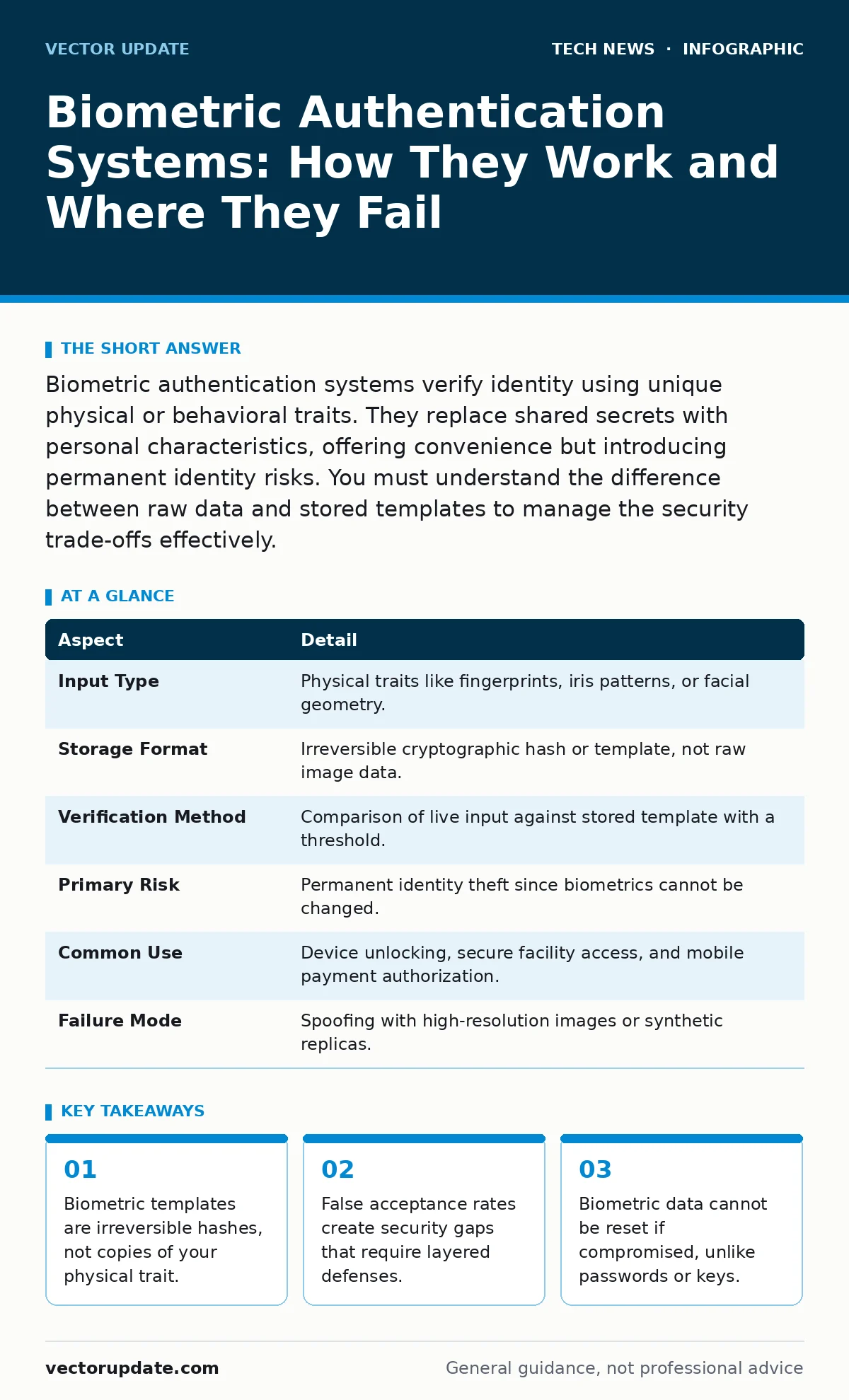
Biometric authentication systems verify identity using unique physical or behavioral traits. They replace shared secrets with personal characteristics, offering convenience but introducing permanent identity risks. You must understand the difference between raw data and stored templates to manage the security trade-offs effectively.
Everyday Analogy for Identity Verification
Think of biometric authentication as using a wax seal instead of a written letter. You press your unique ring into soft wax to leave an impression. The recipient checks the impression against the known pattern of the ring. They do not keep the ring itself. They keep only the shape left behind. If someone steals the wax impression, they can forge new letters. You cannot change the shape of your ring. You must accept that the impression is now compromised forever.
Biometric authentication systems work by capturing a physical characteristic, converting it into a digital template, and comparing that template against a stored reference. The system never stores the actual fingerprint image or face scan. It stores a mathematical representation derived from that data. This process ensures that even if the database is breached, attackers cannot recreate the original biometric trait from the template.
| Aspect | Detail |
|---|---|
| Input Type | Physical traits like fingerprints, iris patterns, or facial geometry. |
| Storage Format | Irreversible cryptographic hash or template, not raw image data. |
| Verification Method | Comparison of live input against stored template with a threshold. |
| Primary Risk | Permanent identity theft since biometrics cannot be changed. |
| Common Use | Device unlocking, secure facility access, and mobile payment authorization. |
| Failure Mode | Spoofing with high-resolution images or synthetic replicas. |
How Biometric Authentication Systems Process Data
The system captures raw data through a sensor. A fingerprint scanner reads ridge patterns. A camera captures facial landmarks. The software extracts specific features from this raw data. It ignores irrelevant details like skin tone or background noise. The algorithm converts these features into a fixed-length string of numbers called a template. This template is unique to the individual but is not the original image.
The system compares the new template against the stored reference. It calculates a similarity score. If the score exceeds a predefined threshold, access is granted. This threshold determines the balance between security and convenience. A high threshold reduces false acceptances but increases false rejections. Users may be locked out more often. A low threshold allows easier access but risks letting impostors in. Administrators must tune this setting based on the sensitivity of the protected resource.
What People Usually Get Wrong
Many users believe biometrics are unbreakable because they are tied to the body. This is false. Biometrics are essentially passwords that you cannot change. If a password is stolen, you reset it. If a fingerprint template is stolen, you cannot get a new fingerprint. Attackers can use stolen templates to create synthetic spoofs. High-resolution photographs can sometimes bypass facial recognition if the system lacks depth sensing or liveness detection.
Another common error is assuming biometrics provide privacy. The system processes your biological data. That data leaves your device in some architectures. Cloud-based authentication sends the template to a server for verification. This creates a central target for attackers. Local storage keeps the template on the device, reducing exposure. You must know where your biometric data resides. Check the privacy policy of any service requesting biometric enrollment.
The Hidden Cost of Permanent Identity
The most significant risk of biometric authentication systems is the permanence of the data. You can rotate API keys. You can revoke OAuth tokens. You can change your WPA3 password. You cannot change your iris pattern. If a database containing biometric templates is breached, your identity is compromised for life. Future systems that use the same biometric trait will be vulnerable.
This creates a long-term liability for organizations. They must protect biometric data with the highest level of encryption and access control. They must also plan for the possibility of mass spoofing. Imagine a scenario where a major social media platform stores facial templates. A breach exposes millions of faces. Attackers can now create deepfakes or synthetic masks to bypass security on other platforms that use facial recognition. The damage compounds across the entire digital ecosystem.
Layering Defenses for Real Security
Biometrics should never be the sole factor of authentication. They work best as one part of a multi-factor approach. Combine biometrics with something you have, like a hardware token or a smartphone. Combine them with something you know, like a PIN or passphrase. This layering ensures that if the biometric factor is spoofed, the attacker still lacks the other required factors.
For device access, use FileVault or similar full-disk encryption tools. These tools often integrate with biometric sensors. If the biometric check fails, the system falls back to a PIN. This fallback is critical. It provides a recovery path if the sensor is dirty or if the user’s appearance has changed. Always ensure that the fallback mechanism is secure and not easily bypassed.
See also: FileVault Disk Encryption: How It Protects Data at Rest · Domain Name Security Extensions: How DNSSEC Stops Hijacking
Managing False Acceptance and Rejection
Every biometric system has error rates. False acceptance occurs when an impostor is accepted as a legitimate user. False rejection occurs when a legitimate user is denied access. These rates are inversely related. Improving security increases inconvenience. You must decide which error is more costly. For a bank vault, false acceptance is catastrophic. For a smartphone, false rejection is annoying.
Environmental factors affect performance. Poor lighting impacts facial recognition. Dry skin affects fingerprint scanners. Age and injury can alter biometric traits over time. Systems must allow for template updates. If you cut your finger, you need to re-enroll your fingerprint. Regular maintenance of biometric templates ensures continued usability. Do not assume enrollment is a one-time event.
Integration with Network Security
Biometric authentication often triggers access to network resources. When a user logs in with a fingerprint, the system may grant access to internal servers. This access must be controlled by proper network segmentation. Use network address translation to hide internal IP addresses from external threats. Monitor traffic with network monitoring tools to detect anomalous behavior after authentication.
If biometrics are used for remote access, ensure the connection is encrypted. Use domain name security practices to prevent DNS spoofing. Attackers may try to intercept the authentication request. If the connection is not secure, the biometric template could be captured in transit. Always verify the integrity of the communication channel between the biometric sensor and the authentication server.
What to Do About Biometric Risks
Start by auditing your current biometric implementations. Identify where templates are stored. Are they on the device or in the cloud? Prefer local storage for high-security environments. Disable biometric enrollment for systems that do not support template encryption. Ensure that the system uses a secure enclave or trusted platform module for processing.
Educate users about the limits of biometrics. Explain that convenience does not equal security. Require multi-factor authentication for sensitive actions. Monitor for signs of spoofing attempts. If you detect unusual access patterns, investigate immediately. Consider the long-term implications of collecting biometric data. Only collect what is necessary. Minimize the attack surface by reducing the amount of biometric data stored.
Key takeaways
- Biometric templates are irreversible hashes, not copies of your physical trait.
- False acceptance rates create security gaps that require layered defenses.
- Biometric data cannot be reset if compromised, unlike passwords or keys.
Frequently asked questions
Can hackers steal my fingerprint from a glass surface?
High-resolution prints can be lifted from smooth surfaces, but they require significant effort and quality. Modern sensors often detect liveness, making simple lifts ineffective.
Is facial recognition safe for public spaces?
Public facial recognition raises privacy concerns and is prone to false positives. It should be used with caution and strict oversight to prevent misidentification.
Do biometrics work if I get a cold or cut?
Minor injuries may cause false rejections. Most systems allow multiple enrollment samples to account for minor variations. Severe injuries may require temporary fallback methods.
How do I reset a compromised biometric?
You cannot reset the biometric trait itself. You must reset the associated account credentials and disable the biometric enrollment on all devices.
How this guide was produced: written by the Vector Update editorial team with AI assistance, checked against the public references listed below, and reviewed when the facts change. See our editorial policy or report an error.