Exposure Management vs Vulnerability Management: The Core Difference
Vulnerability management fixes known flaws in isolated assets, while exposure management maps how those flaws connect to form attack paths across your entire digital estate.

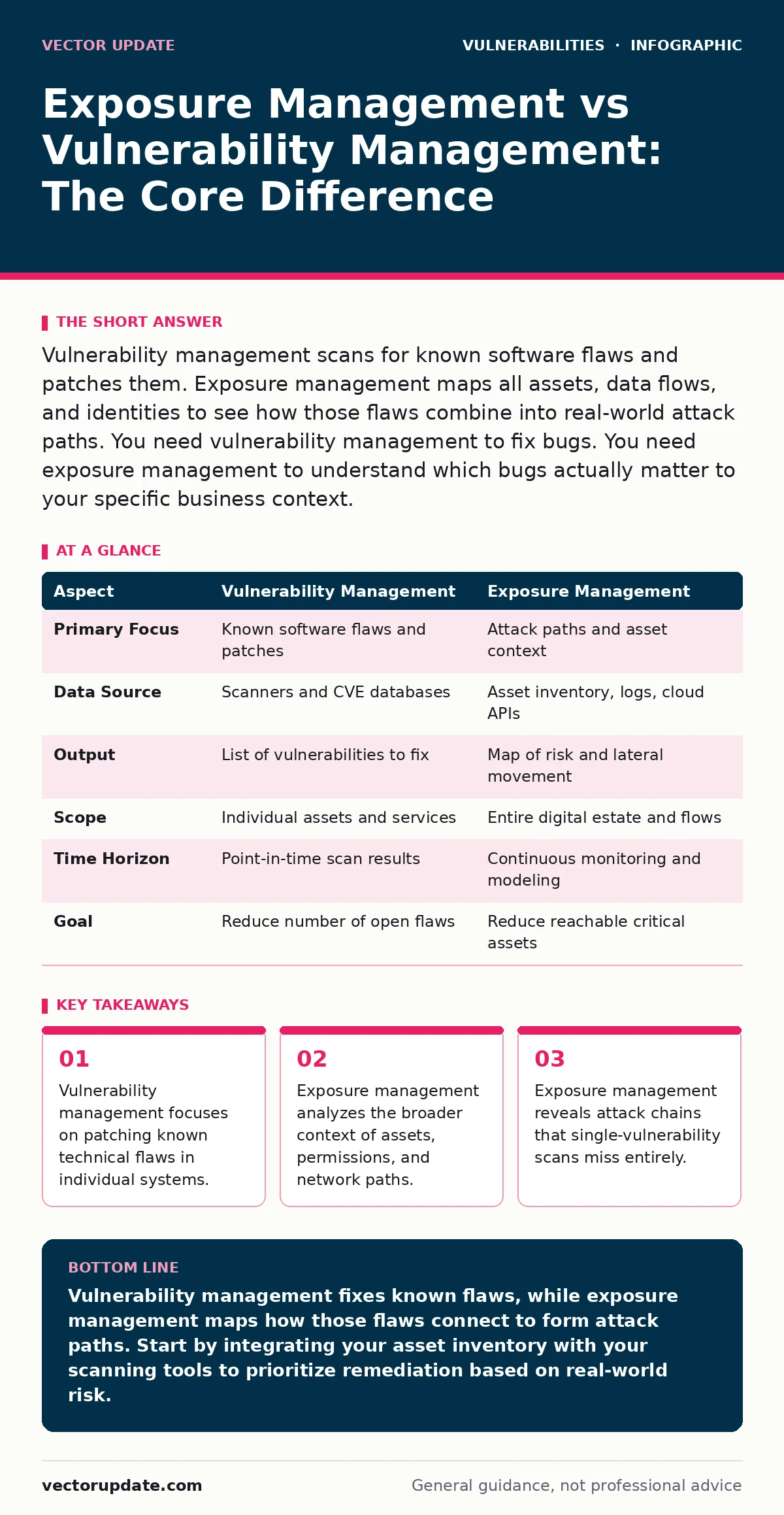
Vulnerability management scans for known software flaws and patches them. Exposure management maps all assets, data flows, and identities to see how those flaws combine into real-world attack paths. You need vulnerability management to fix bugs. You need exposure management to understand which bugs actually matter to your specific business context.
The Core Difference Between Exposure Management and Vulnerability Management
Vulnerability management identifies and remediates known security flaws in software and hardware. It operates on a list of weaknesses with assigned severity scores. Exposure management takes a wider view by mapping all digital assets, data flows, and identity permissions. It determines how those weaknesses combine to create viable attack paths. The former asks if a system is broken. The latter asks if an attacker can reach what matters.
Vulnerability management treats each asset as an isolated entity. It scans for missing patches or misconfigurations. Exposure management treats the environment as a connected graph. It looks at lateral movement possibilities. This distinction matters because a critical vulnerability on an isolated server poses less risk than a minor flaw on a publicly facing gateway. Understanding this difference prevents teams from wasting resources on low-impact fixes while ignoring high-impact exposure.
What Is Vulnerability Management?
Vulnerability management is the process of finding and fixing known security defects. It relies on databases of known issues, such as Common Vulnerabilities and Exposures. Systems scan networks and endpoints to match software versions against these databases. The output is a list of items needing remediation. This approach works well for maintaining baseline hygiene. It ensures that public software components are up to date.
The limitation of this approach is context blindness. A scanner does not know if a vulnerable service is exposed to the internet. It does not know if the service holds sensitive data. It simply reports the presence of a flaw. This method is necessary but insufficient for modern defense. It provides the raw data of weakness without the narrative of risk. You must combine it with broader context to prioritize effectively.
What Is Exposure Management?
Exposure management is the continuous mapping of an organization’s attack surface. It goes beyond software flaws to include identity, configuration, and network topology. It answers questions about who has access to what and how data moves. This method identifies exposure points that traditional scanners miss. For example, a misconfigured cloud storage bucket is an exposure, not a software vulnerability.
This approach requires a complete IT asset inventory. You cannot manage what you do not know exists. Shadow IT and forgotten cloud instances create hidden exposure. Exposure management tools correlate data from multiple sources. They build a dynamic model of the environment. This model allows you to simulate attack paths. You can see how an attacker moves from a low-privilege account to a critical database.
Exposure Management vs Vulnerability Management Comparison
| Aspect | Vulnerability Management | Exposure Management |
|---|---|---|
| Primary Focus | Known software flaws and patches | Attack paths and asset context |
| Data Source | Scanners and CVE databases | Asset inventory, logs, cloud APIs |
| Output | List of vulnerabilities to fix | Map of risk and lateral movement |
| Scope | Individual assets and services | Entire digital estate and flows |
| Time Horizon | Point-in-time scan results | Continuous monitoring and modeling |
| Goal | Reduce number of open flaws | Reduce reachable critical assets |
When to Choose Vulnerability Management
Choose vulnerability management when you need to meet compliance requirements. Many standards mandate regular scanning and patching. This process establishes a baseline of technical hygiene. It is the first line of defense against automated attacks. You need this to handle the volume of known flaws. Without it, your systems remain open to trivial exploitation.
This approach is also necessary for managing firmware vulnerabilities. Firmware updates often contain security fixes that cannot be detected by application-level scans. You must track hardware and embedded system updates separately. Vulnerability management provides the structured workflow for this. It ensures that you do not overlook low-level components. It is the foundation upon which broader security strategies are built.
See also: Map Your Digital Footprint to Stop Silent Data Loss
When to Choose Exposure Management
Choose exposure management when you face complex, interconnected environments. Traditional scanning fails in cloud-native architectures. Microservices and serverless functions change rapidly. Exposure management adapts to this dynamism. It helps you understand broken access control issues that scanners cannot see. It reveals how permissions combine to grant unauthorized access.
This method is vital for identifying business logic flaws. These are design errors that do not appear as code vulnerabilities. A scanner cannot detect that a user can view another user’s data. Exposure management analyzes the flow of data and permissions. It highlights where the logic fails. It is also useful for assessing risks from vulnerable third-party libraries. It shows how a library flaw in one service impacts others.
Where the Two Approaches Overlap
These disciplines are not mutually exclusive. They feed into each other. Vulnerability management provides the raw data of weakness. Exposure management provides the context for prioritization. This combination is known as risk-based vulnerability management. It uses exposure data to rank vulnerabilities. A critical flaw on an internet-facing server gets fixed first. A critical flaw on an isolated device waits.
You need both to handle browser updates effectively. Browsers run many extensions and plugins. Vulnerability management checks for outdated versions. Exposure management checks if those browsers access sensitive internal tools. The overlap ensures you fix the right things first. It prevents alert fatigue. It focuses your team on what truly matters. This integrated approach maximizes security efficiency.
Key takeaways
- Vulnerability management focuses on patching known technical flaws in individual systems.
- Exposure management analyzes the broader context of assets, permissions, and network paths.
- Exposure management reveals attack chains that single-vulnerability scans miss entirely.
Vulnerability management fixes known flaws, while exposure management maps how those flaws connect to form attack paths. Start by integrating your asset inventory with your scanning tools to prioritize remediation based on real-world risk.
Frequently asked questions
Can exposure management replace vulnerability scanners?
No, exposure management needs the data from scanners. It adds context to the findings but does not detect the underlying software flaws itself.
Is exposure management only for cloud environments?
No, it applies to any connected environment. While it excels in cloud-native setups, it is valuable for any complex network with multiple access paths.
How do I prioritize fixes using exposure data?
Prioritize vulnerabilities that are part of active attack paths. Focus on flaws that allow lateral movement to critical assets or sensitive data.
Does exposure management detect zero-day attacks?
No, it cannot detect unknown vulnerabilities. It helps you understand the potential impact if a zero-day is exploited by mapping your exposure.
How this guide was produced: written by the Vector Update editorial team with AI assistance, checked against the public references listed below, and reviewed when the facts change. See our editorial policy or report an error.