How the Internet of Things Works: The Data Path and Control Plane
IoT devices rarely talk to the cloud directly; they rely on local gateways that translate proprietary protocols into standard web requests, creating a single point of failure.
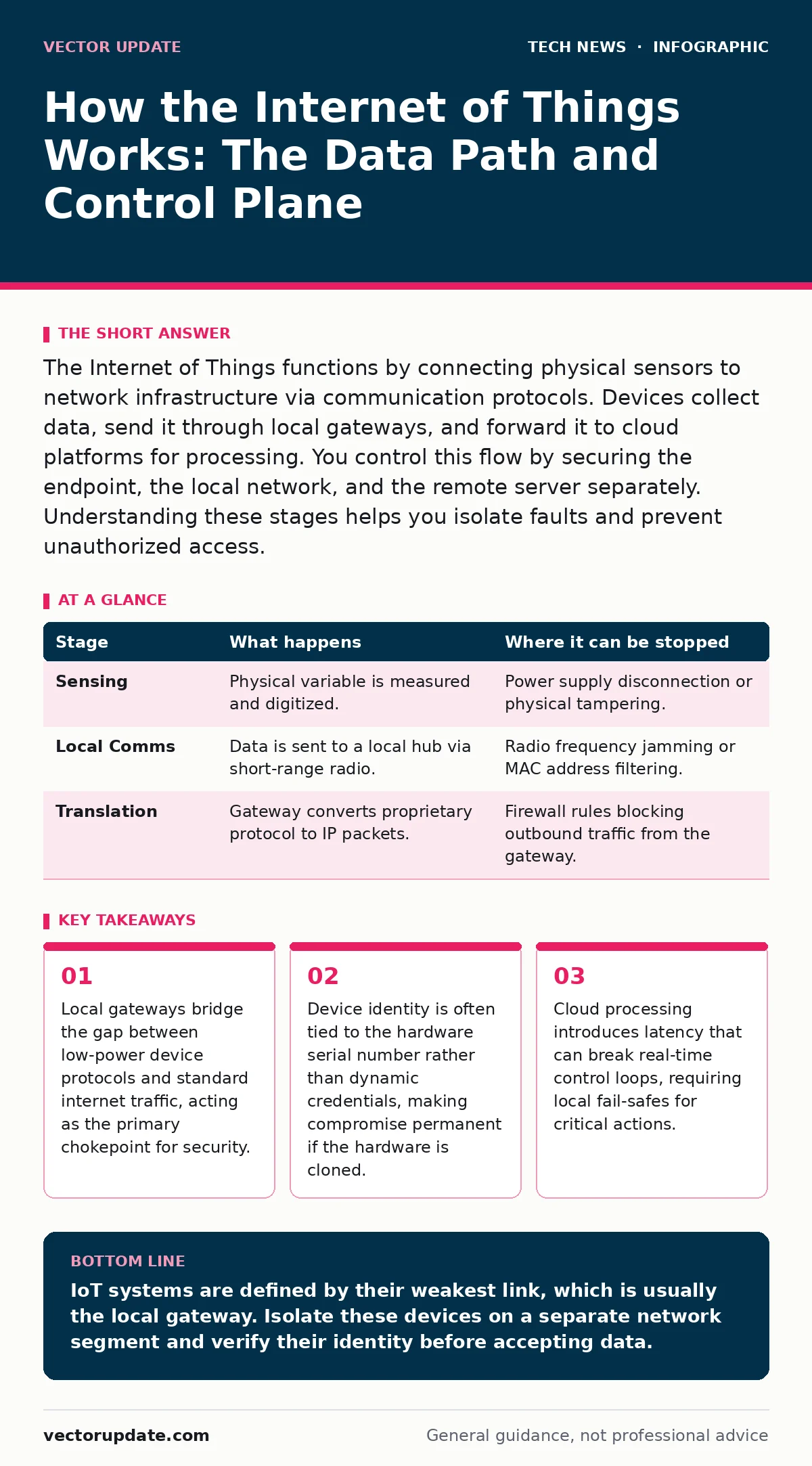
The Internet of Things functions by connecting physical sensors to network infrastructure via communication protocols. Devices collect data, send it through local gateways, and forward it to cloud platforms for processing. You control this flow by securing the endpoint, the local network, and the remote server separately. Understanding these stages helps you isolate faults and prevent unauthorized access.
The Sensor Layer and Data Acquisition
The process begins with the physical interaction. A sensor measures a variable such as temperature, pressure, or motion. It converts this analog signal into digital data. This conversion happens on a microcontroller, a small computer designed for specific tasks. The microcontroller formats the data into a packet. This packet includes the measurement value and a timestamp. It does not yet know where it needs to go. It only knows it has data to send. The energy cost of this step is negligible. The risk here is low because the device is often air-gapped from the wider network until it attempts to transmit.
Local Protocol Translation and the Gateway
Most IoT devices cannot speak standard internet languages. They use lightweight protocols like MQTT or CoAP to save battery and bandwidth. These protocols are not designed for long-distance travel across the public internet. They require a gateway. The gateway is a device that listens to local traffic. It aggregates data from multiple sensors. It then translates this data into HTTP or HTTPS requests. This translation allows the data to traverse standard routers and firewalls. Without this step, your smart thermostat could not send data to a cloud server. The gateway becomes the most critical component. If it fails, all downstream devices lose connectivity. Securing the gateway is harder than securing the individual sensors because it has more code and more exposed interfaces.
Stage 1: Sensing and Local Aggregation
| Stage | What happens | Where it can be stopped |
|---|---|---|
| Sensing | Physical variable is measured and digitized. | Power supply disconnection or physical tampering. |
| Local Comms | Data is sent to a local hub via short-range radio. | Radio frequency jamming or MAC address filtering. |
| Translation | Gateway converts proprietary protocol to IP packets. | Firewall rules blocking outbound traffic from the gateway. |
Network Transit and Addressing
Once the data leaves the gateway, it enters the broader network. It must travel through routers and switches. These devices read the destination address in the packet header. They forward the packet toward the target server. This journey involves multiple hops. Each hop introduces latency. Network address translation is often used here to hide the internal structure of your network. This hides the specific IP addresses of your devices from the outside world. It also allows many devices to share a single public IP address. This conservation of IP addresses is standard practice. However, it complicates troubleshooting. When a packet arrives at the server, the server sees only the public IP of your edge router. It does not know which specific device sent the request.
The Cloud Platform and Processing
The data arrives at the cloud platform. This is a remote server owned by a third party or your own infrastructure. The server receives the HTTP request. It parses the payload. It stores the data in a database. It may trigger an analysis engine. This engine looks for patterns or anomalies. For example, it might detect a sudden drop in temperature. The server then decides on an action. It might send an alert to a mobile app. It might trigger another device. This decision logic is where the business value resides. The server does not care about the physical state of the sensor. It only cares about the data structure. If the data is malformed, the server rejects it. This rejection is silent. The sensor does not know it failed. It just waits for the next transmission cycle.
Command Execution and Feedback Loop
The process is not one-way. The cloud can send commands back to the devices. This is the control plane. The command travels the reverse path. It goes from the cloud, through the network, to the gateway, and finally to the target device. The device executes the command. It changes its state. It might turn on a motor. It might lock a door. It then sends a confirmation back. This confirmation is vital. It proves the command was received and executed. Without it, the system operates blindly. If the confirmation is lost, the cloud might retry the command. This can cause unexpected behavior. For instance, a motor might receive two start commands and overheat. The feedback loop ensures synchronization between the physical world and the digital model.
See also: Intrusion Prevention Systems: How IPS Blocks Threats in Real Time · Network Address Translation: How NAT Works and Its Hidden Risks
Identity Management and Trust
Trust is established through identity. Each device must prove who it is. This is usually done via public key infrastructure. Each device has a unique certificate or key pair. When it connects to the cloud, it presents this certificate. The cloud checks if the certificate is valid. It checks if it has been revoked. If the check passes, the cloud accepts the data. If it fails, the data is dropped. This prevents impersonation. An attacker cannot simply send fake data claiming to be your sensor. They would need the private key. This key is stored in the device's secure memory. If an attacker steals the device and extracts the key, they can clone the device. This is why hardware security is as important as software security.
Failure Modes and Isolation
Things break. Sensors drift out of calibration. Networks drop packets. Servers crash. You must design for these failures. Isolation is the primary defense. Keep IoT devices on a separate network segment. This prevents a compromised sensor from accessing your main computer. Use strict firewall rules. Allow only necessary traffic. Block all other connections. This reduces the attack surface. It also limits the blast radius of a failure. If the IoT network goes down, your core business systems remain unaffected. You also need local fail-safes. If the internet goes out, a smart heater should not turn off. It should maintain its last state. This ensures safety even when the cloud is unreachable.
RELATED: For deeper insights on managing these networks, see our guides on network address translation and network monitoring. Understanding TLS handshake mechanics is also helpful for securing the data in transit.
Key takeaways
- Local gateways bridge the gap between low-power device protocols and standard internet traffic, acting as the primary chokepoint for security.
- Device identity is often tied to the hardware serial number rather than dynamic credentials, making compromise permanent if the hardware is cloned.
- Cloud processing introduces latency that can break real-time control loops, requiring local fail-safes for critical actions.
IoT systems are defined by their weakest link, which is usually the local gateway. Isolate these devices on a separate network segment and verify their identity before accepting data.
Frequently asked questions
Do I need a gateway for every IoT device?
No, simple devices with Wi-Fi and TCP/IP stacks can connect directly. However, gateways are recommended for battery-powered devices using low-power protocols like Zigbee or Bluetooth Low Energy.
Can I secure IoT devices with passwords?
Passwords are weak and often hard-coded. Use certificate-based authentication instead. This provides stronger proof of identity and allows you to revoke access remotely if a device is stolen.
What happens if the cloud server goes down?
Devices should have local logic to handle offline operation. They should store data locally and retry sending it when the connection is restored. Critical functions should not depend on cloud availability.
How do I know if my IoT device is compromised?
Monitor for unusual network traffic. Look for connections to unknown IP addresses or ports. Check for firmware updates that were not authorized. Use network monitoring tools to baseline normal behavior.
How this guide was produced: written by the Vector Update editorial team with AI assistance, checked against the public references listed below, and reviewed when the facts change. See our editorial policy or report an error.