Network Address Translation: How NAT Works and Its Hidden Risks
Network address translation breaks the end-to-end connection model, which creates asymmetric traffic flows that complicate intrusion detection and stateful firewall analysis.

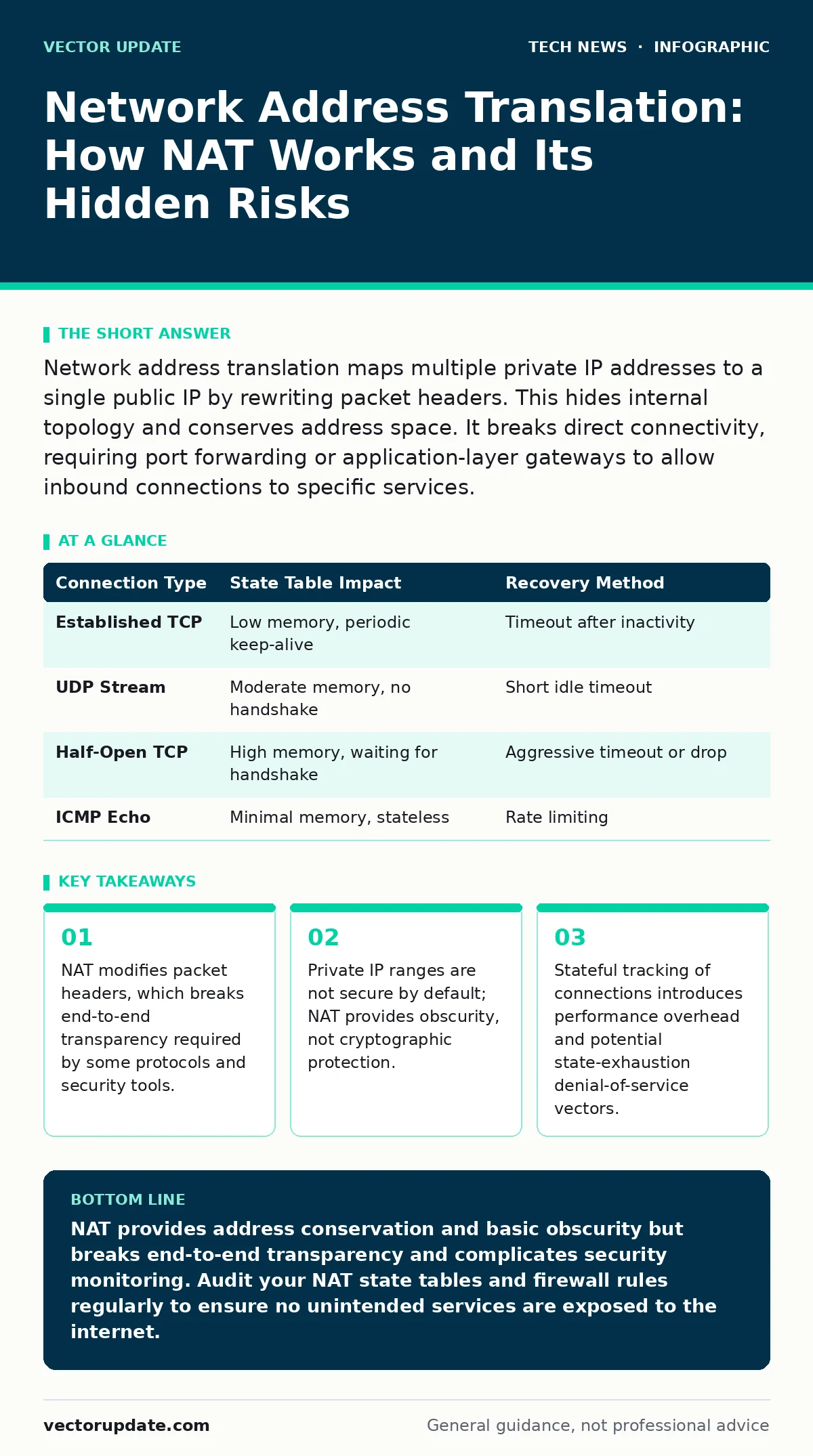
Network address translation maps multiple private IP addresses to a single public IP by rewriting packet headers. This hides internal topology and conserves address space. It breaks direct connectivity, requiring port forwarding or application-layer gateways to allow inbound connections to specific services.
What exactly does Network Address Translation do?
Network Address Translation rewrites the source or destination IP address and port numbers in packet headers as they cross a network boundary. It allows multiple devices on a local network to share a single public IP address. The device performing this translation, usually a router or firewall, maintains a state table to track active connections. When a reply arrives, the device looks up the original internal address and forwards the packet accordingly.
Does NAT provide security by hiding internal devices?
NAT provides security through obscurity, not through encryption or authentication. It makes it difficult for external attackers to initiate direct connections to internal devices because they do not know the private IP addresses. However, this is not a substitute for a proper firewall policy. If an internal device initiates a connection outward, the return path is established automatically. An attacker can still exploit vulnerabilities in outbound-bound applications or use social engineering to pull malicious traffic inward.
Why do some protocols fail when passing through NAT?
Some protocols embed IP addresses or port numbers inside the application payload, not just in the IP header. FTP and SIP are common examples where the control channel and data channels use different ports. Standard NAT only rewrites the IP header, leaving the embedded addresses in the payload unchanged. This mismatch causes the remote server to send data to the wrong address, breaking the connection.
How do Application Layer Gateways solve protocol issues?
Application Layer Gateways inspect the payload of specific protocols to rewrite embedded IP addresses and ports. They understand the syntax of protocols like FTP or SIP and update both the header and the payload. This ensures that the internal device and the external server agree on the connection parameters. However, ALGs add complexity and processing overhead, and they may not support every variant of a protocol.
What happens when the NAT state table fills up?
Every active connection consumes an entry in the NAT state table. These tables have finite memory and processing capacity. If an external attacker sends a flood of connection requests that never complete, the table fills with half-open connections. This prevents legitimate users from establishing new connections, resulting in a denial of service. The network device may drop packets or reset existing connections to free up space, disrupting active services.
| Connection Type | State Table Impact | Recovery Method |
|---|---|---|
| Established TCP | Low memory, periodic keep-alive | Timeout after inactivity |
| UDP Stream | Moderate memory, no handshake | Short idle timeout |
| Half-Open TCP | High memory, waiting for handshake | Aggressive timeout or drop |
| ICMP Echo | Minimal memory, stateless | Rate limiting |
See also: Cyber Espionage Defined: Tactics, Targets, and Silent Persistence · How Advanced Persistent Threats Move: Step-by-Step Breakdown
How does NAT affect network monitoring and logging?
NAT obscures the true source of network traffic in logs and monitoring tools. All outbound traffic from the local network appears to originate from the single public IP address. This makes it difficult to trace malicious activity back to a specific internal host. You must rely on the NAT device’s internal logs to map public ports to private IPs. If these logs are lost or corrupted, forensic analysis becomes nearly impossible. This limitation is a key reason why internal network segmentation and network monitoring are critical for visibility.
Can NAT be used for port forwarding safely?
Port forwarding maps a specific public port to a private IP and port, allowing inbound connections. This exposes the target service directly to the internet, bypassing the obscurity benefit of NAT. You must configure strict firewall rules to limit access to trusted source IPs or subnets. Without these restrictions, the service is vulnerable to brute-force attacks and exploitation of known vulnerabilities. This exposure requires careful attention to secure software development practices for the exposed application.
What is the difference between NAT and a proxy?
A proxy acts as an intermediary application that establishes two separate connections: one to the client and one to the server. It can inspect, filter, and cache content at the application layer. NAT operates at the network or transport layer, simply rewriting addresses without understanding the content. Proxies can enforce detailed access controls and authenticate users, while NAT cannot. However, proxies add significant latency and require client-side configuration, whereas NAT is transparent to the end user.
Why is IPv6 reducing the need for NAT?
IPv6 provides a vastly larger address space, allowing every device to have a unique, globally routable public IP address. This eliminates the address conservation motive for NAT. It restores the original end-to-end design of the internet, simplifying connectivity for peer-to-peer applications and VoIP. However, it also means every device is directly reachable, making host-based firewalls and public key infrastructure for authentication more important. The shift away from NAT changes the security perimeter from the network edge to the individual host.
How does NAT interact with secure enclaves?
Secure enclaves require stable, predictable network identities to establish trust relationships. NAT changes the source IP address, which can break certificate pinning or mutual TLS authentication that relies on IP-based identities. If an enclave expects a specific IP, the translated address will cause the handshake to fail. You may need to use DNS-based identifiers or configure the NAT device to preserve the original source IP for specific traffic flows. This complexity highlights the tension between legacy NAT infrastructure and modern hardware-based security models.
What are the performance implications of heavy NAT usage?
Every packet passing through a NAT device requires a lookup in the state table and header modification. This consumes CPU cycles and memory bandwidth. Under high throughput, this processing can become a bottleneck, increasing latency and reducing overall network performance. Hardware-accelerated NAT offload can mitigate this by moving the processing to dedicated ASICs. However, this reduces flexibility and may not support complex ALG features or deep packet inspection.
Key takeaways
- NAT modifies packet headers, which breaks end-to-end transparency required by some protocols and security tools.
- Private IP ranges are not secure by default; NAT provides obscurity, not cryptographic protection.
- Stateful tracking of connections introduces performance overhead and potential state-exhaustion denial-of-service vectors.
NAT provides address conservation and basic obscurity but breaks end-to-end transparency and complicates security monitoring. Audit your NAT state tables and firewall rules regularly to ensure no unintended services are exposed to the internet.
Frequently asked questions
Can I use NAT with IPv6 addresses?
Yes, you can use NAT with IPv6, but it is generally discouraged. IPv6 is designed to eliminate the need for address translation by providing unique global addresses for every device. Using NAT with IPv6 adds unnecessary complexity and breaks the end-to-end connectivity model that IPv6 was created to restore.
Does NAT hide my IP address from websites?
No, websites see the public IP address of your NAT device, not your private internal IP. This public IP is still unique to your internet connection and can be used to identify your location and internet service provider. NAT does not provide anonymity like a VPN or Tor network would.
Why can't I ping a device on my network from the internet?
ICMP echo requests (pings) are usually blocked by default on NAT devices to prevent external scanning and denial-of-service attacks. Even if port forwarding is configured for other services, ICMP often requires specific rules to allow inbound traffic. This is a security feature to limit the attack surface of your network edge.
How do I know if my NAT is working correctly?
Check the NAT state table on your router or firewall for active connections. Verify that internal devices can reach external resources and that expected inbound services are accessible via port forwarding. If traffic is dropped unexpectedly, inspect the firewall logs for denied packets and ensure the NAT device is not exhausting its state table entries.
How this guide was produced: written by the Vector Update editorial team with AI assistance, checked against the public references listed below, and reviewed when the facts change. See our editorial policy or report an error.