How Public Key Infrastructure Works: The Chain of Trust
Public key infrastructure relies on a chain of digital signatures that validates identity, but a single compromised certificate authority can break trust across every system that relies on it.

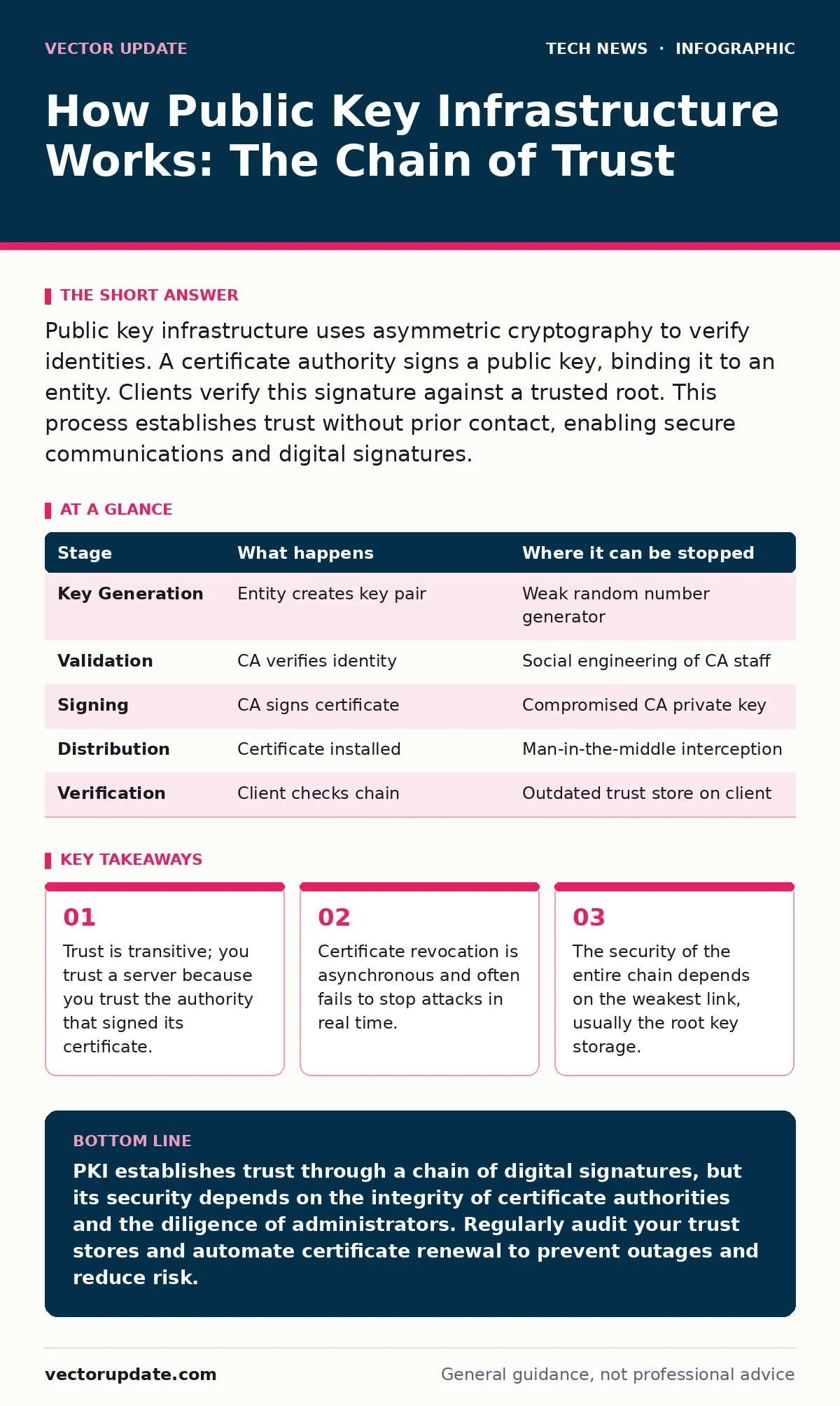
Public key infrastructure uses asymmetric cryptography to verify identities. A certificate authority signs a public key, binding it to an entity. Clients verify this signature against a trusted root. This process establishes trust without prior contact, enabling secure communications and digital signatures.
The Asymmetric Foundation
Public key infrastructure rests on asymmetric cryptography. This method uses two mathematically linked keys: a public key that anyone can see and a private key that stays secret. Data encrypted with the public key can only be decrypted by the private key. Conversely, data signed with the private key can be verified by anyone using the public key.
This duality solves the problem of secure communication between strangers. You do not need to share a secret password to start a conversation. You only need to trust that the public key belongs to the person you think it does. This verification is the core function of PKI.
Without this binding, an attacker could simply generate their own key pair and claim to be a legitimate service. PKI provides the mechanism to prove ownership of a key. It transforms a raw mathematical value into a trusted identity.
Stage 1: Key Generation and Request
The process begins when an entity generates a key pair. Typically, software on a server or device creates these keys locally. The private key never leaves this secure environment. The entity then creates a certificate signing request.
This request contains the public key and identifying information. It also includes a digital signature created by the private key. This signature proves that the entity holding the private key is the one making the request. It prevents others from submitting your public key on your behalf.
The request is sent to a certificate authority. The CA does not need your private key. It only needs the public key and the signed request. This separation ensures that even if the CA is compromised, your private key remains safe.
Stage 2: Identity Validation
The certificate authority must verify the entity's identity before issuing a certificate. This step varies in intensity. For basic certificates, the CA might only verify domain ownership. For extended validation, the CA checks legal existence and physical address.
This validation is the human element in a mathematical process. It introduces risk. If the CA fails to verify correctly, it issues a certificate to an imposter. The mathematical integrity remains, but the trust model breaks.
Imagine a CA that accepts a forged business license. It issues a certificate to a fraudster. Clients trusting that CA will connect to the fraudster, believing they are talking to a legitimate bank. The encryption works perfectly, but the identity is wrong.
Stage 3: Signing and Issuance
Once validation passes, the CA signs the certificate. It hashes the public key and identity data, then encrypts that hash with its own private key. This creates the digital signature. The resulting package is the X.509 certificate.
The certificate now contains the entity's public key, identity, validity period, and the CA's signature. Any client can verify the signature using the CA's public key. If the math checks out, the client knows the CA vouched for this key.
This signature binds the key to the identity. It also binds the certificate to the CA. This creates a chain of trust. The client does not need to know the entity. It only needs to trust the CA.
Stage 4: Distribution and Installation
The CA sends the signed certificate to the entity. The entity installs it on its server or device. The private key remains stored securely on that same system. The public certificate is exposed to the world.
During the TLS handshake, the server presents this certificate to the client. The client extracts the public key from the certificate. It uses this key to encrypt session data or verify signatures.
The client also checks the certificate's validity period. Expired certificates are rejected. This forces regular renewal. It also limits the damage window if a key is compromised.
See also: Internet of Things Misconceptions That Endanger Your Network
Stage 5: Trust Verification
The client must verify the CA's signature. It does this by checking the CA's certificate against its trust store. This store contains root certificates pre-installed in operating systems and browsers.
The client follows the chain upward. If the server certificate is signed by an intermediate CA, the client checks that intermediate. It continues until it reaches a trusted root. If any link in the chain is missing or invalid, the connection fails.
This hierarchical structure allows scalability. You do not need to trust every server directly. You trust a few root CAs. They trust intermediate CAs. Those intermediates trust the servers.
| Stage | What happens | Where it can be stopped |
|---|---|---|
| Key Generation | Entity creates key pair | Weak random number generator |
| Validation | CA verifies identity | Social engineering of CA staff |
| Signing | CA signs certificate | Compromised CA private key |
| Distribution | Certificate installed | Man-in-the-middle interception |
| Verification | Client checks chain | Outdated trust store on client |
Limits and Hidden Costs
PKI is not a silver bullet. It relies on the security of the CA infrastructure. If a root key is stolen, the attacker can sign certificates for any domain. This breaks trust globally until the root is revoked.
Revocation is difficult. Clients often do not check revocation lists in real time. They rely on cached data. This delay allows attackers to use stolen certificates for a short period. The OCSP protocol attempts to fix this, but it introduces latency and privacy issues.
The cost of PKI includes operational overhead. You must manage key rotation, certificate renewal, and trust store updates. Failure to renew certificates causes outages. This is a common failure mode in production environments.
Integrating with Modern Systems
PKI intersects with many other security domains. In DevOps security, automated certificate management is critical. Manual processes do not scale with dynamic cloud environments. Tools must issue and rotate certificates as containers spin up and down.
For Internet of Things devices, PKI is challenging. These devices often have limited processing power. They may not support full certificate chains. Lightweight cryptography protocols are often used instead.
Virtualization security also relies on PKI. Hypervisors use certificates to authenticate management interfaces. If these certificates are weak, attackers can gain control of the host system. Secure enclaves can protect the private keys used in these processes.
Network monitoring tools often inspect TLS traffic. To do this, they must decrypt the traffic. This requires access to the private keys. This creates a trade-off between visibility and security. Storing decryption keys introduces new risk vectors.
The Human Element in Trust
The strongest cryptography fails if humans make mistakes. Phishing attacks often trick users into accepting invalid certificates. They ignore browser warnings. This undermines the entire PKI model.
Security awareness training must address certificate warnings. Users should understand that a red warning means a potential compromise. It is not a nuisance to dismiss.
System administrators must also be vigilant. They must ensure that only authorized certificates are installed. They must monitor for unauthorized certificate issuance. This requires robust logging and alerting.
PKI is a complex system with many moving parts. Understanding its mechanics helps you identify where it can fail. It is not just about encryption. It is about trust. And trust is fragile.
Key takeaways
- Trust is transitive; you trust a server because you trust the authority that signed its certificate.
- Certificate revocation is asynchronous and often fails to stop attacks in real time.
- The security of the entire chain depends on the weakest link, usually the root key storage.
PKI establishes trust through a chain of digital signatures, but its security depends on the integrity of certificate authorities and the diligence of administrators. Regularly audit your trust stores and automate certificate renewal to prevent outages and reduce risk.
Frequently asked questions
Why does my browser warn me about an expired certificate?
The certificate has passed its validity period. This means the certificate authority no longer guarantees the identity of the server. The connection is blocked to prevent potential man-in-the-middle attacks.
Can I use my own certificate authority?
Yes, but clients must manually trust your root certificate. This is common in internal networks. It does not work for public-facing services where users cannot install your root CA.
What is the difference between a CA and a RA?
A certificate authority signs certificates. A registration authority validates identities and forwards requests to the CA. This separation improves security by limiting the CA's exposure.
How long do certificates last?
Validity periods vary, but shorter periods are recommended. Many modern CAs issue certificates valid for only 90 days. This limits the damage if a key is compromised.
How this guide was produced: written by the Vector Update editorial team with AI assistance, checked against the public references listed below, and reviewed when the facts change. See our editorial policy or report an error.