Internet of Things Misconceptions That Endanger Your Network
Most security failures stem from assuming IoT devices behave like servers, ignoring that they lack the operating system layers needed for traditional defense.

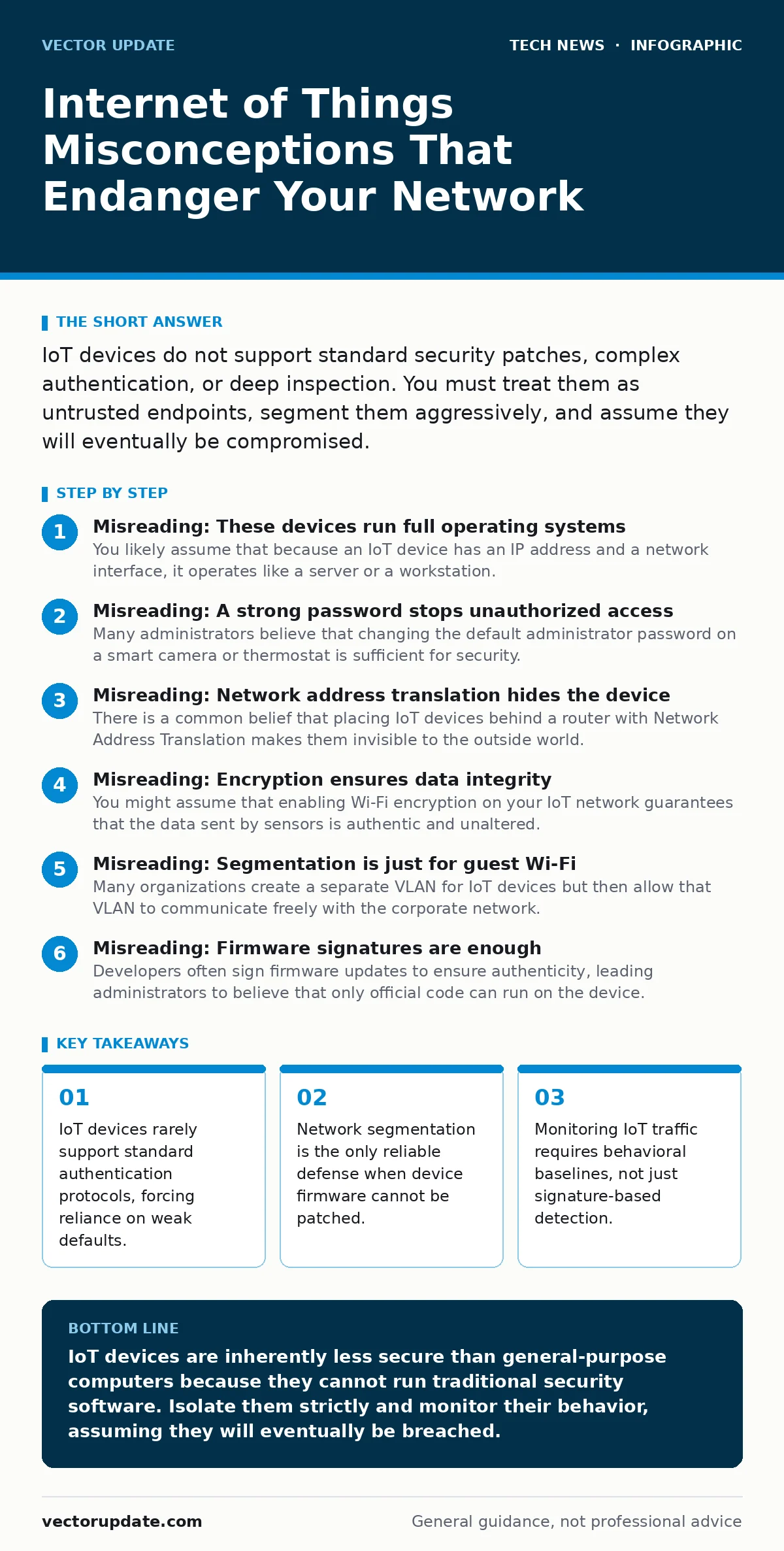
IoT devices do not support standard security patches, complex authentication, or deep inspection. You must treat them as untrusted endpoints, segment them aggressively, and assume they will eventually be compromised.
Misreading: These devices run full operating systems
You likely assume that because an IoT device has an IP address and a network interface, it operates like a server or a workstation. You expect it to handle updates, run background services, and manage user sessions with the same flexibility. This expectation fails because most embedded devices run bare-metal firmware or stripped-down kernels. They lack the resource headroom for traditional security agents or complex patch management systems.
Correct reading: Treat every IoT endpoint as immutable hardware. The software inside rarely changes after deployment, and it rarely supports over-the-air updates that address security vulnerabilities. If a flaw exists in the code, it remains there for the entire lifespan of the device. You cannot patch the device itself, so you must patch the network around it.
Misreading: A strong password stops unauthorized access
Many administrators believe that changing the default administrator password on a smart camera or thermostat is sufficient for security. This view ignores the fact that many IoT devices store credentials in plaintext within their firmware or transmit them without encryption. Even if you change the password, the device may lack the cryptographic primitives to hash it securely. An attacker who gains physical access or intercepts the initial setup handshake can often recover these credentials.
Correct reading: Assume that any credential stored on the device is compromised. Do not trust the device to protect its own secrets. Instead, use network-level controls to prevent the device from communicating with unauthorized hosts. For sensitive operations, consider using public key infrastructure to verify device identity rather than relying on shared secrets that can be extracted from memory.
Misreading: Network address translation hides the device
There is a common belief that placing IoT devices behind a router with Network Address Translation makes them invisible to the outside world. NAT does translate private IP addresses to a public one, masking the internal topology from casual scanners. However, it does not protect against attacks that originate from within the local network or from compromised devices that initiate outbound connections. Many IoT devices phone home to command-and-control servers, bypassing the inbound protection NAT provides.
Correct reading: NAT is a routing mechanism, not a security filter. It allows bidirectional communication for established sessions. If an IoT device is compromised, it can use that connection to exfiltrate data or receive commands. You must inspect outbound traffic, not just inbound traffic. This requires dedicated network monitoring tools capable of analyzing the content and destination of outbound packets from low-trust zones.
Misreading: Encryption ensures data integrity
You might assume that enabling Wi-Fi encryption on your IoT network guarantees that the data sent by sensors is authentic and unaltered. Encryption protects confidentiality, preventing eavesdroppers from reading the payload. It does not, however, prevent an attacker from modifying the data in transit if the encryption handshake is weak or if the device accepts invalid certificates. Without proper authentication, an attacker can inject false sensor readings or disable alarms.
Correct reading: Encryption alone is insufficient for critical IoT data. You must verify the identity of the communicating parties. This often involves a secure TLS handshake where the device presents a certificate that the server validates. If the device cannot support standard certificate validation, you must rely on network segmentation to limit the blast radius of any tampered data.
Misreading: Segmentation is just for guest Wi-Fi
Many organizations create a separate VLAN for IoT devices but then allow that VLAN to communicate freely with the corporate network. This approach treats segmentation as a convenience for billing or bandwidth management, not a security boundary. The assumption is that the devices are trusted enough to print documents or access internal APIs. This ignores the reality that a compromised IoT device is a perfect pivot point for lateral movement.
Correct reading: Segment IoT devices into their own trust zone with strict access control lists. They should only communicate with specific, necessary services and never with internal servers or user workstations. This mirrors the principles of virtualization security, where isolation prevents a breach in one container from affecting the host or other containers. If an IoT device is compromised, the attacker remains trapped in the IoT VLAN.
See also: How Public Key Infrastructure Works: The Chain of Trust
Misreading: Firmware signatures are enough
Developers often sign firmware updates to ensure authenticity, leading administrators to believe that only official code can run on the device. This is a partial truth. Signature verification prevents unauthorized modifications during the update process. It does not prevent an attacker from exploiting a buffer overflow in the running code to execute arbitrary commands. The signature protects the file on disk, not the execution environment in memory.
Correct reading: Code signing is a supply chain control, not a runtime defense. Once the code is running, it has the same privileges as the operating system. If the code contains a vulnerability, the signature offers no protection against exploitation. You must assume the running code is hostile. Use secure enclaves if the device supports them to isolate cryptographic keys, but do not rely on them to prevent code execution attacks.
Misreading: DevOps practices apply to embedded hardware
You may try to apply continuous integration and continuous deployment pipelines to IoT firmware as you would to web applications. This approach fails because IoT devices have constrained resources and often lack the ability to receive frequent updates. Rolling out a broken update to a fleet of physical devices can brick them, requiring manual intervention. The speed of DevOps conflicts with the rigidity of embedded systems.
Correct reading: Adapt your security practices to the constraints of the hardware. Implement DevOps security principles by scanning code for vulnerabilities before it is compiled, not just after deployment. Since you cannot easily patch the device in the field, the initial build must be secure. Test firmware rigorously in an isolated lab environment before releasing it to production.
Key takeaways
- IoT devices rarely support standard authentication protocols, forcing reliance on weak defaults.
- Network segmentation is the only reliable defense when device firmware cannot be patched.
- Monitoring IoT traffic requires behavioral baselines, not just signature-based detection.
IoT devices are inherently less secure than general-purpose computers because they cannot run traditional security software. Isolate them strictly and monitor their behavior, assuming they will eventually be breached.
Frequently asked questions
Can I use a standard firewall to protect IoT devices?
A standard firewall can block unwanted inbound connections, but it cannot inspect the content of outbound traffic from IoT devices effectively. You need application-aware filtering to stop data exfiltration.
Should I disable Wi-Fi on IoT devices?
If possible, use wired connections to reduce the attack surface. Wi-Fi introduces additional protocols and potential entry points. If Wi-Fi is necessary, ensure it uses strong encryption and is on a segmented network.
How do I handle IoT devices that do not support VLANs?
Use port-level segmentation on your switch
How this guide was produced: written by the Vector Update editorial team with AI assistance, checked against the public references listed below, and reviewed when the facts change. See our editorial policy or report an error.