AS-REP Roasting Explained: How to Stop Password Cracking
This attack steals password hashes from the network before you ever type your password, bypassing most standard login protections.

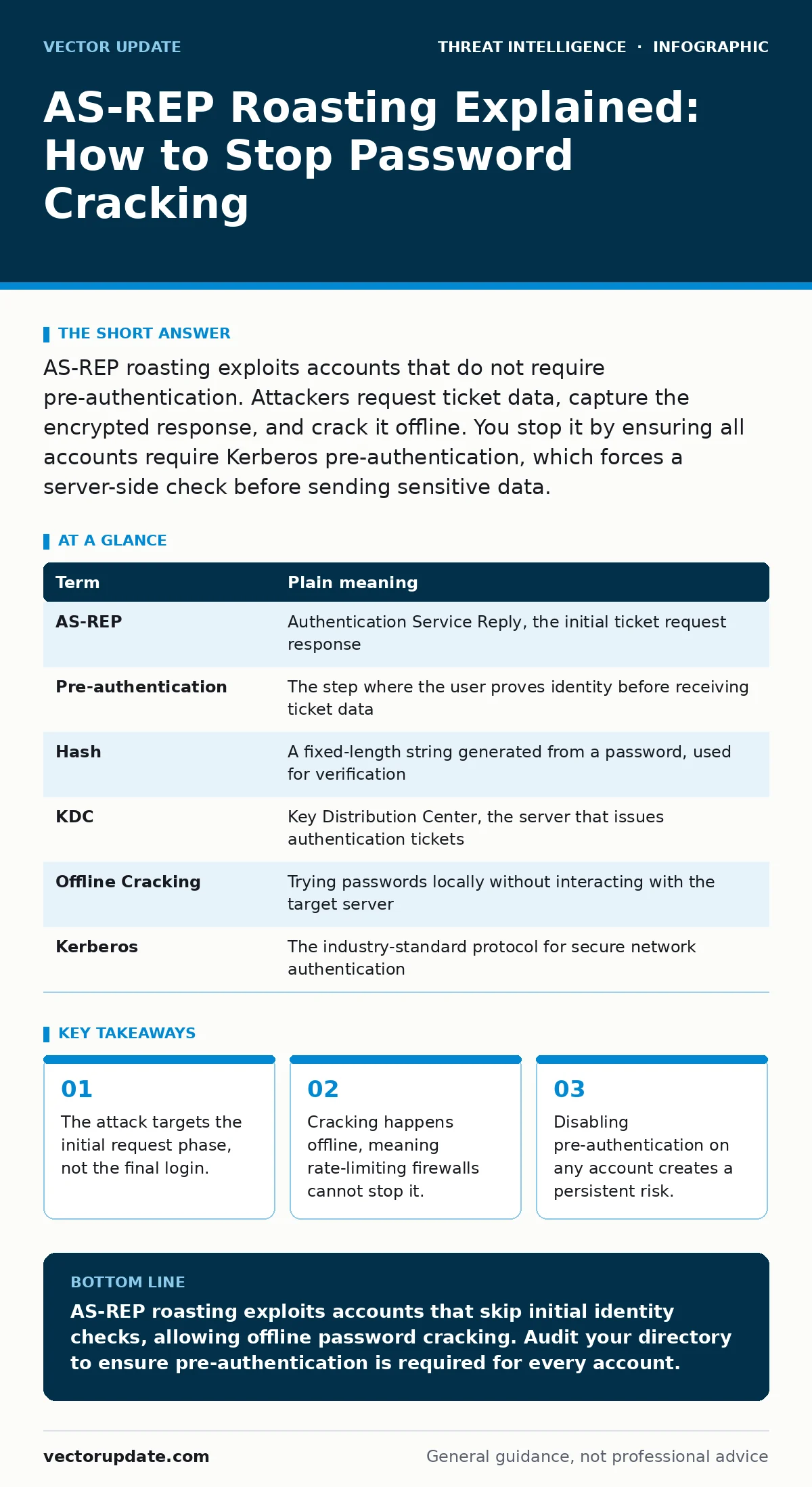
AS-REP roasting exploits accounts that do not require pre-authentication. Attackers request ticket data, capture the encrypted response, and crack it offline. You stop it by ensuring all accounts require Kerberos pre-authentication, which forces a server-side check before sending sensitive data.
The Unlocked Mailbox Analogy
Imagine your password is a key to a house. Normally, the landlord checks your ID before handing you the keys. In AS-REP roasting, some mailboxes are left unlocked. Anyone can look inside, find a sealed envelope containing the key’s blueprint, and take it home. They do not need to break into the house. They simply take the envelope and spend time figuring out the combination in their own garage.
How The Protocol Works
Kerberos is the standard protocol for network authentication in Windows environments. It uses tickets to prove identity without sending passwords over the wire. When you log in, your computer asks the Key Distribution Center for a ticket. If the account has "Do not require Kerberos pre-authentication" enabled, the KDC sends back an encrypted blob immediately. This blob is derived from the user’s password. The attacker captures this blob. They never need to interact with the server again.
Why Firewalls Fail Here
This is a protocol-level exploit, not a network intrusion. The attacker makes a legitimate request. The server responds with a legitimate packet. Traffic filters see normal conversation. The real work happens offline. The attacker runs the captured hash through a wordlist on a powerful GPU cluster. If the password is weak, it breaks in seconds. Strong passwords resist this, but the hash is still exposed. This differs from brute-forcing a login page, where the server can lock you out after five tries. Here, there is no login attempt to trigger an alarm.
| Term | Plain meaning |
|---|---|
| AS-REP | Authentication Service Reply, the initial ticket request response |
| Pre-authentication | The step where the user proves identity before receiving ticket data |
| Hash | A fixed-length string generated from a password, used for verification |
| KDC | Key Distribution Center, the server that issues authentication tickets |
| Offline Cracking | Trying passwords locally without interacting with the target server |
| Kerberos | The industry-standard protocol for secure network authentication |
The Hidden Cost of Convenience
Administrators often disable pre-authentication to support legacy applications or to simplify join processes. This convenience creates a permanent vulnerability. Even if the password is complex, the hash is harvested. Attackers can store these hashes for years. If password complexity policies change later, old hashes might become crackable. This connects to the broader Unified Kill Chain, where early reconnaissance yields long-term advantages. It is a form of privilege escalation attacks because gaining a single user’s hash can lead to domain admin rights if that user has high privileges.
What This Means For You
As an end user, you cannot fix the server setting. Your role is defense in depth. Use long, random passphrases. A twelve-character password is easier to crack than an eight-word passphrase. Do not reuse passwords across systems. If one system is roasted, others remain safe. Enable multi-factor authentication where possible. While MFA does not stop the hash theft, it prevents the attacker from using the cracked password to log in. Monitor your login alerts for unusual activity, though note that this specific attack may not trigger standard alerts.
See also: Unified Kill Chain: How to Map and Break Attack Stages · Warning Signs of Nation-State Cyber Attacks You Can Detect Now
Simple Safety Habits
You can reduce your exposure with three specific actions. These steps do not require administrative rights but improve your personal security posture.
- Use a password manager to generate unique, long passphrases for every account.
- Turn on two-factor authentication on any service that offers it, especially email.
- Check if your organization uses STIX and TAXII for sharing threat indicators, which may alert admins to roasting activity.
The Administrative Fix
For system owners, the fix is straightforward. Ensure the "Do not require Kerberos pre-authentication" flag is unchecked for all user and service accounts. Scan the environment for accounts with this setting enabled. This is a static configuration check, not a complex hunt. Tools can query the directory for this attribute. Once disabled, the AS-REP response is not sent, and the hash cannot be captured. This complements strategies for securing AI agents and other modern endpoints by hardening the identity layer.
Beyond The Initial Breach
If an attacker obtains a hash, they may pivot. This is where advanced persistent threats operate, moving laterally through the network. They might use cyber espionage techniques to extract data silently. Understanding AS-REP roasting helps you see how small misconfigurations enable large breaches. It is not about stopping every attack, but about removing the easiest paths. nation-state cyber attacks often start with these low-hanging fruits. By locking the mailbox, you force attackers to find harder targets.
Final Thoughts On Identity
Identity is the new perimeter. When networks are segmented, identity becomes the entry point. AS-REP roasting exploits a gap in identity verification. It shows that convenience in configuration leads to exposure. You must balance ease of use with strict security settings. Do not assume that encryption protects everything. If the protocol allows data leakage during setup, that data is fair game. Keep your credentials strong, your settings tight, and your monitoring active.
Key takeaways
- The attack targets the initial request phase, not the final login.
- Cracking happens offline, meaning rate-limiting firewalls cannot stop it.
- Disabling pre-authentication on any account creates a persistent risk.
AS-REP roasting exploits accounts that skip initial identity checks, allowing offline password cracking. Audit your directory to ensure pre-authentication is required for every account.
Frequently asked questions
Can multi-factor authentication stop AS-REP roasting?
MFA does not prevent the hash from being stolen, but it stops the attacker from using the cracked password to log in.
Do I need to change my password if this attack is possible?
If your admin has secured the setting, no. If not, use a unique, strong passphrase to make offline cracking difficult.
Is this attack only for Windows networks?
It is specific to Kerberos implementations, which are common in Windows but can appear in other Unix-like systems.
How do I know if my account is vulnerable?
Only an administrator can check the directory settings. Ask your IT team to audit the "pre-authentication" attribute.
How this guide was produced: written by the Vector Update editorial team with AI assistance, checked against the public references listed below, and reviewed when the facts change. See our editorial policy or report an error.