Cyber Espionage Defined: Tactics, Targets, and Silent Persistence
Cyber espionage relies on long-term access and data exfiltration rather than immediate destruction, making early detection far more difficult than for ransomware.
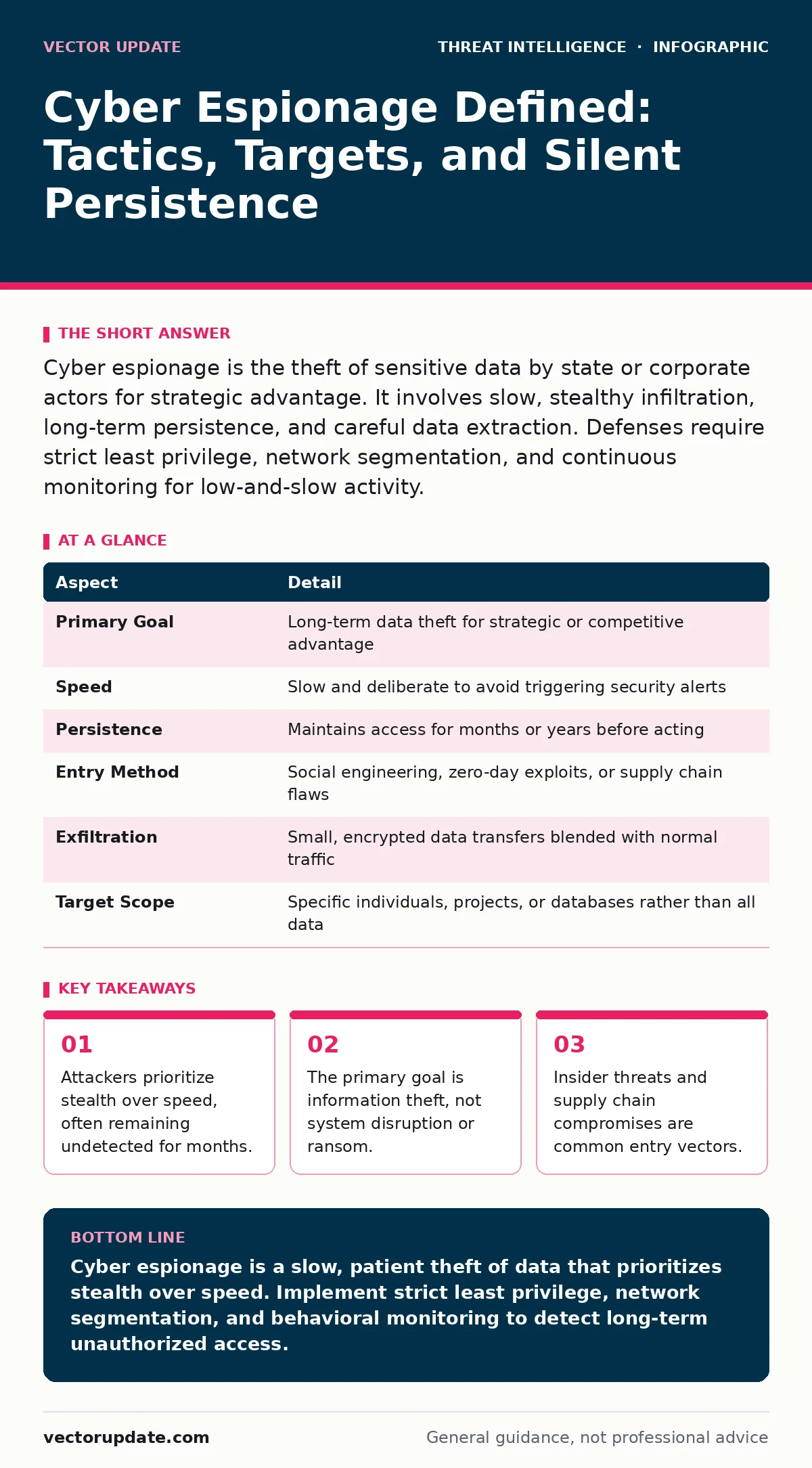
Cyber espionage is the theft of sensitive data by state or corporate actors for strategic advantage. It involves slow, stealthy infiltration, long-term persistence, and careful data extraction. Defenses require strict least privilege, network segmentation, and continuous monitoring for low-and-slow activity.
The Silent Watcher Analogy
Imagine a burglar who does not smash windows or trigger alarms. Instead, they pick the lock, enter quietly, and set up a small camera in the living room. They watch for weeks, noting when people leave documents on the table. Only when they have gathered enough information do they leave, copying notes discreetly. This is how cyber espionage operates. It is not a heist; it is surveillance.
The objective is not to destroy your systems or demand payment. The goal is to observe, record, and steal specific information over time. This distinction changes how you must detect and respond to the threat.
At a Glance: Espionage Mechanics
| Aspect | Detail |
|---|---|
| Primary Goal | Long-term data theft for strategic or competitive advantage |
| Speed | Slow and deliberate to avoid triggering security alerts |
| Persistence | Maintains access for months or years before acting |
| Entry Method | Social engineering, zero-day exploits, or supply chain flaws |
| Exfiltration | Small, encrypted data transfers blended with normal traffic |
| Target Scope | Specific individuals, projects, or databases rather than all data |
How Infiltration Occurs
The entry point is rarely a dramatic hack. Attackers often use spear-phishing emails that appear to come from trusted colleagues or partners. These messages contain malicious attachments or links to credential-harvesting sites. Once a user clicks, the attacker gains a foothold.
Another common path is through the software supply chain. If a vendor’s update mechanism is compromised, every customer who installs the update receives the malware. This allows attackers to bypass perimeter defenses entirely. You must assume that software from third parties can be tainted.
Initial access is just the beginning. The attacker moves laterally through the network, seeking accounts with higher privileges. They look for stored passwords, SSH keys, or configuration files that reveal how systems are connected. This phase is quiet and methodical.
The Value of Stealth
In cybercrime, speed is often an advantage. Ransomware encrypts files quickly to minimize the window for backup restoration. In espionage, speed is a liability. If you move too fast, you trigger anomalies. Attackers use techniques like living-off-the-land binaries to blend in. These are legitimate system tools used in malicious ways, which standard antivirus software often ignores.
They also limit their activity. Instead of downloading a large file at once, they might exfiltrate a few kilobytes per day. This keeps traffic volumes within normal parameters. Detecting this requires analyzing behavior over time, not just looking for large data transfers.
This approach aligns with the Unified Kill Chain model, which breaks down an attack into stages. Espionage operators spend the most time in the "installation" and "actions on objectives" stages. They wait. Patience is their primary weapon.
Who Gets Targeted
You might assume only governments are at risk. That is a misconception. Any organization holding intellectual property, customer data, or strategic plans is a target. Financial institutions, healthcare providers, and manufacturing firms are frequent victims. The value of the data determines the effort an attacker will invest.
If your organization holds unique research or proprietary code, you are a high-value target. Attackers may tailor their approach to your specific industry. They might use terminology or branding relevant to your sector to make phishing attempts more convincing.
Even small organizations are at risk if they serve as a stepping stone to a larger partner. This is why supply chain security matters. Your security posture affects your customers and vendors.
See also: Unified Kill Chain: How to Map and Break Attack Stages · How Advanced Persistent Threats Move: Step-by-Step Breakdown
Common Misconceptions
Many security teams focus on perimeter defense. They build high walls and assume that if nothing gets in, they are safe. This fails against espionage because attackers often enter through legitimate channels. They use stolen credentials that are technically valid. A firewall cannot stop a valid login from inside the network.
Another mistake is assuming that data loss means a large file transfer. Espionage is often fragmentary. An attacker might take screenshots of a document, then delete the local copy. The original file remains untouched, so hash-based integrity checks show no change. You must monitor for access patterns, not just file modifications.
People also confuse espionage with sabotage. While some nation-state cyber attacks aim to disrupt infrastructure, espionage aims to steal information. Confusing the two leads to the wrong detection tools. You need monitoring for long-term access, not just intrusion detection for brute force attempts.
Reducing the Risk
Start with strict access controls. Apply the principle of least privilege. Users should only have access to the data they need for their specific job. This limits the damage if an account is compromised. Use multi-factor authentication everywhere, especially for remote access and administrative accounts.
Network segmentation is critical. Divide your network into zones. If an attacker compromises a workstation in the marketing department, they should not be able to reach the engineering servers. This containment strategy slows down lateral movement.
Monitor for unusual behavior. Look for logins at odd hours, access to multiple disparate systems, or large numbers of files being read rather than modified. These are signs of reconnaissance. Implement a SIEM solution that correlates logs across different systems.
The Human Element
Technology alone cannot stop espionage. Attackers manipulate people. They build relationships with target employees over months or years. This is known as pre-texting. The attacker might pose as a journalist, a recruiter, or a colleague from another department.
Training must go beyond "do not click links." Employees need to understand the value of the data they handle. They should recognize when a request for information is unusual or urgent. A sudden request for sensitive documents, especially via an unsecured channel, is a red flag.
Encourage a culture of skepticism. It is better to verify a request and be wrong than to share data and be compromised. Report suspicious contacts to security teams immediately.
Key takeaways
- Attackers prioritize stealth over speed, often remaining undetected for months.
- The primary goal is information theft, not system disruption or ransom.
- Insider threats and supply chain compromises are common entry vectors.
Cyber espionage is a slow, patient theft of data that prioritizes stealth over speed. Implement strict least privilege, network segmentation, and behavioral monitoring to detect long-term unauthorized access.
Frequently asked questions
How is cyber espionage different from ransomware?
Ransomware aims to disrupt operations and extract money by encrypting files. Cyber espionage aims to steal sensitive information quietly, often leaving systems operational to avoid detection.
Can a small business be a target for cyber espionage?
Yes, especially if the business holds unique data, serves as a supplier to larger targets, or has weaker security that provides an easy entry point for attackers to pivot.
What is the role of STIX and TAXII in espionage defense?
These are open standards for sharing threat intelligence. They allow organizations to exchange information about known espionage tactics, techniques, and procedures, improving collective defense.
Do zero-day exploits make espionage unavoidable?
No, while zero-days are powerful, they are rare. Most espionage relies on common vulnerabilities and social engineering. Strong hygiene and patching mitigate the majority of these risks.
How this guide was produced: written by the Vector Update editorial team with AI assistance, checked against the public references listed below, and reviewed when the facts change. See our editorial policy or report an error.