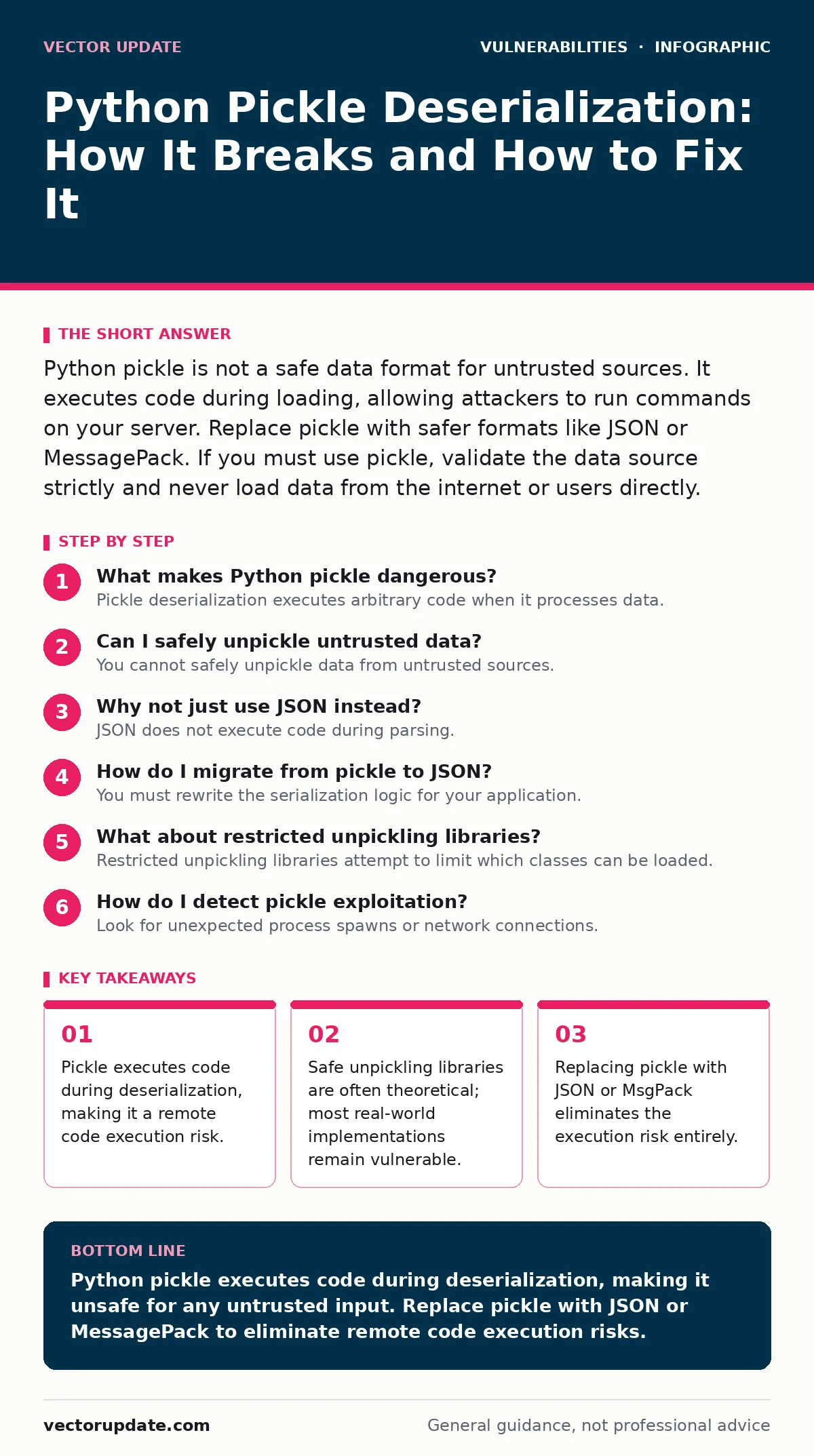
Python Pickle Deserialization: How It Breaks and How to Fix It
Python pickle modules execute arbitrary code when they deserialize data, turning any untrusted input stream into a remote execution vector for attackers.
Python pickle is not a safe data format for untrusted sources. It executes code during loading, allowing attackers to run commands on your server. Replace pickle with safer formats like JSON or MessagePack. If you must use pickle, validate the data source strictly and never load data from the internet or users directly.
What makes Python pickle dangerous?
Pickle deserialization executes arbitrary code when it processes data. The pickle module in Python does not just reconstruct objects; it runs the code required to build them. An attacker who controls the pickle stream can inject instructions that run before the data is even used. This turns data ingestion into command execution. You cannot treat pickle as a simple serialization format. It behaves like a script interpreter.
Can I safely unpickle untrusted data?
You cannot safely unpickle data from untrusted sources. The pickle protocol allows objects to define how they are restored. Attackers craft objects that trigger system commands during this restoration phase. No amount of input validation stops an attacker who controls the entire pickle stream. The format itself lacks a sandbox. Any library claiming to make pickle safe for untrusted input is likely incorrect or limited to very specific, known object types.
Why not just use JSON instead?
JSON does not execute code during parsing. It only creates basic data structures like lists and dictionaries. This separation of data and logic makes JSON safe for untrusted input. You lose the ability to serialize complex Python objects, such as class instances with methods. However, most applications do not need to serialize executable code. If you need to store object state, convert the state to a dictionary first, then use JSON. This breaks the link between data and execution.
How do I migrate from pickle to JSON?
You must rewrite the serialization logic for your application. Identify every place where pickle.dump or pickle.load is called. Replace these calls with json.dump and json.load. You will need to handle custom objects by defining __dict__ access or explicit conversion methods. This process is tedious but necessary. The trade-off is that you lose automatic handling of complex types. You gain protection against remote code execution. This is a one-time cost for long-term security.
| Feature | Python Pickle | JSON | MessagePack |
|---|---|---|---|
| Code Execution | Yes | No | No |
| Human Readable | No | Yes | No |
| Custom Objects | Native | Manual | Manual |
| Data Size | Small | Larger | Small |
| Safety | Unsafe | Safe | Safe |
What about restricted unpickling libraries?
Restricted unpickling libraries attempt to limit which classes can be loaded. These tools maintain a whitelist of allowed types. They fail when an attacker finds a gadget chain within the allowed types. A gadget chain is a sequence of safe-looking objects that combine to execute malicious code. This is similar to how vulnerable third-party libraries often contain unexpected execution paths. Whitelisting is a management burden that degrades over time. New versions of libraries introduce new gadgets. The protection is fragile.
See also: Detect Zero-Click Exploits: Log Signals and Blind Spots
How do I detect pickle exploitation?
Look for unexpected process spawns or network connections. Pickle attacks often trigger system commands. These commands may try to download tools or exfiltrate data. Monitor for processes that start from Python interpreters but behave like shell commands. Check for outbound connections to unknown hosts. This detection is reactive. You already suffered a compromise. The goal is to limit damage. Use file integrity monitoring to catch changes. Review logs for unusual Python activity.
Is there a secure pickle protocol?
No secure pickle protocol exists for untrusted data. The protocol was designed for speed and compatibility, not security. It trusts the data source completely. Some developers try to patch the unpickler to ignore certain opcodes. These patches are incomplete. Attackers adapt by using different opcodes or object methods. The underlying issue is that the format allows code execution. You cannot fix this by tweaking the parser. You must change the format. Consider silent security patches if you are stuck with legacy code, but know they are not a permanent fix.
How does this relate to other vulnerabilities?
Pickle deserialization is a form of code injection. It shares characteristics with type confusion vulnerabilities where the program misinterprets data types. It also resembles time-of-check to time-of-use (TOCTOU) bugs in how it trusts state. The core issue is trusting external input to define internal behavior. This pattern appears in many languages. Java deserialization, PHP unserialize, and .NET binary formatter all share this risk. The lesson is universal. Do not deserialize untrusted data into executable objects.
What if I must use pickle?
Use pickle only for trusted, internal data. Never accept pickle data from the internet, users, or external services. Encrypt and sign the data if it crosses boundaries. This prevents tampering but does not prevent execution if the key is compromised. It is better to use a format like MessagePack. MessagePack offers performance similar to pickle without the execution risk. It supports complex data types safely. The migration effort is worth it. The risk of remote code execution is too high to ignore.
How do I prevent this in new projects?
Enforce a policy that bans pickle for any external input. Use linters to detect pickle usage in code reviews. Configure your CI/CD pipeline to flag imports of the pickle module. Educate your team on the risks. Make safe alternatives the default choice. When designing APIs, specify JSON or Protobuf. This prevents accidental adoption of pickle. Security is easier when the default path is safe. Do not rely on developers to remember the risks. Build the constraints into your tools.
Key takeaways
- Pickle executes code during deserialization, making it a remote code execution risk.
- Safe unpickling libraries are often theoretical; most real-world implementations remain vulnerable.
- Replacing pickle with JSON or MsgPack eliminates the execution risk entirely.
Python pickle executes code during deserialization, making it unsafe for any untrusted input. Replace pickle with JSON or MessagePack to eliminate remote code execution risks.
Frequently asked questions
Does hashing the pickle data prevent exploitation?
No, hashing only verifies integrity. It does not stop the execution of malicious code if the attacker knows the secret key or if the hash is bypassed.
Can I use pickle for local file storage safely?
Only if you are certain no attacker can write to that file. If an attacker gains write access, they can inject malicious pickle data.
Is cPickle safer than pickle?
No, cPickle is just a faster C implementation of the same protocol. It shares the same security flaws and execution risks.
What is the best alternative for complex objects?
MessagePack or Protocol Buffers are good alternatives. They support complex types and are safe from code execution during parsing.
How this guide was produced: written by the Vector Update editorial team with AI assistance, checked against the public references listed below, and reviewed when the facts change. See our editorial policy or report an error.