Type Confusion Vulnerabilities Prevention Checklist for Secure Code
Type confusion allows attackers to bypass memory safety by tricking the system into treating data as a different object, enabling remote code execution without user interaction.

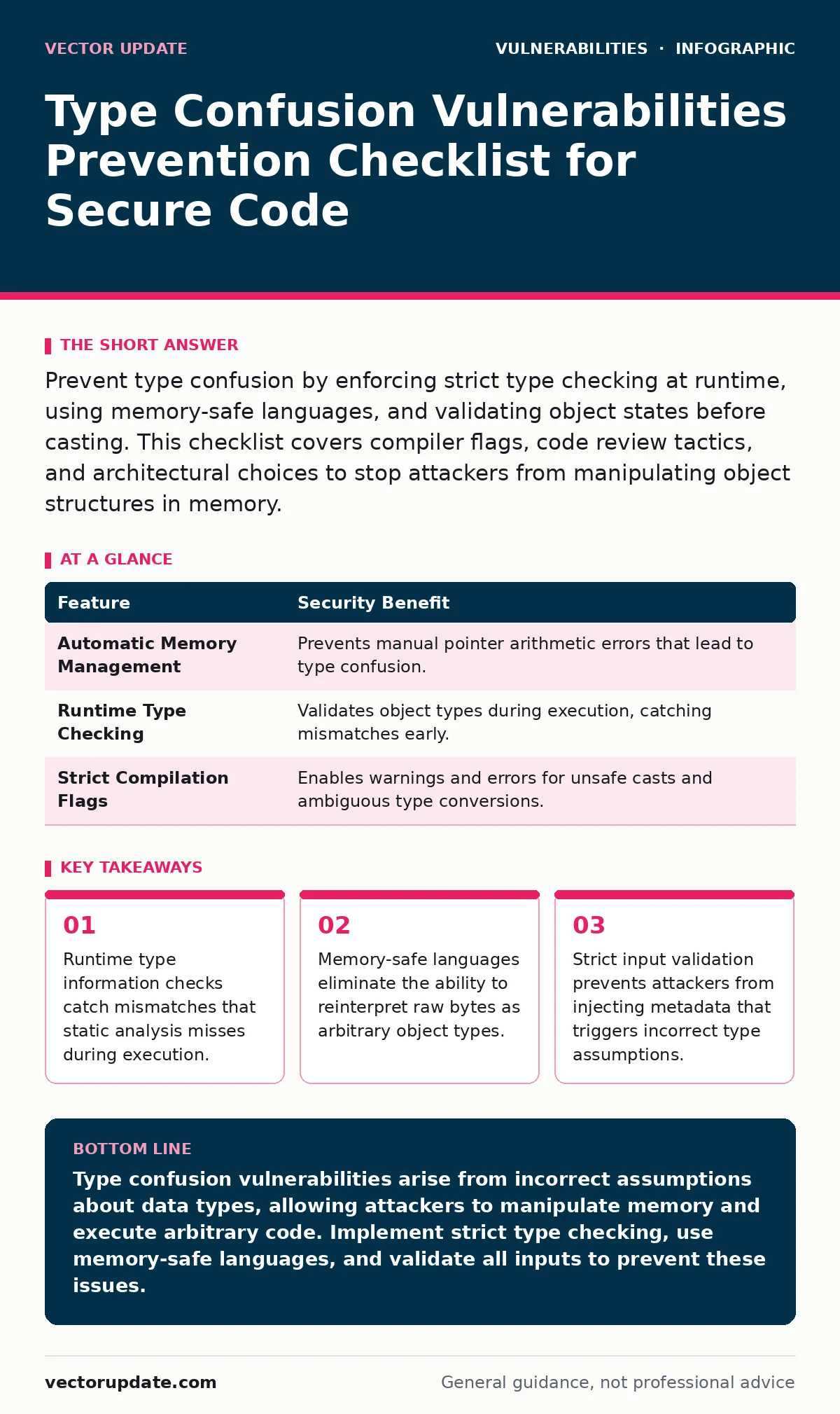
Prevent type confusion by enforcing strict type checking at runtime, using memory-safe languages, and validating object states before casting. This checklist covers compiler flags, code review tactics, and architectural choices to stop attackers from manipulating object structures in memory.
Understanding the Mechanism
Type confusion occurs when a system treats a data structure as one type while it is actually another. This mismatch allows an attacker to access memory locations or invoke methods that should be restricted. The vulnerability arises when the program assumes a specific layout or behavior based on a type label, but the underlying data has been altered or misidentified.
This issue is common in complex software that handles polymorphic objects or dynamic data structures. When the program casts an object to a different type without verifying its true nature, it can read or write to unintended memory regions. This often leads to crashes or, more dangerously, the execution of arbitrary code.
Language and Compiler Choices
Choosing the right development environment is the first line of defense. Languages that manage memory automatically and enforce type safety at runtime significantly reduce the attack surface. These languages prevent direct memory manipulation, making it difficult for an attacker to craft data that confuses the type system.
| Feature | Security Benefit |
|---|---|
| Automatic Memory Management | Prevents manual pointer arithmetic errors that lead to type confusion. |
| Runtime Type Checking | Validates object types during execution, catching mismatches early. |
| Strict Compilation Flags | Enables warnings and errors for unsafe casts and ambiguous type conversions. |
You should enable strict compilation flags that warn about implicit type conversions. These flags help identify code paths where the compiler might assume a type that is not guaranteed. While this adds complexity to the build process, it catches issues that static analysis tools might overlook.
Code Review and Validation
Code reviews must focus on how objects are created, modified, and destroyed. Reviewers should look for places where type information is stored separately from the data itself. If an attacker can modify the type label without changing the data, they can force the system to interpret the data incorrectly.
- Verify all external inputs: Validate that data structures match expected schemas before processing to prevent malformed objects from entering the system.
- Check object lifecycle management: Ensure that objects are properly initialized and destroyed to avoid use-after-free conditions that can lead to type confusion.
- Audit dynamic type checks: Confirm that runtime checks are performed before any type casting or method invocation on polymorphic objects.
Static analysis tools can help identify potential issues, but they cannot catch all runtime behaviors. You must combine automated tools with manual review to ensure that type assumptions hold true in all execution paths. This is similar to the approach used in risk-based vulnerability management, where you prioritize checks based on the potential impact of the vulnerability.
Architectural Defenses
Designing systems with security in mind reduces the likelihood of type confusion vulnerabilities. One effective strategy is to minimize the use of dynamic typing and polymorphism in security-critical components. By keeping these components simple and static, you reduce the complexity that attackers can exploit.
Another approach is to use separate memory spaces for different types of data. This isolation ensures that even if an attacker manipulates one type of data, they cannot easily affect others. This concept aligns with exposure management, where you limit the attack surface by reducing the number of accessible interfaces.
- Isolate critical components: Run high-risk code in separate processes or containers to limit the impact of a successful exploit.
- Use secure APIs: Wrap low-level memory operations in higher-level APIs that enforce type safety and prevent direct memory access.
- Implement integrity checks: Add checksums or hashes to data structures to detect tampering before the system processes them.
Testing and Validation
Testing must go beyond functional correctness to include security-specific scenarios. Fuzzing is a powerful technique for discovering type confusion vulnerabilities. By feeding random or malformed data into the system, you can trigger edge cases that lead to type mismatches.
- Perform fuzz testing: Use fuzzers to generate invalid inputs and observe how the system handles type errors.
- Test with malformed objects: Create test cases that include objects with incorrect type labels or corrupted metadata.
- Validate error handling: Ensure that the system fails securely when type checks fail, rather than crashing or continuing with incorrect assumptions.
These tests help identify vulnerabilities that might not be apparent during normal operation. They are particularly useful for finding issues related to pre-authentication vulnerabilities, where an attacker can exploit the system before any validation checks are performed.
See also: TOCTOU Bugs: Risks and Protection for Small Businesses · Bug Bounty Triage for Small Teams: A Practical Workflow
Mitigation and Response
Even with strong defenses, some vulnerabilities may slip through. Having a plan for detection and response is critical. Monitoring for unusual behavior, such as unexpected crashes or access violations, can help identify active exploits.
- Enable crash reporting: Collect detailed information about crashes to help identify the root cause of type confusion issues.
- Monitor for anomalous behavior: Look for signs of unauthorized access or unexpected system behavior that might indicate an exploit.
- Patch promptly: Apply security updates as soon as they are available to fix known type confusion vulnerabilities.
This approach is similar to handling silent security patches, where updates are applied without user interaction to minimize the window of exposure. By staying proactive, you can reduce the impact of any vulnerabilities that are discovered.
Final Checklist Items
- Enforce strict type safety: Use languages and compilers that enforce type safety at runtime to prevent type confusion.
- Validate all inputs: Check all external inputs to ensure they match expected types and formats before processing.
- Isolate components: Run critical code in isolated environments to limit the impact of a successful exploit.
- Test extensively: Use fuzzing and other testing techniques to identify potential type confusion vulnerabilities.
- Monitor and respond: Set up monitoring to detect and respond to active exploits quickly.
Key takeaways
- Runtime type information checks catch mismatches that static analysis misses during execution.
- Memory-safe languages eliminate the ability to reinterpret raw bytes as arbitrary object types.
- Strict input validation prevents attackers from injecting metadata that triggers incorrect type assumptions.
Type confusion vulnerabilities arise from incorrect assumptions about data types, allowing attackers to manipulate memory and execute arbitrary code. Implement strict type checking, use memory-safe languages, and validate all inputs to prevent these issues.
Frequently asked questions
What is the difference between type confusion and buffer overflow?
Buffer overflow occurs when data exceeds the allocated memory space, while type confusion involves treating data as the wrong type, leading to incorrect memory access.
Can static analysis tools detect type confusion vulnerabilities?
Static analysis can identify potential issues, but it cannot catch all runtime behaviors. Dynamic testing and code reviews are also necessary.
How do I know if my system is vulnerable to type confusion?
Look for complex type systems, dynamic casting, and lack of runtime type checks. Fuzz testing can help identify specific vulnerabilities.
Are there specific languages that are more resistant to type confusion?
Languages with strong type safety and automatic memory management, such as Rust or Java, are more resistant to type confusion vulnerabilities.
How this guide was produced: written by the Vector Update editorial team with AI assistance, checked against the public references listed below, and reviewed when the facts change. See our editorial policy or report an error.