Bug Bounty Triage for Small Teams: A Practical Workflow
Small organizations avoid costly breaches by filtering false positives early and delegating complex code analysis to specialized external partners.

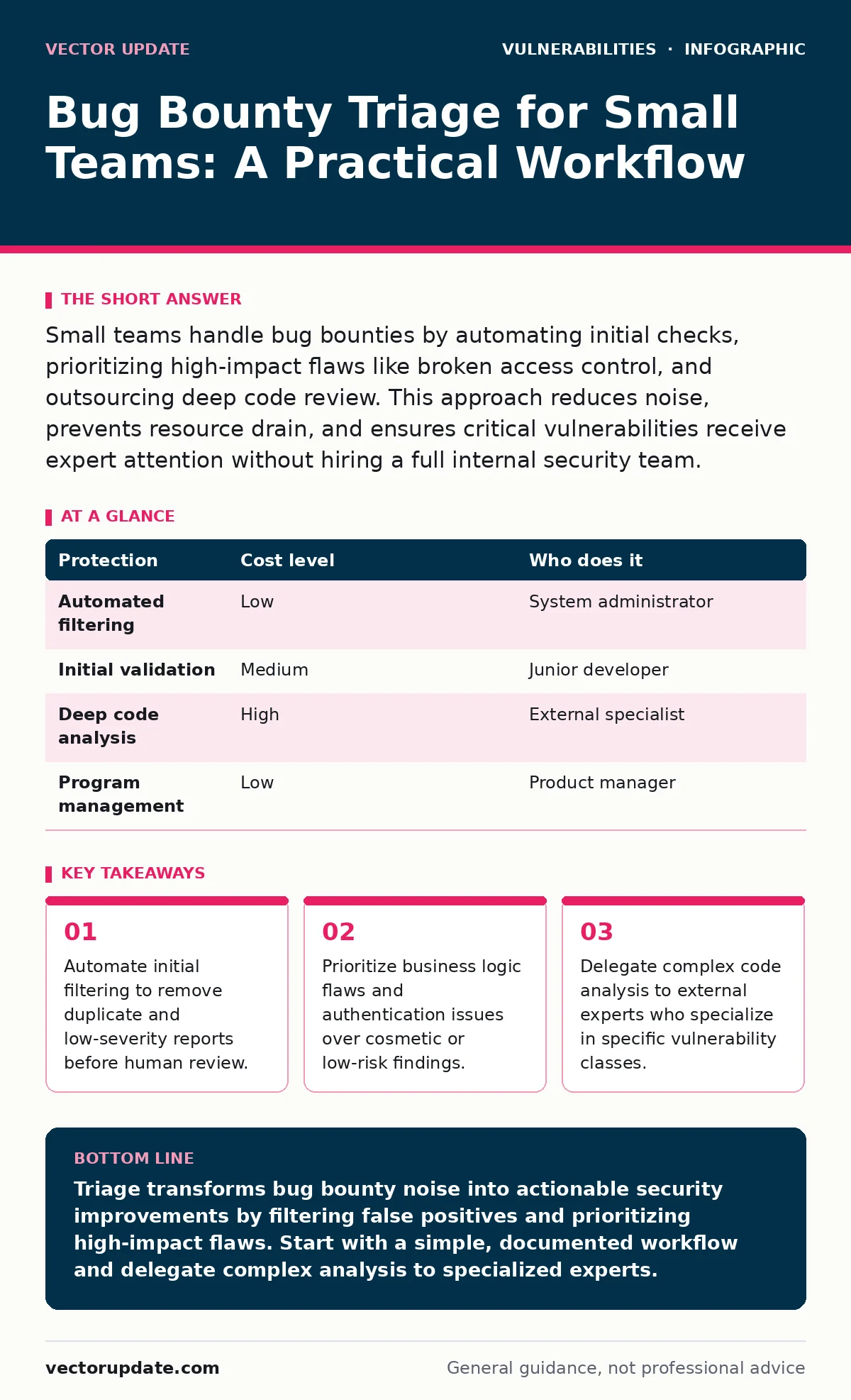
Small teams handle bug bounties by automating initial checks, prioritizing high-impact flaws like broken access control, and outsourcing deep code review. This approach reduces noise, prevents resource drain, and ensures critical vulnerabilities receive expert attention without hiring a full internal security team.
Why Triage Matters at Small Scale
Small organizations face a unique challenge with bug bounty programs. They lack the large security teams that enterprise companies use to filter noise. Every report consumes developer time. Developers are expensive and scarce. When a team spends hours investigating a false positive, they delay feature development and fix real bugs. Triage separates signal from noise. It ensures that only valid, high-impact vulnerabilities reach the engineering team.
This process preserves productivity. It also prevents alert fatigue. When every report feels urgent, nothing feels urgent. Triage restores focus. It allows small teams to compete with larger rivals by managing risk efficiently. You do not need a dedicated security analyst to start. You need a clear process. This process defines who looks at what, when, and how. It turns chaos into a manageable workflow.
Affordable Ways to Manage Reports
You can manage bug bounties without expensive tools. Start with a simple ticketing system. Create a standard template for responders. This template forces reporters to provide proof of concept steps. Without clear reproduction steps, you cannot validate a claim. Automate the initial check. Use scripts to scan for common false positives. For example, many reports claim cross-site scripting (XSS) but fail to demonstrate execution. Your script can check if the payload reflects in the HTML context.
If it does not, mark it as invalid immediately. This saves human hours. Use open-source frameworks for initial validation. These tools are free and well-documented. They help you establish a baseline. You can build on this baseline as your program grows. Do not rush to buy commercial platforms. They add cost and complexity. Keep it simple. Focus on clarity and consistency. A simple process is better than a complex one that nobody follows.
| Protection | Cost level | Who does it |
|---|---|---|
| Automated filtering | Low | System administrator |
| Initial validation | Medium | Junior developer |
| Deep code analysis | High | External specialist |
| Program management | Low | Product manager |
What to Delegate to Experts
Not all vulnerabilities require the same expertise. Some issues are straightforward. A missing header is easy to fix. Other issues are subtle. Business logic flaws often require deep understanding of your application’s intent. A developer might not see the flaw because they know how the system is supposed to work. An outsider sees how it breaks. Delegate these complex issues. You can hire freelance security consultants. Look for specialists in specific areas. For example, if you handle financial transactions, hire an expert in business logic flaws.
If you use complex data serialization, look for someone who understands Python pickle deserialization risks. This targeted approach is more efficient than hiring a generalist. It ensures you get the right expertise for the problem. You pay for the analysis, not the general availability. This reduces cost. It also speeds up resolution. Experts know the patterns. They can identify the root cause faster. You retain control of the fix. They provide the insight. You implement the solution. This division of labor is sustainable.
Prioritizing High-Impact Vulnerabilities
Not all bugs are equal. A typo in a footer is annoying. A broken access control flaw is catastrophic. Prioritize based on impact. Ask yourself: what can an attacker do? Can they read data? Can they modify data? Can they take over accounts? Authentication and authorization issues are usually the highest priority. These flaws allow attackers to impersonate users. They bypass security boundaries. Next, look for data exposure. Can an attacker access sensitive information? Then, consider availability.
Can an attacker crash the system? Finally, address lower-risk issues. These include cosmetic flaws or minor configuration errors. Do not ignore them, but do not rush them. Create a backlog. Schedule fixes for these issues. This approach ensures that critical risks are addressed first. It also manages developer workload. You avoid burnout by focusing on what matters. Prioritization is a judgment call. Use your knowledge of the business. Understand what data is valuable. Protect the crown jewels first.
Handling False Positives and Noise
Bug bounty programs generate noise. Some reports are duplicates. Others are misunderstandings. Some are even malicious attempts to waste your time. You must handle this noise efficiently. Do not engage with every report personally. Use a triage queue. Assign a junior team member to review initial claims. They check for basic validity. Is the report within scope? Does it include a proof of concept? Is it a duplicate? If the answer is no, close the report.
Provide a brief explanation. This helps reporters improve their future submissions. It also maintains a good relationship with the community. Do not be dismissive. Be clear and factual. If a report is valid, escalate it. If it is invalid, close it. Speed matters. Fast responses encourage more high-quality reports. Slow responses encourage spam. Keep the pipeline moving. This discipline keeps the program healthy. It ensures that real vulnerabilities get attention.
See also: TOCTOU Bugs: Risks and Protection for Small Businesses · Type Confusion Vulnerabilities Prevention Checklist for Secure Code
Building a Repeatable Workflow
Consistency is key to successful triage. Create a standard operating procedure. Document the steps for each type of vulnerability. For example, how do you validate a type confusion vulnerability? How do you assess the risk of silent security patches? Document these processes. Share them with the team. Train new members on the workflow. Review the process regularly. Update it as you learn. Did a certain type of report cause confusion?
Clarify the guidelines. Did a new tool help? Integrate it. Continuous improvement is vital. It keeps the process effective. It also reduces errors. A documented workflow is easier to audit. It provides evidence of due diligence. This is important for compliance. It also helps with onboarding. New team members can learn the process quickly. They do not need to guess. They follow the guide. This reduces friction. It increases efficiency.
Questions for IT Providers
If you outsource triage, you need to vet providers carefully. Ask specific questions. Do not accept vague answers. Here are 3 questions to ask:
- What is your process for validating complex business logic flaws?
- How do you handle reports that are outside the defined scope?
- Can you provide references from similar-sized organizations?
These questions reveal their expertise and approach. They also show their professionalism. A good provider will answer clearly. They will explain their methodology. They will be transparent about their limitations. Do not hire the cheapest option. Hire the most competent. Quality matters more than cost in security. A missed vulnerability costs more than a good consultant. Choose wisely. This decision impacts your security posture. It also impacts your reputation. Build a partnership, not just a transaction. This ensures long-term success.
Integrating with Development Cycles
Triage is not an isolated activity. It connects to your development process. When a vulnerability is confirmed, create a ticket. Assign it to the right developer. Set a deadline based on severity. Track the fix. Verify the fix. Close the ticket. This loop ensures accountability. It also provides metrics. You can track time to fix. You can track the number of issues. These metrics help you improve. They show trends. They highlight weak areas.
Use this data to strengthen your development practices. Train developers on common pitfalls. For example, teach them about time-of-check to time-of-use (TOCTOU) bugs. These bugs are subtle and dangerous. Education reduces the number of issues. It improves code quality. It also speeds up triage. When developers understand the risks, they write better code. This reduces the burden on the security team. It creates a culture of security. Everyone contributes. This is the ultimate goal.
Key takeaways
- Automate initial filtering to remove duplicate and low-severity reports before human review.
- Prioritize business logic flaws and authentication issues over cosmetic or low-risk findings.
- Delegate complex code analysis to external experts who specialize in specific vulnerability classes.
Triage transforms bug bounty noise into actionable security improvements by filtering false positives and prioritizing high-impact flaws. Start with a simple, documented workflow and delegate complex analysis to specialized experts.
Frequently asked questions
How do I validate a complex business logic flaw?
Map the intended user journey and compare it to the reported attack path. Look for steps where authorization checks are missing or bypassed. Consult with product owners to understand the expected behavior.
What is the best way to handle duplicate reports?
Link duplicate reports to the original ticket. Thank the second reporter for their diligence. Explain that the issue is already being addressed. This maintains goodwill while avoiding redundant work.
Should I pay for false positives?
No. Only pay for valid, in-scope vulnerabilities. Define your scope and rules clearly in your program policy. This prevents abuse and ensures you reward meaningful contributions.
How often should I review my triage process?
Review your process quarterly. Analyze metrics like time to triage and false positive rate. Adjust your workflow based on these insights. Continuous improvement keeps the program effective.
How this guide was produced: written by the Vector Update editorial team with AI assistance, checked against the public references listed below, and reviewed when the facts change. See our editorial policy or report an error.