Machine Learning for Fraud Detection: 8 Engineering Best Practices
Model drift silently degrades fraud detection accuracy over time, requiring continuous monitoring and retraining to maintain effectiveness against evolving attacker tactics.

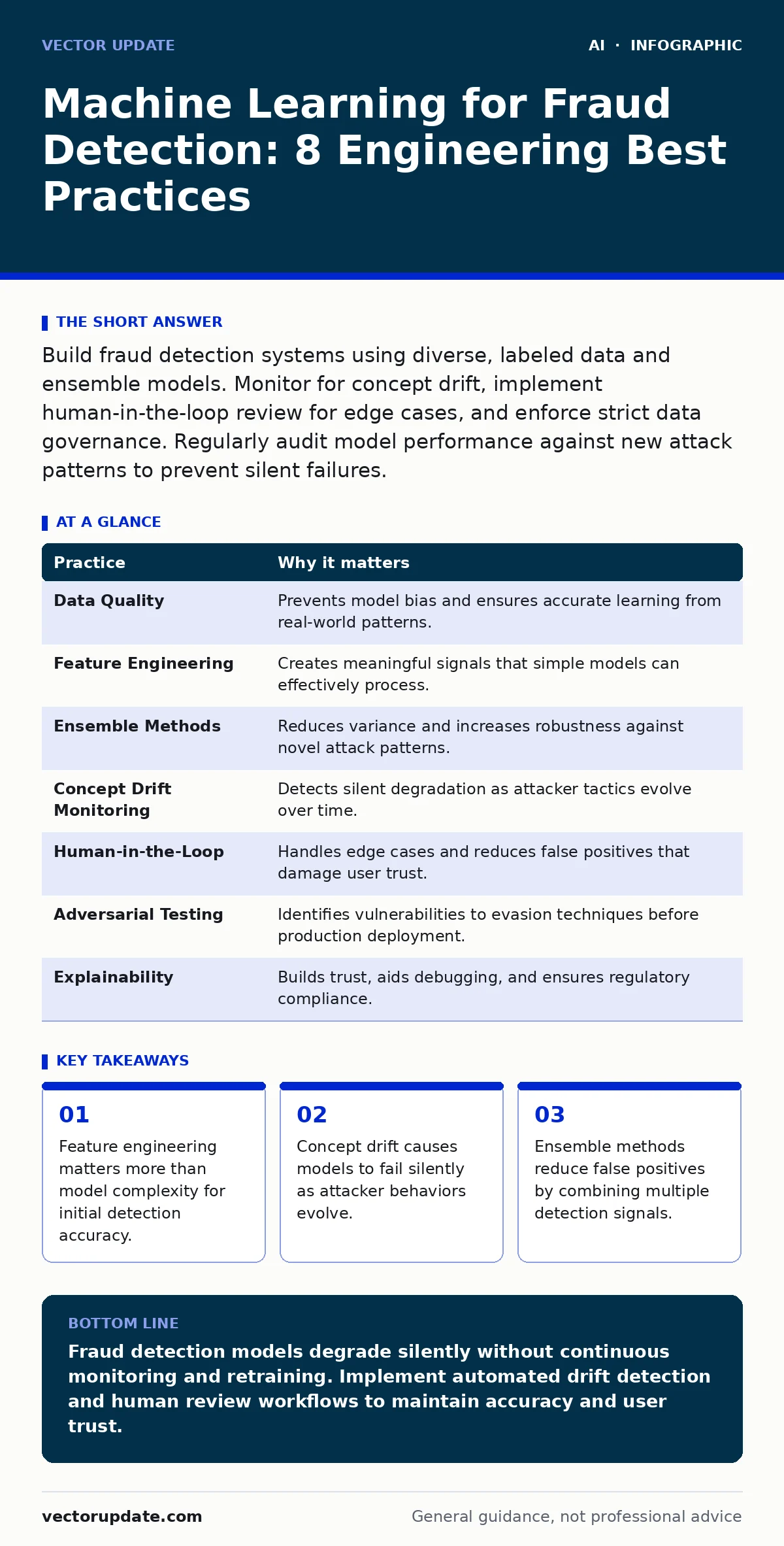
Build fraud detection systems using diverse, labeled data and ensemble models. Monitor for concept drift, implement human-in-the-loop review for edge cases, and enforce strict data governance. Regularly audit model performance against new attack patterns to prevent silent failures.
Data Quality and Labeling Integrity
Machine learning models learn from historical data, so the quality of that data determines the ceiling of your detection capability. Fraud patterns evolve rapidly, meaning last year’s labeled transactions may not reflect current attacker behavior. You must ensure your training data includes a balanced representation of both legitimate and fraudulent activities.
Imbalanced datasets cause models to ignore rare fraud events because the majority class dominates the loss function. You must use techniques like oversampling minority classes or applying class weights during training. This forces the model to pay attention to the rare, high-value fraud signals rather than optimizing for overall accuracy on benign transactions.
Tip: Audit your labeling process regularly. Human annotators introduce bias and error, so implement double-blind labeling for ambiguous cases and calculate inter-annotator agreement scores to measure consistency.
Feature Engineering Over Model Complexity
Complex neural networks do not automatically outperform simpler models if the input features are weak. The most valuable inputs for fraud detection are often derived features, not raw transaction data. You must create features that capture behavioral anomalies, such as velocity checks or geographic impossibility.
Raw data like transaction amounts or timestamps provides little context on its own. Derived features, such as the number of transactions in the last hour or the deviation from a user’s typical spending pattern, provide the signal the model needs. These engineered features allow even simple logistic regression models to perform effectively, reducing computational cost and latency.
Tip: Focus on temporal and behavioral features. A transaction’s timing relative to previous activity often reveals more about intent than the transaction amount itself.
Ensemble Methods for Robust Detection
Relying on a single model creates a single point of failure. Attacker tactics can shift in ways that exploit the specific weaknesses of one algorithm. You should combine multiple models, such as decision trees, gradient boosting, and neural networks, into an ensemble.
Each model type captures different patterns in the data. Decision trees handle non-linear relationships well, while linear models capture global trends. By aggregating their predictions, you smooth out individual model errors and reduce the variance of the final prediction. This approach increases stability and reduces the likelihood of missing novel fraud patterns.
Tip: Use a weighted voting system where models with higher historical precision contribute more to the final decision. This allows you to prioritize precision over recall in high-risk scenarios.
Monitoring for Concept Drift
Concept drift occurs when the statistical properties of the target variable change over time. In fraud detection, this means attackers change their methods, rendering the model’s learned patterns obsolete. You must monitor the distribution of input features and the model’s prediction confidence over time.
Silent degradation is the biggest risk. A model may continue to produce predictions, but its accuracy drops as the underlying fraud patterns shift. You need automated alerts for significant changes in feature distributions or prediction confidence scores. This allows you to retrain the model before it starts missing fraud or generating excessive false positives.
Tip: Implement a sliding window comparison of feature distributions. Compare the current week’s data against the previous month’s baseline to detect gradual shifts in user behavior or attack patterns.
Human-in-the-Loop Review
Automated models cannot handle every edge case with perfect accuracy. High-confidence predictions should be acted upon automatically, but low-confidence or ambiguous cases require human review. You must design a workflow that routes these cases to analysts without creating a bottleneck.
False positives damage customer trust and increase operational costs. A user blocked for a legitimate transaction may leave your platform. Human analysts provide context that models lack, such as understanding a user’s recent life events or business activities. This feedback loop also generates high-quality labeled data for future model training.
Tip: Prioritize cases for human review based on potential financial impact and user tenure. Long-term customers with slight anomalies are less risky than new accounts with high-value transactions.
See also: Synthetic Media Defined: What It Is and How It Works · EU AI Act FAQ: What It Means for Your Systems and Data
Adversarial Robustness Testing
Fraudsters actively probe detection systems to find weaknesses. They may use techniques like feature perturbation to make fraudulent transactions look legitimate. You must test your model against adversarial examples to ensure it does not fail under attack.
Adversarial attacks involve making small, imperceptible changes to input data to mislead the model. For example, splitting a large fraudulent transaction into several smaller ones that fall below detection thresholds. You need to simulate these attacks during the testing phase to identify vulnerabilities before they are exploited in production.
Tip: Use generative models to create synthetic adversarial examples. Train your detection model on these synthetic attacks to improve its resilience against real-world evasion techniques.
Explainability and Compliance
Black-box models are difficult to debug and may violate regulatory requirements. You must use techniques that explain why a model made a specific prediction. This is not just for compliance; it helps engineers identify model bias and improve feature engineering.
Explainability methods like SHAP or LIME provide local explanations for individual predictions. They show which features contributed most to a fraud score. This transparency allows analysts to trust the model’s decisions and provides users with clear reasons for account restrictions, reducing support tickets.
Tip: Integrate explainability tools into your monitoring dashboard. This allows you to track if the model is relying on spurious correlations, such as zip codes, which may indicate bias rather than fraud.
Secure Data Pipeline and Privacy
Fraud detection systems process sensitive personal and financial data. You must secure the data pipeline against leaks and unauthorized access. This includes encrypting data at rest and in transit, and implementing strict access controls.
Data privacy regulations require you to minimize data collection and retain only what is necessary. You must implement data anonymization or pseudonymization techniques before feeding data into the model. This reduces the risk of exposing sensitive information in case of a breach.
Tip: Use differential privacy techniques during training. This adds noise to the data to prevent the model from memorizing specific individual records, protecting user privacy while maintaining model accuracy.
| Practice | Why it matters |
|---|---|
| Data Quality | Prevents model bias and ensures accurate learning from real-world patterns. |
| Feature Engineering | Creates meaningful signals that simple models can effectively process. |
| Ensemble Methods | Reduces variance and increases robustness against novel attack patterns. |
| Concept Drift Monitoring | Detects silent degradation as attacker tactics evolve over time. |
| Human-in-the-Loop | Handles edge cases and reduces false positives that damage user trust. |
| Adversarial Testing | Identifies vulnerabilities to evasion techniques before production deployment. |
| Explainability | Builds trust, aids debugging, and ensures regulatory compliance. |
| Secure Pipeline | Protects sensitive user data and prevents unauthorized access or leaks. |
Integrating with Security Operations
Fraud detection does not exist in a vacuum. It must integrate with your broader security operations. Alerts from fraud models should feed into your security information and event management system for correlation with other security signals.
This integration allows you to detect coordinated attacks that span multiple vectors. For example, a fraud alert combined with a login anomaly from a new device may indicate account takeover. You must ensure seamless data flow between fraud detection and security teams to enable rapid response.
Tip: Create unified dashboards that display fraud alerts alongside security events. This provides context for analysts and reduces the time to investigate and respond to complex incidents.
Key takeaways
- Feature engineering matters more than model complexity for initial detection accuracy.
- Concept drift causes models to fail silently as attacker behaviors evolve.
- Ensemble methods reduce false positives by combining multiple detection signals.
- Human review is necessary for ambiguous cases to prevent user friction.
Fraud detection models degrade silently without continuous monitoring and retraining. Implement automated drift detection and human review workflows to maintain accuracy and user trust.
Frequently asked questions
How often should I retrain my fraud detection model?
Retrain when concept drift metrics exceed predefined thresholds, typically when feature distributions or prediction confidence shifts significantly. This may be weekly, monthly, or event-driven.
What is the best model for fraud detection?
There is no single best model. Ensemble methods combining gradient boosting machines and neural networks often provide the best balance of accuracy, speed, and robustness.
How do I handle false positives in fraud detection?
Implement a human-in-the-loop review process for low-confidence predictions. Use explainability tools to understand why the model flagged the transaction and adjust thresholds accordingly.
Can machine learning detect all types of fraud?
No. Machine learning is effective for pattern-based fraud but may miss novel, one-off attacks. It should be part of a layered security strategy that includes rule-based systems and human analysis.
How this guide was produced: written by the Vector Update editorial team with AI assistance, checked against the public references listed below, and reviewed when the facts change. See our editorial policy or report an error.