Deepfake Detection for Small Teams: Practical Tools and Limits
Most deepfake detection tools fail on low-resolution video, forcing small teams to prioritize metadata verification over visual analysis.
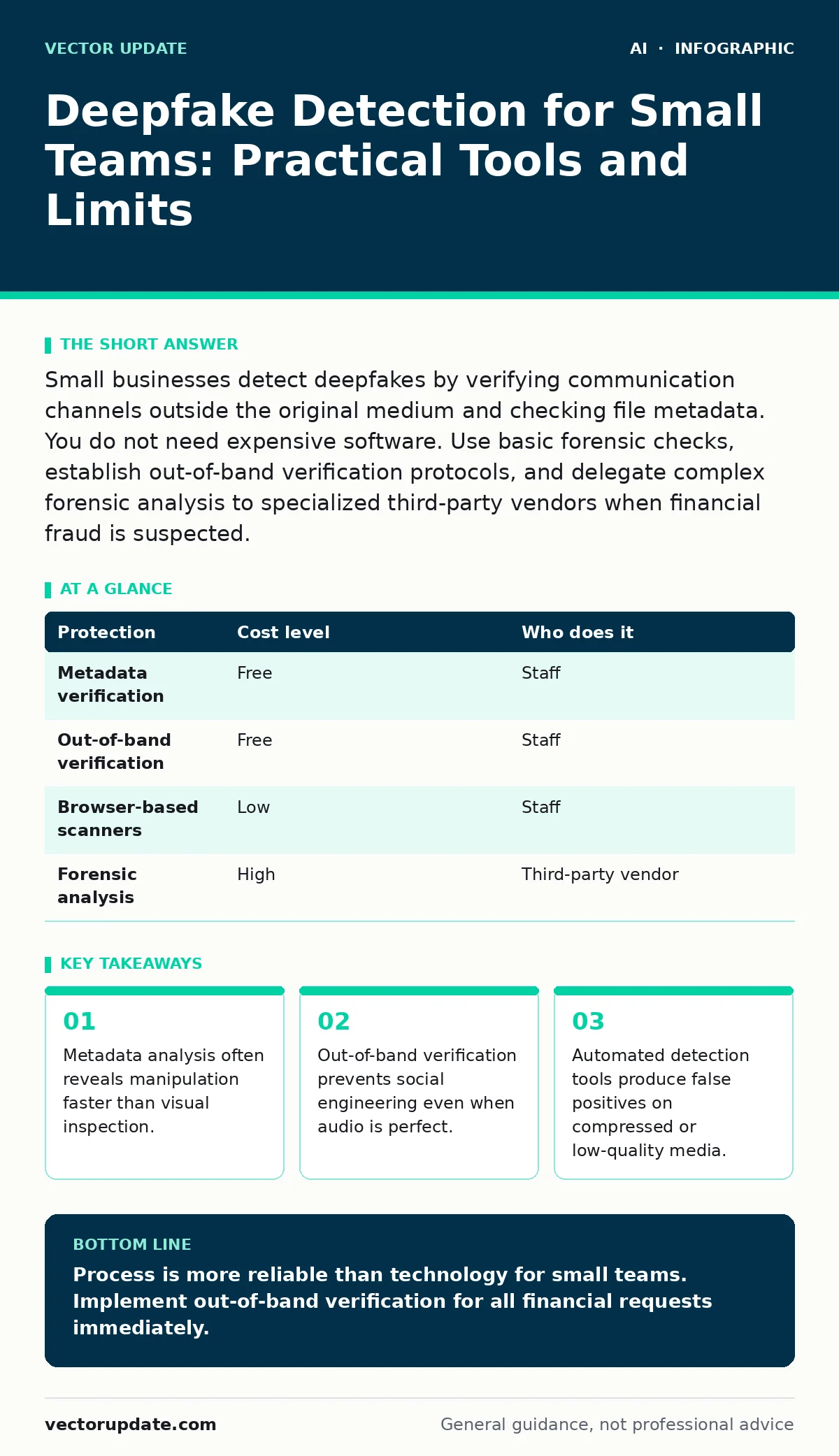
Small businesses detect deepfakes by verifying communication channels outside the original medium and checking file metadata. You do not need expensive software. Use basic forensic checks, establish out-of-band verification protocols, and delegate complex forensic analysis to specialized third-party vendors when financial fraud is suspected.
Small organizations face a unique threat surface regarding synthetic media. You lack the dedicated security operations center that large enterprises maintain. This means you cannot afford to rely on expensive, proprietary detection suites that require constant tuning. Instead, you must rely on process and basic forensic hygiene. The goal is not to catch every fake, but to stop the ones that cause financial loss or reputational damage.
The Metadata Advantage
Visual deepfake detection is an arms race that small teams cannot win. Adversarial generation tools improve faster than detection algorithms can adapt. However, the digital footprint of a file often remains consistent. Metadata is data about data, such as creation time, software used, and modification history. When a deepfake is generated, the original metadata is often stripped or replaced with generic entries.
Suppose you receive a suspicious image. Right-click the file and view its properties. Look for the software tag. If the file claims to be from a standard smartphone camera but lists a Python library or a known generative model in the creation tool field, it is likely synthetic. This is a free, immediate check that requires no external tools. It is not foolproof, as attackers can strip metadata, but it is a strong initial filter.
Out-of-Band Verification
The most effective defense against deepfake fraud is not technical, but procedural. You must verify the identity of the sender through a different channel than the one used for the request. This is called out-of-band verification. If you receive a video call requesting a wire transfer, hang up and call the person using a known, trusted phone number. Do not use the number provided in the video or email.
This method works because it breaks the attack chain. The attacker controls the digital medium, but they do not control your physical phone line or your direct line of sight. For small businesses, this protocol is cheaper and more reliable than any detection software. It adds friction to the workflow, which is a feature, not a bug. Friction stops impulse decisions driven by urgency.
Affordable Technical Controls
You can implement basic technical controls without significant expense. Browser extensions that scan for manipulated media can provide a second layer of defense. These tools analyze pixel-level artifacts and inconsistencies in lighting or shadows. They are not perfect and will flag legitimate low-quality video as suspicious. Treat these alerts as warnings, not proof.
Integrate these checks into your existing workflow. If your team uses a specific communication platform, ensure that platform’s security features are enabled. Many platforms now include indicators for verified users or encrypted channels. While these do not detect deepfakes directly, they reduce the attack surface by making it harder for attackers to impersonate trusted accounts. Refer to our guide on deepfake fraud for more details on how these attacks are structured.
| Protection | Cost level | Who does it |
|---|---|---|
| Metadata verification | Free | Staff |
| Out-of-band verification | Free | Staff |
| Browser-based scanners | Low | Staff |
| Forensic analysis | High | Third-party vendor |
Delegating Complex Analysis
When a deepfake is suspected and involves significant financial risk, delegate the analysis. You do not need to become a forensic expert. Specialized vendors offer manual review services. They use advanced machine learning models and human expertise to determine if media is synthetic. This is a paid service, but it is only needed for high-stakes incidents.
Do not attempt to run complex detection models on your own infrastructure. These models require significant computational power and regular updates to remain effective. Maintaining them is a full-time job. By delegating, you convert a fixed cost into a variable one. You pay only when you need the service. This aligns with the principles of responsible AI practices, where you acknowledge the limitations of automated systems.
The Limits of Automation
Automated detection tools suffer from high false positive rates. Compressed video, poor lighting, and low resolution create artifacts that look like deepfake signatures to algorithms. If you rely solely on automation, you will waste time investigating legitimate media. This leads to alert fatigue, where staff begin to ignore warnings.
You must balance automation with human judgment. Use automated tools to flag potential issues, but require human review for any action that involves money or sensitive data. This hybrid approach ensures you catch the obvious fakes while avoiding unnecessary disruption. For more on how AI fits into broader security strategies, see AI in security operations.
See also: EU AI Act FAQ: What It Means for Your Systems and Data · AI in Security Operations: 8 Best Practices for Real-World Defense
Questions for IT Providers
If you outsource your IT security, you need to know how they handle synthetic media. Ask specific questions to ensure they have a plan. Do not accept vague answers about "monitoring" or "protection."
- How do you verify the identity of users requesting financial transactions?
- What tools do you use to analyze suspicious media files?
- How often are your detection models updated to handle new generation techniques?
- What is the protocol for reporting suspected deepfake incidents?
- Do you provide training on recognizing synthetic media to end-users?
These questions help you assess whether your provider is prepared for this evolving threat. They also ensure you are aligned on expectations. For context on regulatory pressures, the EU AI Act imposes strict requirements on high-risk AI systems, which may affect your vendors.
Continuous Process Improvement
Deepfake detection is not a one-time fix. It is an ongoing process. Regularly update your verification protocols. Test them with simulated scenarios. Suppose a manager sends a fake request to test the finance team’s response. Measure how quickly they verify the request. Use this data to improve training and procedures.
Stay informed about new detection techniques. The landscape of synthetic media changes rapidly. New artifacts emerge, and old ones disappear. By staying curious and proactive, you can adapt your defenses. This approach complements machine learning for fraud detection, which also requires constant retraining and adjustment.
Key takeaways
- Metadata analysis often reveals manipulation faster than visual inspection.
- Out-of-band verification prevents social engineering even when audio is perfect.
- Automated detection tools produce false positives on compressed or low-quality media.
Process is more reliable than technology for small teams. Implement out-of-band verification for all financial requests immediately.
Frequently asked questions
Can I detect a deepfake just by looking at it?
No. Modern deepfakes are visually indistinguishable from real video to the human eye. You must rely on metadata, context, and verification protocols.
Do I need expensive software to detect deepfakes?
No. Basic metadata checks and out-of-band verification are free and highly effective. Expensive software is only needed for complex forensic analysis.
What should I do if I suspect a deepfake?
Stop the transaction. Verify the sender’s identity through a trusted, separate channel. If financial loss is likely, engage a forensic specialist.
How often should I update my deepfake detection tools?
Continuously. The techniques used to create deepfakes evolve rapidly. Regular updates and retraining are necessary to maintain effectiveness.
How this guide was produced: written by the Vector Update editorial team with AI assistance, checked against the public references listed below, and reviewed when the facts change. See our editorial policy or report an error.