Cloud Penetration Testing Misunderstandings Corrected
Cloud penetration testing fails when teams treat infrastructure like servers instead of treating APIs and identities as the primary attack surface for data exfiltration.

Cloud penetration testing is not a server scan. It targets identity permissions, API misconfigurations, and storage exposure. Misunderstanding this leads to wasted effort on patching boxes that are already compromised via weak access controls. Focus on least privilege and API security to actually reduce your attack surface effectively.
Misreading: It Is Just Scanning Servers
Correct reading: Cloud penetration testing targets the control plane, not just the compute plane. Traditional network scanners look for open ports and unpatched operating systems. Cloud environments separate management from workload execution. Attacking a virtual machine directly is rare compared to exploiting the identity that manages it. You must test how identities interact with resources. This shifts the focus from firewalls to permissions.
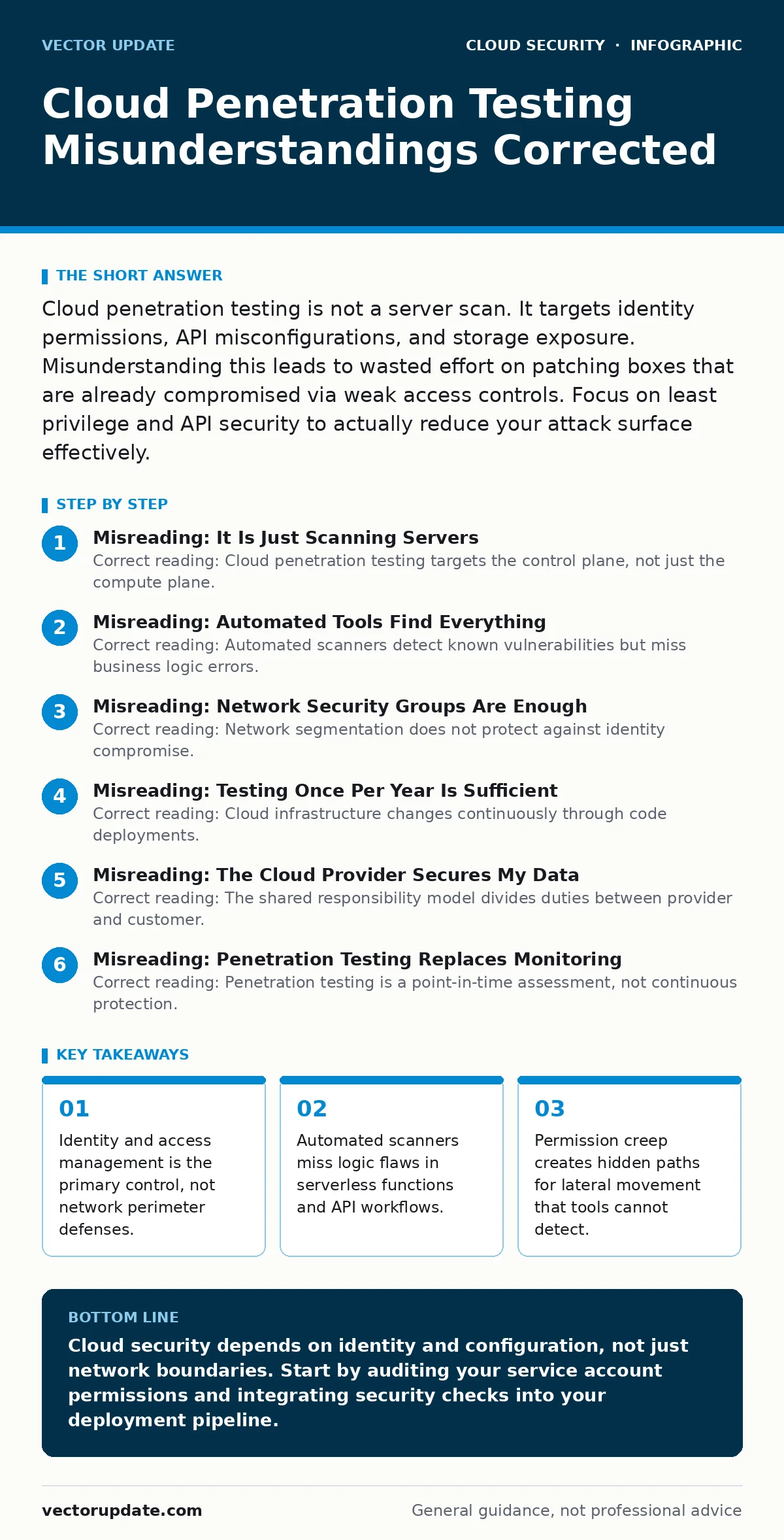
Misreading: Automated Tools Find Everything
Correct reading: Automated scanners detect known vulnerabilities but miss business logic errors. A tool can find an unencrypted database but cannot determine if a legitimate user account has excessive write access to financial records. Logic flaws require human reasoning to exploit. Suppose a serverless function allows any user to reset passwords without verifying ownership. A scanner sees valid code execution but misses the authorization failure. Manual testing is required for these complex interactions.
Misreading: Network Security Groups Are Enough
Correct reading: Network segmentation does not protect against identity compromise. Even if your cloud firewalls block all external traffic, an attacker with valid credentials can access resources from inside the network. This is why open security groups are less dangerous than you think if identities are strict. However, most teams neglect identity hardening. They rely on network rules that attackers bypass by using stolen tokens. Test whether a compromised user can move laterally without network exposure.
Misreading: Testing Once Per Year Is Sufficient
Correct reading: Cloud infrastructure changes continuously through code deployments. A secure configuration today can become vulnerable after a minor update. Infrastructure as code introduces drift where manual changes diverge from templates. This creates shadow IT assets that bypass security controls. Continuous testing is necessary to catch these drift events. Annual tests only validate the state of a snapshot. You need automated checks integrated into your deployment pipeline to ensure every change maintains security standards.
Misreading: The Cloud Provider Secures My Data
Correct reading: The shared responsibility model divides duties between provider and customer. The provider secures the underlying hardware and virtualization layer. You secure the data, identities, and configurations within your tenant. Many teams assume encryption at rest is automatic. It often requires explicit configuration. Without proper key management, encrypted data is useless if keys are exposed. Review your cloud encryption settings to ensure you control the keys, not just the storage provider.
See also: Open Security Groups: 6 Myths Blocking Your Cloud Defense · Secure Cloud APIs: Block Exploits, Limit Scope, and Verify Identity
Misreading: Penetration Testing Replaces Monitoring
Correct reading: Penetration testing is a point-in-time assessment, not continuous protection. It finds gaps before attackers do but does not stop active attacks. You still need cloud logging and monitoring to detect anomalies in real time. A pentest might reveal that insecure cloud APIs allow excessive data export. Monitoring detects when that API is actually used maliciously. Both are necessary. Testing validates your defenses; monitoring enforces them during operations. Combine them for a complete security posture.
Misreading: External Tests Are More Valuable
Correct reading: Internal tests often reveal deeper flaws in permission models. External tests simulate an attacker with no access. Internal tests simulate an attacker who has already breached the perimeter. In cloud environments, the perimeter is porous. Most data breaches involve insiders or compromised credentials. Testing from inside your environment reveals how far an attacker can go with minimal initial access. This helps you design better containment strategies. Prioritize internal tests to improve your incident response capabilities.
Key takeaways
- Identity and access management is the primary control, not network perimeter defenses.
- Automated scanners miss logic flaws in serverless functions and API workflows.
- Permission creep creates hidden paths for lateral movement that tools cannot detect.
Cloud security depends on identity and configuration, not just network boundaries. Start by auditing your service account permissions and integrating security checks into your deployment pipeline.
Frequently asked questions
How often should we perform cloud penetration testing?
Perform automated checks continuously and manual penetration tests at least annually or after major infrastructure changes. Continuous monitoring fills the gaps between manual tests.
Do we need special tools for cloud penetration testing?
Standard tools work for network issues, but you need cloud-native tools for identity and API testing. These tools understand the specific command structures and permission models of your cloud provider.
Can we use cloud landing zones to prevent testing issues?
Cloud landing zones provide a secure baseline but do not eliminate the need for testing. They reduce configuration errors but cannot detect logic flaws or emerging threats. Testing validates that the landing zone remains secure under attack.
Is it legal to test our own cloud accounts?
Most cloud providers allow testing of your own resources but restrict automated denial-of-service tests. Always review your provider's acceptable use policy before starting. Unauthorized testing can result in account suspension.
How this guide was produced: written by the Vector Update editorial team with AI assistance, checked against the public references listed below, and reviewed when the facts change. See our editorial policy or report an error.