Cryptomining Attacks on Exposed Servers: Detection and Mitigation
Cryptomining attacks hide in plain sight by throttling CPU usage to avoid detection while slowly draining your operational budget and hardware lifespan.

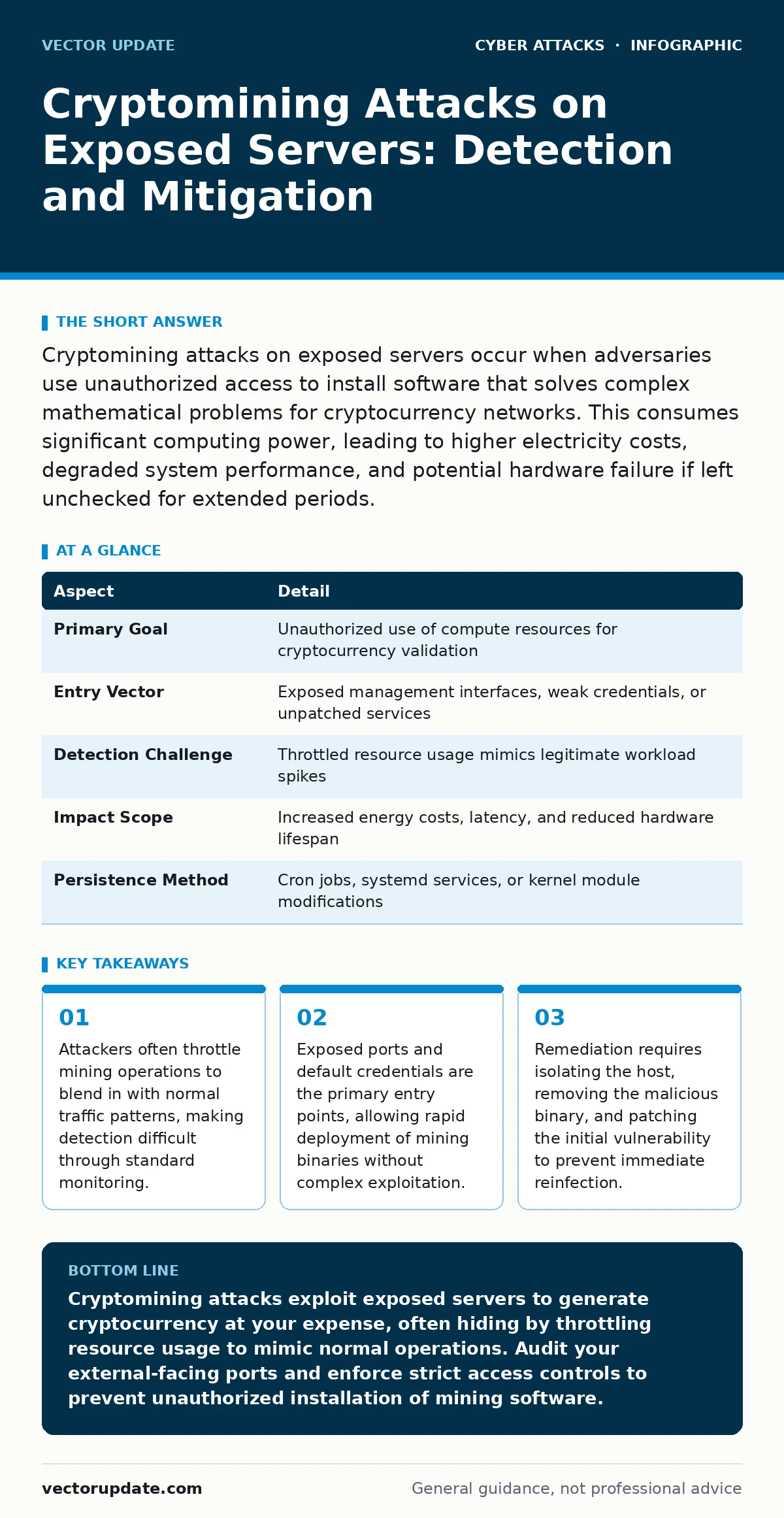
Cryptomining attacks on exposed servers occur when adversaries use unauthorized access to install software that solves complex mathematical problems for cryptocurrency networks. This consumes significant computing power, leading to higher electricity costs, degraded system performance, and potential hardware failure if left unchecked for extended periods.
The Silent Resource Drain
Imagine a rental property where a squatter lives in the attic. They pay no rent, use your electricity to run high-power equipment, and keep their noise level low enough that you barely notice. You only discover the intrusion when your electric bill triples or the building’s heating system fails due to overload. Cryptomining attacks on exposed servers function with identical mechanics.
The adversary does not steal your data or encrypt your files. Instead, they rent your hardware. They use your processing power to validate transactions on a decentralized ledger. You bear the cost of energy and hardware depreciation. The attacker collects the digital currency rewards. This asymmetry defines the threat model. The damage is financial and operational rather than reputational or data-centric.
| Aspect | Detail |
|---|---|
| Primary Goal | Unauthorized use of compute resources for cryptocurrency validation |
| Entry Vector | Exposed management interfaces, weak credentials, or unpatched services |
| Detection Challenge | Throttled resource usage mimics legitimate workload spikes |
| Impact Scope | Increased energy costs, latency, and reduced hardware lifespan |
| Persistence Method | Cron jobs, systemd services, or kernel module modifications |
How the Infection Chain Unfolds
The attack begins with exposure. A server sits behind a firewall but exposes a management port or application interface to the public internet. An automated scanner identifies this open endpoint. The attacker attempts common default credentials or exploits a known vulnerability in the service running on that port. Once authenticated, they establish a foothold. They do not immediately begin mining. High CPU usage triggers alerts. Instead, they install a lightweight agent.
This agent performs reconnaissance. It checks for virtualization indicators, available core counts, and network connectivity. If the environment looks profitable, it downloads the actual mining client. The client is often obfuscated or packed to avoid signature-based detection. It then connects to a mining pool. A mining pool combines the efforts of many miners to solve blocks. The rewards are distributed based on contribution. Your server becomes just one node in this distributed network.
Who Bears the Cost
You might assume only large cloud providers face this risk. That assumption is incorrect. Any organization with internet-facing infrastructure is a target. Small businesses with a single web server are attractive targets because they often lack dedicated security monitoring. They may run legacy software with unpatched vulnerabilities. Large enterprises face a different challenge. They have thousands of endpoints.
An attacker can compromise a single development server and use it to pivot deeper into the network. Cloud customers pay for the compute hours consumed by the miner. If the miner runs for weeks, the bill reflects that usage. You pay for the electricity that powers the data center rack. You pay for the cooling required to manage the heat generated by sustained high CPU loads. Hardware components degrade faster under constant stress. Fans wear out. Power supplies fail. The cost extends beyond the monthly invoice.
Common Forms of Mining Malware
Mining malware takes several forms. The most common is a standalone binary. This executable runs in user space. It is easy to detect if you scan for known file hashes. More sophisticated attackers use shell scripts. These scripts download the miner at runtime. They often use temporary directories to avoid leaving traces. Some attackers employ rootkits. These modify the operating system kernel to hide processes. Standard system monitoring tools report normal CPU usage. The miner runs in a hidden state.
Another variant is container-based mining. Attackers compromise a container orchestration platform. They deploy a mining container that looks like a legitimate application. It scales automatically. If the host has spare resources, the container requests more. This form is particularly dangerous in cloud environments. It bypasses traditional endpoint protection. It relies on the isolation of the container runtime. If the runtime is compromised, the attacker has full control.
What People Usually Get Wrong
Many administrators focus solely on CPU usage. They set alerts for sustained high processor load. This approach fails against throttled miners. Modern mining software includes logic to limit resource consumption. It monitors system load. If the load exceeds a threshold, it pauses mining. It resumes when the system is idle. This behavior mimics a legitimate backup job or data indexing process. Another common mistake is ignoring memory usage.
Some miners allocate significant RAM for hash calculations. A sudden increase in memory consumption without a corresponding application update indicates compromise. A third error is assuming cloud providers handle this risk. Shared responsibility models place the security of the operating system and installed applications on you. The provider secures the physical infrastructure. You secure the virtual instance. Ignoring this distinction leaves you vulnerable.
Reducing Risk Through Hardening
Prevention starts with network segmentation. Do not expose management interfaces to the public internet. Use virtual private networks for administrative access. This removes the attack surface for automated scanners. Implement least privilege principles. Service accounts should not have administrative rights. They should only have permissions necessary for their function. Regular patching is non-negotiable. Vulnerabilities in web servers and databases are frequent entry points. Update software promptly.
Monitor for anomalous outbound connections. Mining clients must communicate with mining pools. These connections often go to non-standard ports. Blocking unnecessary outbound traffic limits the attacker’s ability to exfiltrate data or receive commands. Use intrusion prevention systems to block known malicious traffic patterns. These systems inspect packets in real time. They can drop connections from known mining pool IP ranges. This adds a layer of defense without requiring changes to the server configuration.
Detection and Remediation Steps
When you suspect a compromise, act quickly. Isolate the affected server from the network. This prevents lateral movement. The attacker may use the compromised host to target other systems. Analyze the process list. Look for processes with high CPU or memory usage that do not correspond to known applications. Check for unexpected network connections. Use network monitoring tools to identify traffic destined for mining pools. Identify the malicious binary. Remove it from the file system. Check for persistence mechanisms.
Attackers often create scheduled tasks or startup scripts to ensure the miner restarts after a reboot. Remove these entries. Review user accounts. Create new administrative credentials. Delete any unauthorized accounts created by the attacker. Patch the vulnerability that allowed the initial entry. This step is critical. Without patching, the attacker will regain access. Monitor the system for a period. Ensure no residual activity remains. Consider rebuilding the server from a known good image. This guarantees removal of all traces.
The Hidden Cost of Dwell Time
The longer a miner remains on your system, the harder it is to remove. Attackers use the initial access to deploy additional tools. They may install keyloggers or backdoors. These tools persist even after you remove the miner. They allow the attacker to return later. They may also use the server as a pivot point. They scan your internal network for other vulnerabilities. This expands the breach. Detecting and remediating a single miner is manageable. Cleaning up a widespread infection is costly.
It requires forensic analysis. It may involve legal notification. It damages stakeholder trust. The financial impact grows with time. Energy costs accumulate. Hardware fails. Business operations slow. The downtime required for remediation affects productivity. Early detection is the most effective mitigation. Implement continuous monitoring. Use behavioral analytics to identify deviations from normal baselines. This allows you to catch throttled miners before they cause significant damage.
Key takeaways
- Attackers often throttle mining operations to blend in with normal traffic patterns, making detection difficult through standard monitoring.
- Exposed ports and default credentials are the primary entry points, allowing rapid deployment of mining binaries without complex exploitation.
- Remediation requires isolating the host, removing the malicious binary, and patching the initial vulnerability to prevent immediate reinfection.
Cryptomining attacks exploit exposed servers to generate cryptocurrency at your expense, often hiding by throttling resource usage to mimic normal operations. Audit your external-facing ports and enforce strict access controls to prevent unauthorized installation of mining software.
Frequently asked questions
How do I know if my server is being used for cryptomining?
Look for sustained high CPU or memory usage that does not correlate with known applications. Check for unexpected outbound network connections to non-standard ports. Monitor for increased power consumption or slower system response times.
Can firewall rules prevent cryptomining attacks?
Firewalls can block known mining pool IP addresses and ports, but they do not prevent initial compromise. If an attacker already has access, they can use alternative communication channels. Network segmentation and least privilege are more effective.
Is cloud infrastructure safe from cryptomining attacks?
Cloud infrastructure follows a shared responsibility model. The provider secures the physical hardware, but you secure the virtual instances and applications. Exposed cloud servers with weak credentials are frequent targets for cryptomining.
What is the difference between cryptomining and ransomware?
Ransomware encrypts your data and demands payment for decryption. Cryptomining uses your resources to generate cryptocurrency without encrypting data. Ransomware causes immediate, visible disruption. Cryptomining causes gradual, financial damage.
How this guide was produced: written by the Vector Update editorial team with AI assistance, checked against the public references listed below, and reviewed when the facts change. See our editorial policy or report an error.