How Disinformation Bot Networks Operate and What to Watch For
Automated accounts mimic human behavior patterns to amplify specific narratives, making them difficult to distinguish from genuine public sentiment without technical analysis.

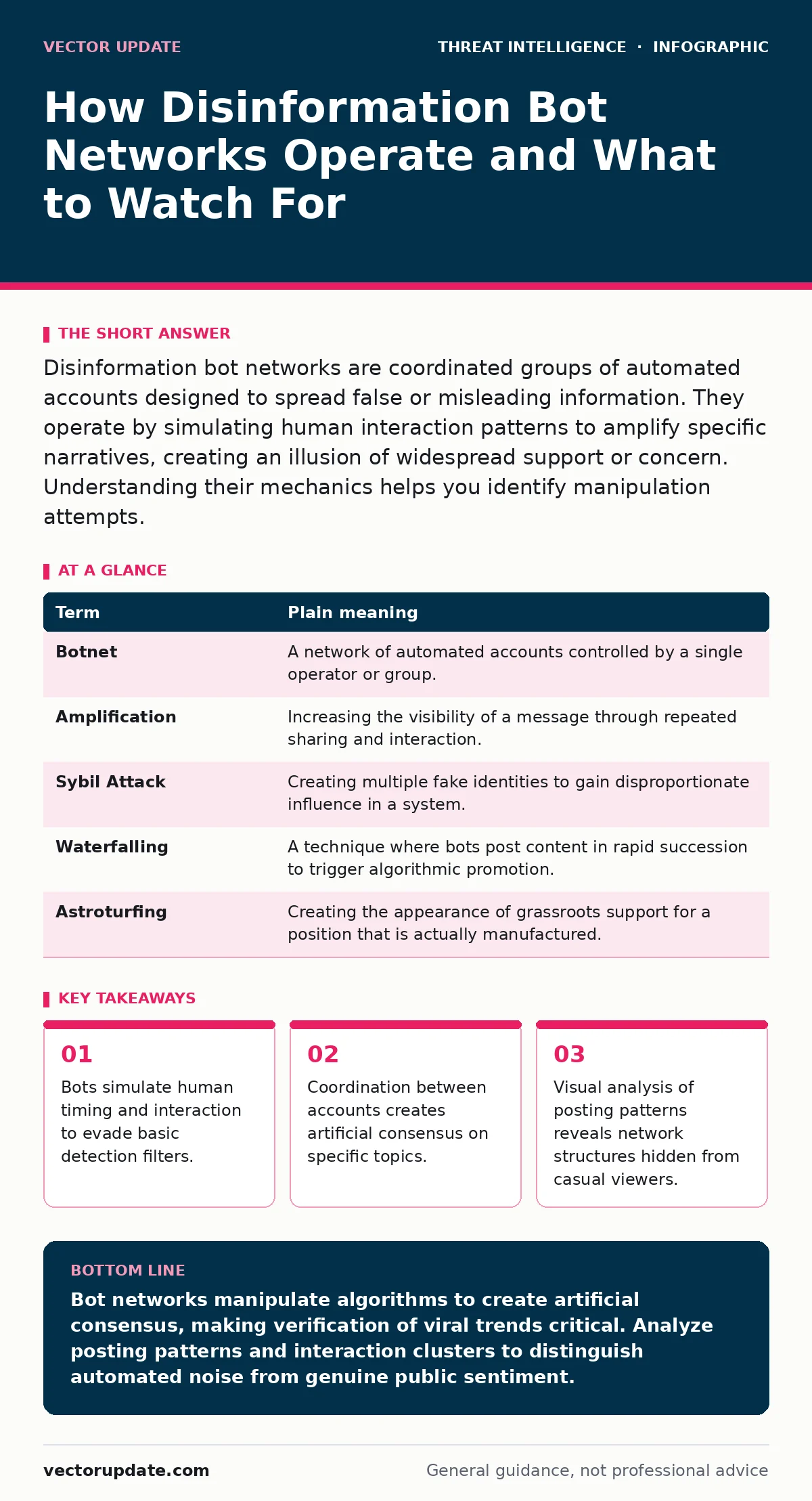
Disinformation bot networks are coordinated groups of automated accounts designed to spread false or misleading information. They operate by simulating human interaction patterns to amplify specific narratives, creating an illusion of widespread support or concern. Understanding their mechanics helps you identify manipulation attempts.
The Echo Chamber Analogy
Imagine a large town square where residents discuss local issues. A small group hires actors to stand in the crowd. These actors repeat the same phrases at specific intervals. They clap when the speaker says something favorable. They boo when the speaker mentions a competing viewpoint. To an outsider, the crowd seems divided or unified. In reality, the actors drive the perceived mood. This is how disinformation bot networks function. They do not change minds directly. They shift the perceived center of discourse.
Defining the Mechanism
A bot is a software program that performs automated tasks over the internet. A bot network, or botnet, is a group of these programs controlled by a central authority. When used for disinformation, the goal is not malware distribution. The goal is narrative control. These networks mimic human behavior to avoid detection. They post, like, share, and comment. The sophistication varies. Simple bots post identical messages. Advanced bots use natural language processing to generate unique text. Both types aim to create volume and velocity.
| Term | Plain meaning |
|---|---|
| Botnet | A network of automated accounts controlled by a single operator or group. |
| Amplification | Increasing the visibility of a message through repeated sharing and interaction. |
| Sybil Attack | Creating multiple fake identities to gain disproportionate influence in a system. |
| Waterfalling | A technique where bots post content in rapid succession to trigger algorithmic promotion. |
| Astroturfing | Creating the appearance of grassroots support for a position that is actually manufactured. |
Common Points of Confusion
Many observers confuse bots with trolls. A troll is a human who posts inflammatory content to provoke reactions. A bot is automated. A troll seeks engagement through conflict. A bot seeks visibility through volume. Another confusion involves state sponsorship. While some networks link to nation-state cyber attacks, many are commercial operations. They sell influence to the highest bidder. The motive is often profit, not ideology. Distinguishing between state actors and commercial mercenaries changes how you assess the threat.
The Mechanics of Coordination
Coordination is the hallmark of a bot network. Independent users post randomly. Bots post in clusters. This clustering creates artificial trends. Algorithms on social platforms prioritize trending content. Bots exploit this design. They post a hashtag or keyword simultaneously. The algorithm detects a surge in activity. It promotes the content to a wider audience. Real users then see the promoted content. They may engage with it, believing it is popular. This feedback loop validates the false narrative. The process mirrors privilege escalation attacks in system administration. Small, seemingly harmless actions combine to gain significant control.
Visualizing the Network
You can analyze bot behavior by looking at interaction patterns. Real humans have irregular posting habits. They sleep, work, and eat. Bots often post at regular intervals or during peak traffic hours. They may interact with each other in closed loops. Account A likes Account B’s post. Account B replies to Account A. This reciprocal interaction boosts visibility. It creates a dense cluster of connections. Graph visualization tools can map these connections. You will see tight clusters with few external links. Human networks are sparse and irregular. Bot networks are dense and structured.
See also: How Advanced Persistent Threats Move: Step-by-Step Breakdown
The Role of Content Generation
Modern bots do not just copy-paste. They generate content. Large language models allow bots to write unique comments. They can respond to questions in context. This makes detection harder. Simple keyword filters fail. Semantic analysis becomes necessary. The content may be factually true but misleading in context. This is known as truth-based disinformation. The bot shares real data to support a false conclusion. This approach is more resilient than obvious lies. It forces critics to debunk complex arguments. It drains the resources of those trying to correct the record.
Mitigation and Detection
You cannot stop all bot activity. Platforms constantly update their defenses. Operators constantly adapt their techniques. This is an arms race. Your best defense is awareness and verification. Check the source of viral content. Look for corroborating evidence from independent outlets. Analyze the account history. Look for signs of automation. Use tools that analyze posting patterns. Do not rely on profile pictures or bios. These are easily faked. Focus on behavior. Behavior is harder to simulate perfectly at scale.
Practical Steps for Analysis
- Examine Posting Times: Check if the account posts at irregular hours or in rapid bursts. Human activity follows a circadian rhythm. Bot activity often does not.
- Analyze Interaction Clusters: Look for accounts that only interact with each other. A lack of external engagement suggests a closed network.
- Verify Content Origins: Trace the original source of a viral claim. Bot networks often strip context as content spreads. Finding the origin reveals the intent.
The Hidden Cost of Engagement
Engaging with bot content feeds the algorithm. Likes, comments, and shares signal interest. Even negative engagement boosts visibility. The goal of the operator is to trigger a reaction. If you argue with a bot, you amplify its message. Silence is often the most effective countermeasure. Reporting accounts helps platforms identify patterns. Collective reporting improves automated detection. Individual engagement does not. It only increases the reach of the false narrative.
Long-Term Implications
Bot networks reshape public discourse. They make extreme views appear mainstream. This polarization undermines trust in institutions. It complicates decision-making for organizations. You must account for manipulated data in your threat intelligence. Assume that viral trends may be artificial. Verify before acting. This skepticism protects your organization from reactive decisions based on false premises. It also aligns with best practices for handling advanced persistent threats. Patience and verification are your strongest tools.
Key takeaways
- Bots simulate human timing and interaction to evade basic detection filters.
- Coordination between accounts creates artificial consensus on specific topics.
- Visual analysis of posting patterns reveals network structures hidden from casual viewers.
Bot networks manipulate algorithms to create artificial consensus, making verification of viral trends critical. Analyze posting patterns and interaction clusters to distinguish automated noise from genuine public sentiment.
Frequently asked questions
How can I tell if an account is a bot?
Look for irregular posting times, lack of personal history, and reciprocal interactions with other suspicious accounts. Automated accounts often have generic profiles and post at machine-like intervals.
Do bots only spread lies?
No. Bots often spread true information out of context to support a false narrative. They may also amplify polarizing content to drive engagement and platform revenue.
Can I block all bot activity on my platform?
You can reduce bot impact by implementing rate limiting and CAPTCHA challenges. However, sophisticated bots mimic human behavior. Complete elimination is not possible without restricting legitimate user access.
Are bot networks illegal?
Laws vary by jurisdiction. Impersonation and fraud are illegal. Organizing a network for political influence may not be. Enforcement is difficult due to cross-border operations and anonymous hosting.
How this guide was produced: written by the Vector Update editorial team with AI assistance, checked against the public references listed below, and reviewed when the facts change. See our editorial policy or report an error.