Secure Software Development: Answers to Eight Critical Questions
Code that passes all tests can still fail in production because static analysis tools cannot detect logic flaws or race conditions that only appear under specific runtime conditions.

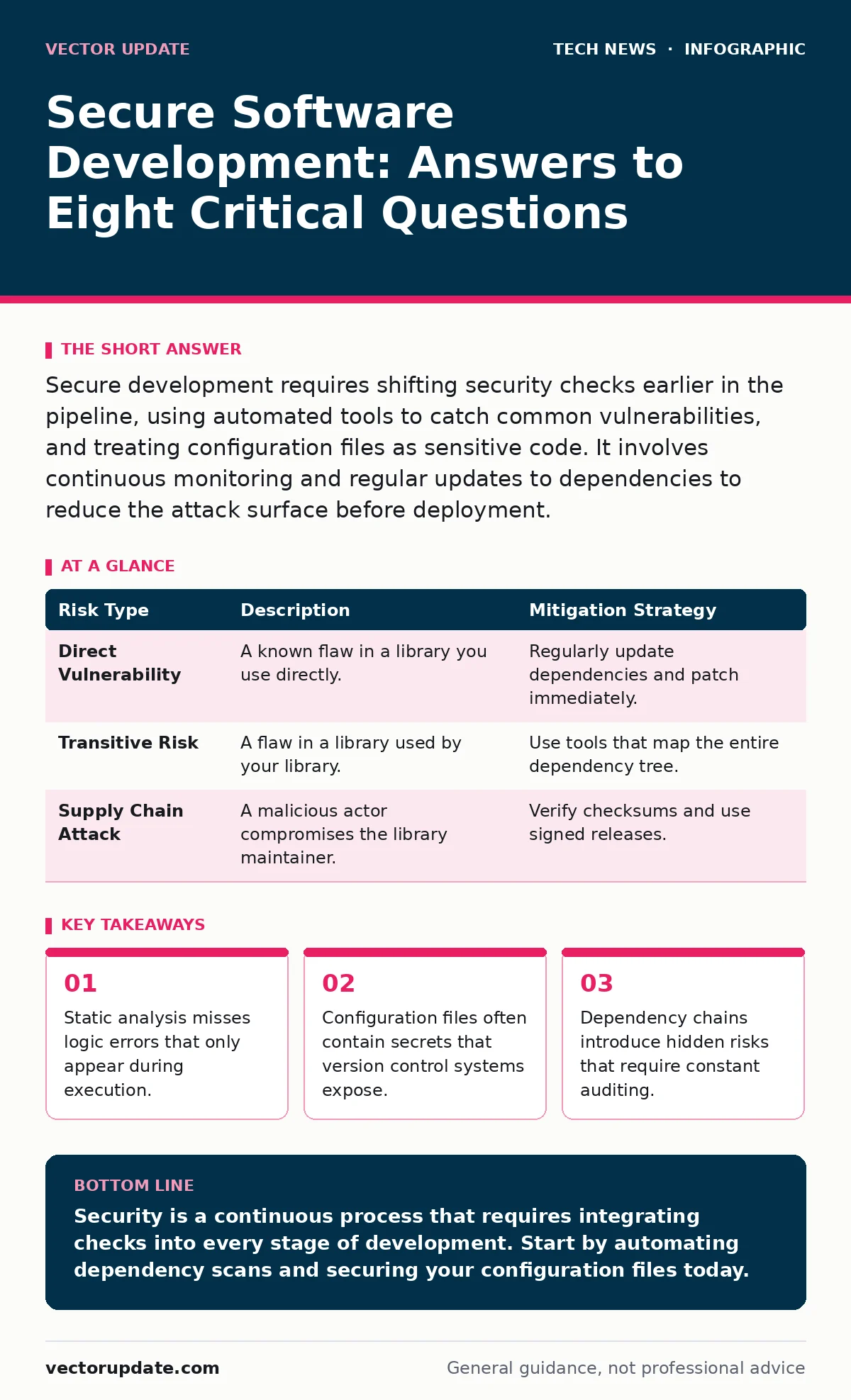
Secure development requires shifting security checks earlier in the pipeline, using automated tools to catch common vulnerabilities, and treating configuration files as sensitive code. It involves continuous monitoring and regular updates to dependencies to reduce the attack surface before deployment.
Does code that passes all tests guarantee security?
No, passing tests only confirms the software behaves as expected under the specific conditions you programmed. Security flaws often lie in how the software handles unexpected input or interacts with other systems. You might have thorough unit tests for a login function, but if the database query is not parameterized, an attacker can still inject malicious commands.
Tests verify correctness, not safety against malicious intent. An attacker does not care about your test coverage; they care about the gap between your assumptions and reality.
How do I stop secrets from leaking in version control?
You must treat configuration files and environment variables as sensitive artifacts that require strict access controls. Storing API keys or database passwords in plain text within your repository allows anyone with read access to steal them. Use a dedicated secrets management service to inject these values at runtime rather than committing them to your code base.
Imagine a developer who accidentally commits a private key to a public repository. Even if they delete the file immediately, the key remains in the git history. This is why automated scanning of commits is necessary to catch these leaks before they become permanent.
Why are third-party dependencies a security risk?
Every library you import adds its code to your application, expanding the surface area for potential attacks. If a dependency contains a known vulnerability, your software inherits that flaw regardless of how secure your own code is. This is known as the transitive risk, where a secure component is compromised by an insecure one it relies on.
You do not write the code in these libraries, so you cannot audit it as thoroughly as your own work. Attackers often target popular libraries because compromising one library can affect thousands of applications simultaneously.
| Risk Type | Description | Mitigation Strategy |
|---|---|---|
| Direct Vulnerability | A known flaw in a library you use directly. | Regularly update dependencies and patch immediately. |
| Transitive Risk | A flaw in a library used by your library. | Use tools that map the entire dependency tree. |
| Supply Chain Attack | A malicious actor compromises the library maintainer. | Verify checksums and use signed releases. |
Can static analysis tools find all security flaws?
Static analysis tools scan your source code for patterns that match known vulnerabilities, such as buffer overflows or SQL injection. They are excellent at catching syntax errors and obvious mistakes but fail to understand the logic of your application. They cannot detect race conditions or complex business logic flaws that only manifest during execution.
Think of static analysis as a spell-checker for security. It finds typos, but it cannot tell if your essay makes sense. You need dynamic testing, which runs the code, to find issues that static tools miss.
What is the role of DevOps security in the pipeline?
DevOps security, often called DevSecOps, integrates security checks into every stage of the development lifecycle. Instead of waiting for a final security audit before release, you run automated scans during code commits, builds, and deployments. This approach catches issues early when they are cheaper and easier to fix.
This shift left strategy reduces the time between discovering a flaw and fixing it. It also ensures that security becomes a shared responsibility rather than a bottleneck at the end of the project.
See also: How Public Key Infrastructure Works: The Chain of Trust
How do I secure configuration files in production?
Configuration files often contain sensitive information like database credentials or encryption keys. You must ensure these files are not readable by unauthorized users or processes. Use file permissions to restrict access and consider using secure enclaves to protect sensitive data during processing.
Imagine a web server that logs errors to a file readable by the public. If an error message includes a stack trace with internal paths or variables, an attacker gains insight into your infrastructure. Always sanitize logs and restrict file permissions to the minimum necessary.
Why is the TLS handshake critical for security?
The TLS handshake establishes a secure connection between a client and a server, exchanging encryption keys. If this process is misconfigured, attackers can perform man-in-the-middle attacks to intercept or modify data. You must disable older, insecure protocols and cipher suites that are known to be vulnerable.
A failed handshake usually results in a connection error, but a weak handshake can allow an attacker to decrypt traffic without either party knowing. Regularly audit your TLS configuration to ensure it meets current security standards.
How does network monitoring help secure software?
Network monitoring observes traffic patterns to detect anomalies that might indicate an attack. While it does not prevent vulnerabilities in code, it helps you detect when those vulnerabilities are being exploited. By analyzing traffic flows, you can identify unusual data exfiltration or command-and-control communications.
This is particularly useful for detecting attacks that bypass application-level security. An attacker might use a valid API key to perform malicious actions, which network monitoring can flag based on unusual volume or timing.
What is the impact of Internet of Things devices on security?
Internet of Things devices often have limited processing power and run outdated software, making them easy targets. When these devices connect to your network, they can serve as entry points for attackers to reach more critical systems. You must segment IoT devices from your main network to limit their access.
Suppose a smart thermostat is compromised. An attacker could use it to scan your internal network for other vulnerable devices. Treating IoT devices as untrusted entities reduces the risk of lateral movement within your infrastructure.
How do I handle security in a microservices architecture?
Microservices increase complexity because each service is a potential entry point. You must secure each service individually and monitor the communication between them. Use public key infrastructure to verify the identity of services communicating with each other, ensuring that only authorized services can interact.
This approach prevents a compromised service from easily attacking others. It also allows you to isolate incidents, containing the damage to a single service rather than the entire application.
Key takeaways
- Static analysis misses logic errors that only appear during execution.
- Configuration files often contain secrets that version control systems expose.
- Dependency chains introduce hidden risks that require constant auditing.
Security is a continuous process that requires integrating checks into every stage of development. Start by automating dependency scans and securing your configuration files today.
Frequently asked questions
How often should I update my dependencies?
Update dependencies as soon as security patches are released. Delaying updates increases the window of exposure to known vulnerabilities.
Can I use open-source libraries safely?
Yes, but you must audit them for vulnerabilities and monitor for new issues. Open-source code is transparent, allowing for community review, but it also exposes flaws to attackers.
What is the difference between static and dynamic analysis?
Static analysis examines code without running it, while dynamic analysis tests the running application. Both are necessary for a complete security assessment.
How do I prevent SQL injection?
Use parameterized queries or prepared statements to ensure that user input is treated as data, not executable code. This prevents attackers from injecting malicious SQL commands.
How this guide was produced: written by the Vector Update editorial team with AI assistance, checked against the public references listed below, and reviewed when the facts change. See our editorial policy or report an error.