YARA Rules Examples: How to Write Detection Logic That Works
YARA rules detect file structure patterns rather than known hashes, allowing you to identify new variants of malware that traditional scanners miss entirely.

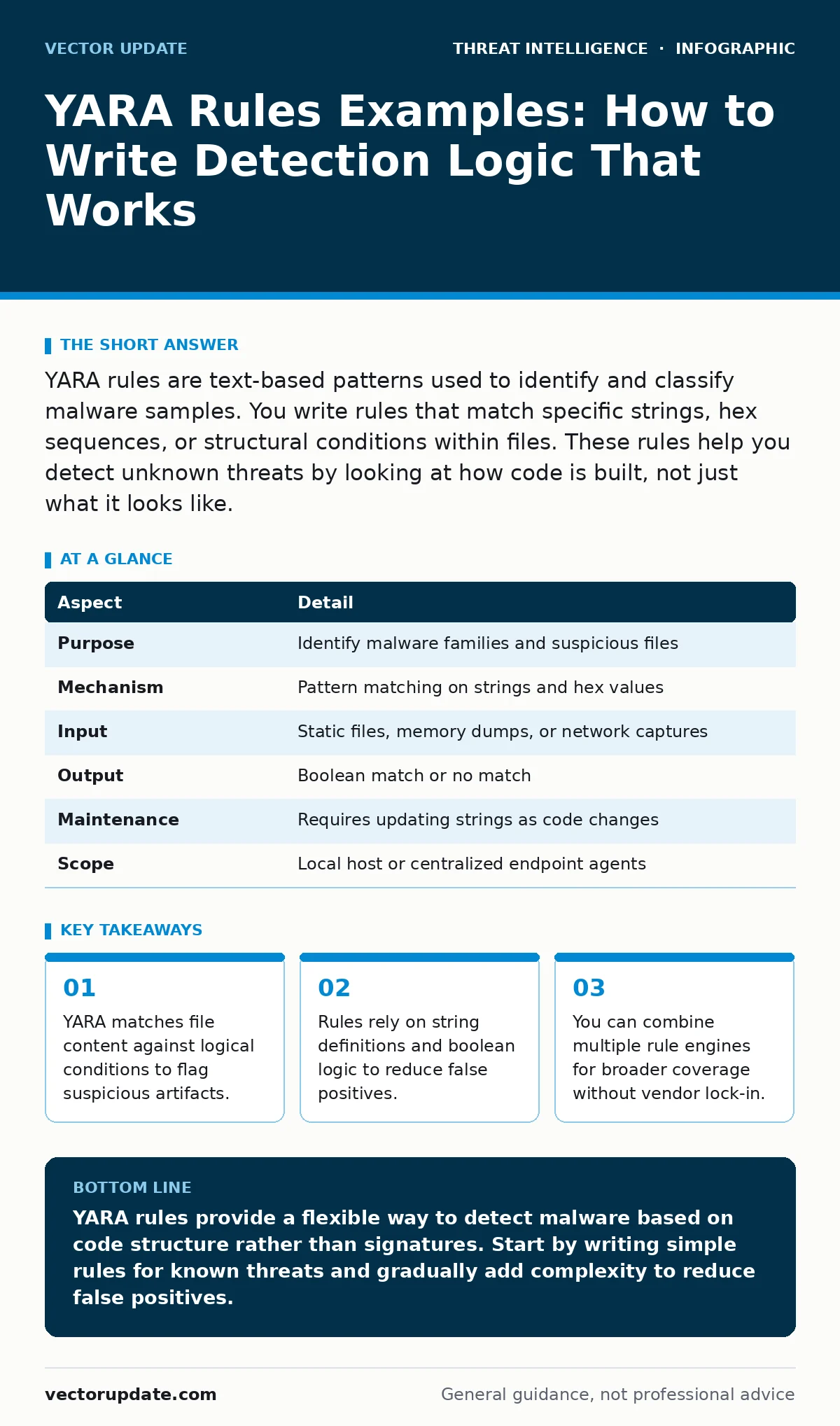
YARA rules are text-based patterns used to identify and classify malware samples. You write rules that match specific strings, hex sequences, or structural conditions within files. These rules help you detect unknown threats by looking at how code is built, not just what it looks like.
Imagine sorting a library by the shape of the books rather than their titles. You might find a new, unread book because its spine has the same unique curve as a known bestseller. YARA rules work similarly. They look at the internal structure and specific byte sequences of a file. This approach allows you to find new threats that share code with known malware.
| Aspect | Detail |
|---|---|
| Purpose | Identify malware families and suspicious files |
| Mechanism | Pattern matching on strings and hex values |
| Input | Static files, memory dumps, or network captures |
| Output | Boolean match or no match |
| Maintenance | Requires updating strings as code changes |
| Scope | Local host or centralized endpoint agents |
How YARA Rules Work
YARA rules define a set of conditions that must be true for a match to occur. The engine reads a file and checks if it contains specific text, hexadecimal sequences, or other structural elements. You define these elements in the rule header. The body of the rule contains the logic. This logic uses operators like "and", "or", and "not" to combine conditions. A match occurs only when the entire logical statement evaluates to true.
The engine does not execute the file. It scans the raw data. This makes it safe to analyze potentially dangerous code. You can run YARA on static files stored on a disk. You can also run it on memory dumps. This allows you to find malware that hides in RAM but leaves no trace on the hard drive. The rule engine is lightweight and fast. It processes large volumes of data without significant resource consumption.
YARA Rules Examples
People searching for yara rules examples often want to see how the syntax translates to real detection. A basic rule identifies a file containing a specific string. You define the string in the "strings" section. You then reference it in the "condition" section. For example, a rule might look for the phrase "MaliciousPayload" in ASCII format. If the file contains that exact sequence of bytes, the rule triggers.
You can make rules more precise by adding constraints. You might require the string to appear within a certain number of bytes from the start of the file. You can also require multiple strings to be present. The rule might trigger only if "StringA" and "StringB" both exist. This reduces false positives. It ensures the file has the specific combination of indicators you expect.
Who It Affects
YARA rules affect anyone who needs to identify malicious software. Security analysts use them to triage alerts. They scan quarantined files to determine if they are part of a known campaign. Malware researchers use them to classify new variants. They extract unique strings from a sample and create a rule to find similar files.
System administrators use YARA to monitor endpoints. They deploy rules to detect unauthorized scripts or tools. This helps them find lateral movement tools or privilege escalation attacks. The rules help identify when an attacker has dropped a payload on a server. This is critical for early detection. It allows you to respond before the attacker establishes persistence.
What People Usually Get Wrong
Many users create rules that are too broad. They match common strings like "System32" or "Windows". This generates thousands of false positives. The alerts become noise. Analysts ignore the alerts because they are not useful. You must balance sensitivity with specificity. Use unique strings or complex conditions to avoid matching benign files.
Another common mistake is relying on single strings. Attackers can easily change a single string. This breaks the rule. The malware becomes invisible to your detection. You should use multiple strings and structural conditions. This makes the rule resilient to minor changes. It also helps detect obfuscated code. The rule looks for the presence of multiple indicators, not just one.
Advanced Techniques and Trade-offs
You can use regular expressions in YARA rules. This allows you to match complex patterns. For example, you can match a series of hexadecimal bytes that vary slightly. This is useful for detecting polymorphic malware. The malware changes its appearance but keeps its core structure. Regular expressions help you match the structure while ignoring the cosmetic changes.
You can also use YARA to analyze memory. This requires a different approach. You look for patterns in the process memory. This helps find malware that runs only in memory. It does not write to disk. This is common in fileless attacks. However, scanning memory is more resource-intensive. It can slow down the system. You must limit the scope of memory scans to critical processes.
See also: Privilege Escalation Attacks: How Attackers Steal Control
Integrating with Other Frameworks
YARA rules work best when integrated into a broader strategy. They are not a standalone solution. You should combine them with other detection methods. For example, you can use YARA to identify a file. Then you use a behavioral analysis tool to see what the file does. This gives you a complete picture. It helps you understand the threat.
You can align YARA detections with the Unified Kill Chain framework. This helps you map detections to specific stages of an attack. You might have rules for the delivery stage. These rules look for malicious attachments. You might have rules for the installation stage. These rules look for persistence mechanisms. This structure helps you prioritize responses. It ensures you are detecting threats at every stage.
Maintaining Your Rule Set
Rules become stale over time. Attackers update their code. Your rules must update too. You should review your rules regularly. Remove rules that generate false positives. Update rules that miss new variants. This requires a process. You need to track the performance of each rule. You need to measure the number of matches and the accuracy of each match.
You can automate this process. Use tools to test new rules against a dataset of benign files. This ensures you do not introduce false positives. You can also test against a dataset of known malware. This ensures you do not miss known threats. This continuous improvement cycle keeps your detection effective. It ensures your rules remain relevant.
Key takeaways
- YARA matches file content against logical conditions to flag suspicious artifacts.
- Rules rely on string definitions and boolean logic to reduce false positives.
- You can combine multiple rule engines for broader coverage without vendor lock-in.
YARA rules provide a flexible way to detect malware based on code structure rather than signatures. Start by writing simple rules for known threats and gradually add complexity to reduce false positives.
Frequently asked questions
Can YARA detect ransomware?
Yes, YARA can detect ransomware by matching specific encryption routines or ransom note strings. It identifies the file before or during the encryption process.
Is YARA a antivirus solution?
No, YARA is a pattern matching tool. It does not block or remove malware. You must integrate it with a response system to take action on matches.
How do I handle false positives?
Refine your rules by adding more conditions. Use unique strings and structural constraints. Test rules against benign files before deployment.
Can YARA analyze network traffic?
YARA is designed for files and memory. You can extract files from network traffic and scan them. It does not analyze raw packet headers directly.
How this guide was produced: written by the Vector Update editorial team with AI assistance, checked against the public references listed below, and reviewed when the facts change. See our editorial policy or report an error.